875 posters, 25 topics, 3,440 authors, 1,061 institutions
ePostersLive by SciGen Technologies S.A. All rights reserved.
SAGES 2026 Annual Meeting Emerging Technology Session
March 25-28, 2026 | Tampa, FL, USA

P534
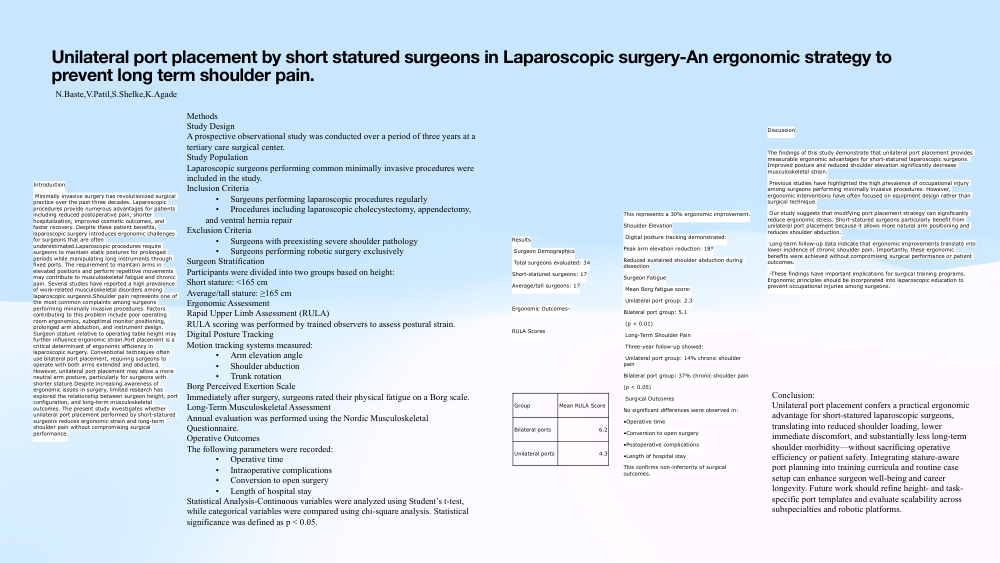
Unilateral Port Placement by Short-Statured Surgeons in Laparoscopic Surgery: An Ergonomic Strategy to Prevent Long-Term Shoulder Pain
Poster Presenter
Authors
Affiliations
Part of Topic
Ergonomics
Introduction
Minimally invasive surgery has revolutionized surgical practice over the past three decades. Laparoscopic procedures provide numerous advantages for patients including reduced postoperative pain, shorter hospitalization, improved cosmetic outcomes, and faster recovery. Despite these patient benefits, laparoscopic surgery introduces ergonomic challenges for surgeons that are often underestimated.Laparoscopic procedures require surgeons to maintain static postures for prolonged periods while manipulating long instruments through fixed ports. The requirement to maintain arms in elevated positions and perform repetitive movements may contribute to musculoskeletal fatigue and chronic pain. Several studies have reported a high prevalence of work-related musculoskeletal disorders among laparoscopic surgeons.Shoulder pain represents one of the most common complaints among surgeons performing minimally invasive procedures. Factors contributing to this problem include poor operating room ergonomics, suboptimal monitor positioning, prolonged arm abduction, and instrument design. Surgeon stature relative to operating table height may further influence ergonomic strain.Port placement is a critical determinant of ergonomic efficiency in laparoscopic surgery. Conventional techniques often use bilateral port placement, requiring surgeons to operate with both arms extended and abducted. However, unilateral port placement may allow a more neutral arm posture, particularly for surgeons with shorter stature.Despite increasing awareness of ergonomic issues in surgery, limited research has explored the relationship between surgeon height, port configuration, and long-term musculoskeletal outcomes. The present study investigates whether unilateral port placement performed by short-statured surgeons reduces ergonomic strain and long-term shoulder pain without compromising surgical performance.
Methods
Study Design
A prospective observational study was conducted over a period of three years at a tertiary care surgical center.
Study Population
Laparoscopic surgeons performing common minimally invasive procedures were included in the study.
Inclusion Criteria-Surgeons performing laparoscopic procedures regularly,Procedures including laparoscopic cholecystectomy, appendectomy, and ventral hernia repair
Exclusion Criteria-Surgeons with preexisting severe shoulder pathology,Surgeons performing robotic surgery exclusively
Surgeon Stratification
Participants were divided into two groups based on height:
Short stature: <165 cmAverage/tall stature: ≥165 cm
Ergonomic Assessment
Rapid Upper Limb Assessment (RULA)
RULA scoring was performed by trained observers to assess postural strain.
Digital Posture Tracking
Motion tracking systems measured:
- Arm elevation angle
- Shoulder abduction
- Trunk rotation
Borg Perceived Exertion Scale
Immediately after surgery, surgeons rated their physical fatigue on a Borg scale.
Long-Term Musculoskeletal Assessment
Annual evaluation was performed using the Nordic Musculoskeletal Questionnaire.
Operative Outcomes
The following parameters were recorded:
- Operative time
- Intraoperative complications
- Conversion to open surgery
- Length of hospital stay
Statistical Analysis
Continuous variables were analyzed using Student’s t-test, while categorical variables were compared using chi-square analysis. Statistical significance was defined as p < 0.05.
Results
Surgeon Demographics
Total surgeons evaluated: 34
Short-statured surgeons: 17
Average/tall surgeons: 17
Ergonomic Outcomes-
RULA Scores
|
Group |
Mean RULA Score |
|
Bilateral ports |
6.2 |
|
Unilateral ports |
4.3 |
This represents a 30% ergonomic improvement.
Shoulder Elevation
Digital posture tracking demonstrated:
Peak arm elevation reduction: 18°
Reduced sustained shoulder abduction during dissection
Surgeon Fatigue
Mean Borg fatigue score:
Unilateral port group: 2.3
Bilateral port group: 5.1
(p < 0.01)
Long-Term Shoulder Pain
Three-year follow-up showed:
Unilateral port group: 14% chronic shoulder pain
Bilateral port group: 37% chronic shoulder pain
(p < 0.05)
Surgical Outcomes
No significant differences were observed in:
•Operative time
•Conversion to open surgery
•Postoperative complications
•Length of hospital stay
This confirms non-inferiority of surgical outcomes.
⸻
Discussion
The findings of this study demonstrate that unilateral port placement provides measurable ergonomic advantages for short-statured laparoscopic surgeons. Improved posture and reduced shoulder elevation significantly decrease musculoskeletal strain.
Previous studies have highlighted the high prevalence of occupational injury among surgeons performing minimally invasive procedures. However, ergonomic interventions have often focused on equipment design rather than surgical technique.
Our study suggests that modifying port placement strategy can significantly reduce ergonomic stress. Short-statured surgeons particularly benefit from unilateral port placement because it allows more natural arm positioning and reduces shoulder abduction.
Long-term follow-up data indicate that ergonomic improvements translate into lower incidence of chronic shoulder pain. Importantly, these ergonomic benefits were achieved without compromising surgical performance or patient outcomes.
-These findings have important implications for surgical training programs. Ergonomic principles should be incorporated into laparoscopic education to prevent occupational injuries among surgeons.
Limitations
Several limitations should be acknowledged.
•Single-center study
•Moderate sample size
•Observational design
Future multicenter randomized studies are needed to validate these findings.
Conclusion
Unilateral port placement represents a practical and effective ergonomic strategy for short-statured surgeons performing laparoscopic surgery. By reducing shoulder elevation and musculoskeletal strain, this technique may prevent long-term occupational injury while maintaining excellent surgical outcomes.
Incorporating stature-aware ergonomic principles into laparoscopic training may enhance surgeon well-being and extend career longevity.