875 posters, 25 topics, 3,440 authors, 1,061 institutions
ePostersLive by SciGen Technologies S.A. All rights reserved.
SAGES 2026 Annual Meeting Emerging Technology Session
March 25-28, 2026 | Tampa, FL, USA

P527
Development of a Scalable Laparoscopic Training Program Based on a Crane Origami Model and a Validated Objective Structured Assessment of Technical Skills (OSATS)
Part of Topic
Education / Simulation
Development of a Scalable Laparoscopic Training Program Based on a Crane Origami Model and a Validated Objective Structured Assessment of Technical Skills (OSATS)
Jacinta Sigala Sánchez, MD, PGY1 (1); Diego Romero, MS-VII (1); Fernando Munoz Flores, MD (2); Cristobal Bassa, MD (1); Yanina Labarca, BDS (1,2); Jose Ortega, MD (2)
(1)Facultad de Medicina Universidad Finis Terrae; (2)Facultad de Medicina Clinica Alemana de Santiago, Universidad del Desarrollo
INTRODUCTION
Laparoscopic skill acquisition presents a steep learning curve for surgical residents, and traditional training models have logistical and pedagogical limitations. Simulation offers a safe alternative, but there is a need for structured, low-cost, and objectively assessable curricula. This study aimed to design, implement, and establish the feasibility of a novel laparoscopic training program using a crane origami model, integrating principles of Deconstruction into Key Steps (DIKS) and a validated, task-specific OSATS tool.
METHODS
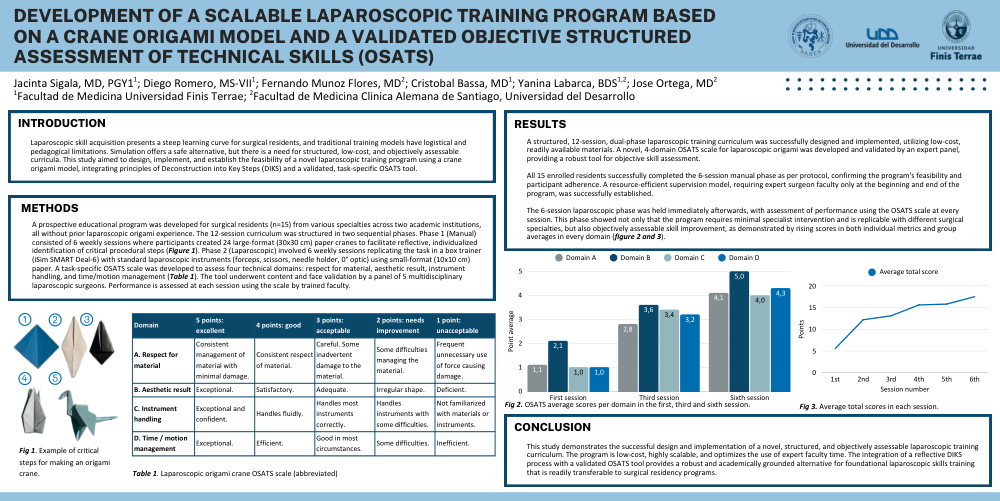
A prospective educational program was developed for surgical residents (n=15) from various specialties across two academic institutions, all without prior laparoscopic origami experience. The 12-session curriculum was structured in two sequential phases. Phase 1 (Manual) consisted of 6 weekly sessions where participants created 24 large-format (30x30 cm) paper cranes to facilitate reflective, individualized identification of critical procedural steps (Figure 1). Phase 2 (Laparoscopic) involved 6 weekly sessions replicating the task in a box trainer (iSim SMART Deal-6) with standard laparoscopic instruments (forceps, scissors, needle holder, 0° optic) using small-format (10x10 cm) paper. A task-specific OSATS scale was developed to assess four technical domains: respect for material, aesthetic result, instrument handling, and time/motion management (Table 1). The tool underwent content and face validation by a panel of 5 multidisciplinary laparoscopic surgeons. Performance is assessed at each session using the scale by trained faculty.
| Domain | 5 points: excellent | 4 points: good | 3 points: acceptable | 2 points: needs improvement | 1 point: unacceptable |
| A. Respect for material | Consistent management of material with minimal damage. | Consistent respect of material. | Careful. Some inadvertent damage to the material. | Some difficulties managing the material. | Frequent unnecessary use of force causing damage. |
| B. Aesthetic result | Exceptional. | Satisfactory. | Adequate. | Irregular shape. | Deficient. |
| C. Instrument handling | Exceptional and confident. | Handles fluidly. | Handles most instruments correctly. | Handles instruments with some difficulties. | Not familiarized with materials or instruments. |
| D. Time / motion management | Exceptional. | Efficient. | Good in most circumstances. | Some difficulties. | Inefficient. |
Table 1. Laparoscopic origami crane OSATS scale (abbreviated)
RESULTS
A structured, 12-session, dual-phase laparoscopic training curriculum was successfully designed and implemented, utilizing low-cost, readily available materials. A novel, 4-domain OSATS scale for laparoscopic origami was developed and validated by an expert panel, providing a robust tool for objective skill assessment.
All 15 enrolled residents successfully completed the 6-session manual phase as per protocol, confirming the program's feasibility and participant adherence. A resource-efficient supervision model, requiring expert surgeon faculty only at the beginning and end of the program, was successfully established.
The 6-session laparoscopic phase was held immediately afterwards, with assessment of performance using the OSATS scale at every session. This phase showed not only that the program requires minimal specialist intervention and is replicable with different surgical specialties, but also objectively assessable skill improvement, as demonstrated by rising scores in both individual metrics and group averages in every domain (figure 2 and 3).
CONCLUSION
This study demonstrates the successful design and implementation of a novel, structured, and objectively assessable laparoscopic training curriculum. The program is low-cost, highly scalable, and optimizes the use of expert faculty time. The integration of a reflective DIKS process with a validated OSATS tool provides a robust and academically grounded alternative for foundational laparoscopic skills training that is readily transferable to surgical residency programs.