875 posters, 25 topics, 3,440 authors, 1,061 institutions
ePostersLive by SciGen Technologies S.A. All rights reserved.
SAGES 2026 Annual Meeting Emerging Technology Session
March 25-28, 2026 | Tampa, FL, USA

P524
Video-based Assessment of Surgical Residents Performing Minimally Invasive Abdominal Surgery Offers Granular Feedback Using Multiple Assessment Tools
Poster Presenter
Authors
Affiliations
Part of Topic
Education / Simulation
Video-based Assessment of Surgical Residents Performing Minimally Invasive Abdominal Surgery Offers Granular Feedback Using Multiple Assessment Tools
Authors:
Ann DeBord Smith, MD, MPH, Director Bariatric Surgery1; Bruce Ramshaw, MD, CMIO2; 1VA Boston Medical Center; 2Caresyntax Corporation
Take home: Video-based assessments of residents’ operative skills using the Caresyntax platform show increased skill among more senior residents. We can use this technique to monitor entrustable professional activities (EPAs).
Background:
•The purpose was to provide fair evaluation of operative performance to residents.
•Video-based assessment (using Caresyntax in this study) allows unbiased evaluation of anonymous residents doing laparoscopic or robotic cases.
•Faculty reviewing the videos were blinded to resident year, gender, and race freeing reviewers to give honest feedback based on the video before them without preconceived notions about the resident.
•Multiple assessment tools were available including SIMPL, GASS, and GCD among others as well as free text feedback.
Methods:
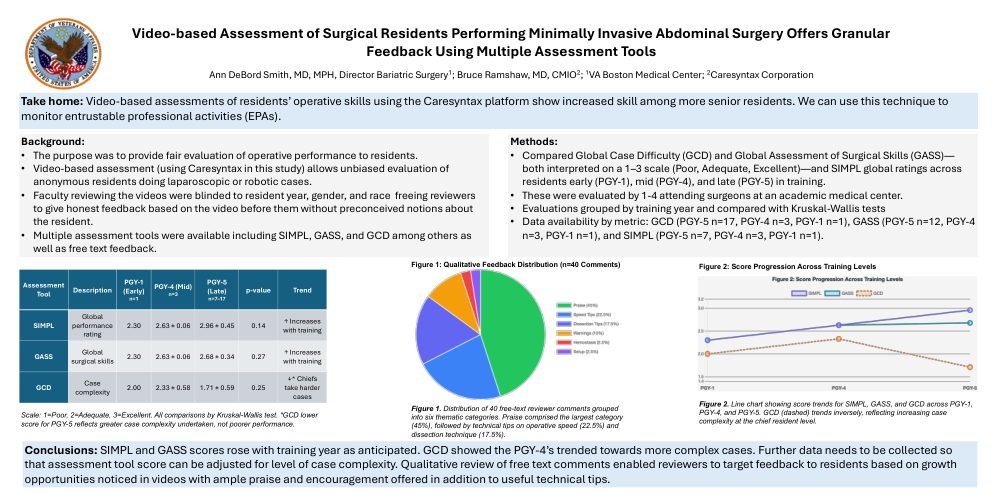
•Compared Global Case Difficulty (GCD) and Global Assessment of Surgical Skills (GASS)—both interpreted on a 1–3 scale (Poor, Adequate, Excellent)—and SIMPL global ratings across residents early (PGY-1), mid (PGY-4), and late (PGY-5) in training.
•These were evaluated by 1-4 attending surgeons at an academic medical center.
•Evaluations grouped by training year and compared with Kruskal-Wallis tests
•Data availability by metric: GCD (PGY-5 n=17, PGY-4 n=3, PGY-1 n=1), GASS (PGY-5 n=12, PGY-4 n=3, PGY-1 n=1), and SIMPL (PGY-5 n=7, PGY-4 n=3, PGY-1 n=1).
Results: SIMPL average scores rose by training year (PGY-5=2.96±0.45, PGY-4=2.63±0.06, PGY-1=2.3 [n=1]; p=0.14) as did GASS average scores (PGY-5=2.68±0.34, PGY-4=2.63±0.06, PGY-1=2.3[n=1]; p=0.27). Average GCD score did not correspond to training year. Chief residents had the lowest GCD score (PGY-5=1.71±0.59, PGY-4=2.33±0.58, PGY-1=2.0[n=1]; p=0.25). Forty qualitative comments were grouped into 6 categories of feedback type. Breakdown of feedback type included technical tips on speed (22.5%), dissection (17.5%), hemostasis (2.5%), and setup (2.5%); warnings (10%); and praise (45%).
Conclusions: SIMPL and GASS scores rose with training year as anticipated. GCD showed the PGY-4’s trended towards more complex cases. Further data needs to be collected so that assessment tool score can be adjusted for level of case complexity. Qualitative review of free text comments enabled reviewers to target feedback to residents based on growth opportunities noticed in videos with ample praise and encouragement offered in addition to useful technical tips.