875 posters, 25 topics, 3,440 authors, 1,061 institutions
ePostersLive by SciGen Technologies S.A. All rights reserved.
SAGES 2026 Annual Meeting Emerging Technology Session
March 25-28, 2026 | Tampa, FL, USA

P521
EXPOSURE AND DISSECTION PITFALLS IN EARLY LAPAROSCOPIC CHOLECYSTECTOMY: A MULTICENTER VIDEO-BASED ERROR ANALYSIS
Poster Presenter
Part of Topic
Education / Simulation
EXPOSURE AND DISSECTION PITFALLS IN EARLY LAPAROSCOPIC CHOLECYSTECTOMY: A MULTICENTER VIDEO-BASED ERROR ANALYSIS
Authors: Vildosola C; Rui-Wamba J, MD; Becker B, MD; Castiglioni E, MD; Aguilera M, MD; Jarry C, MD, MSc; Gaete M, MD, MSc; Varas J, MD, MSc; Pontificia Universidad Católica De Chile
INTRODUCTION
Laparoscopic cholecystectomy (LC) is a core procedure in general surgery training. Safe progression toward the Critical View of Safety (CVS) requires precise exposure and dissection of Calot's triangle, yet these steps remain challenging for novice trainees. Identifying recurrent technical pitfalls may inform targeted feedback, simulation, and safer progression along the learning curve.
METHODS
•Multicenter cross-sectional study based on secondary analysis of structured expert video-review feedback from seven academic centers.
•Up to five LC videos per PGY-1 resident were included from their first 11 cases when complete video and corresponding feedback were available.
•Structured expert comments were coded inductively into mutually exclusive technical pitfalls.
•These pitfalls were then categorized into operative domains through independent review and consensus
RESULTS
Study snapshot:
•Seven academic centers
•First-year residents
•First 11 cases screened
•5 videos max per resident
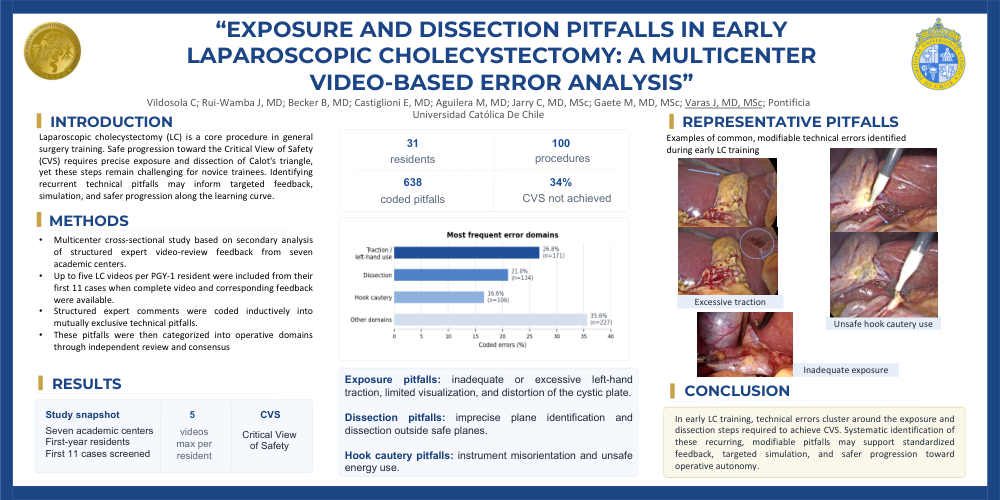
•31 residents
•100 procedures
•638 coded pitfalls
•34% CVS not achieved
•Exposure pitfalls: inadequate or excessive left-hand traction, limited visualization, and distortion of the cystic plate.
•Dissection pitfalls: imprecise plane identification and dissection outside safe planes.
•Hook cautery pitfalls: instrument misorientation and unsafe energy use.
CONCLUSION
In early LC training, technical errors cluster around the exposure and dissection steps required to achieve CVS. Systematic identification of these recurring, modifiable pitfalls may support standardized feedback, targeted simulation, and safer progression toward operative autonomy.