875 posters, 25 topics, 3,440 authors, 1,061 institutions
ePostersLive by SciGen Technologies S.A. All rights reserved.
SAGES 2026 Annual Meeting Emerging Technology Session
March 25-28, 2026 | Tampa, FL, USA

P517
Early Exposure to the Society of American Gastrointestinal and Endoscopic Surgeons (SAGES) Video Library in Surgery Residency Enhances Ethical and Protocol-Oriented Approach to Minimally Invasive Surgery
Poster Presenter
Authors
Vishakha Patil, Nitin Baste, Shubham Shelke, Kunal Agade, Kalpa Sinha
Affiliations
Part of Topic
Education / Simulation
Early Exposure to the Society of American Gastrointestinal and Endoscopic Surgeons (SAGES) Video Library in Surgery Residency Enhances Ethical and Protocol-Oriented Approach to Minimally Invasive Surgery
Background:
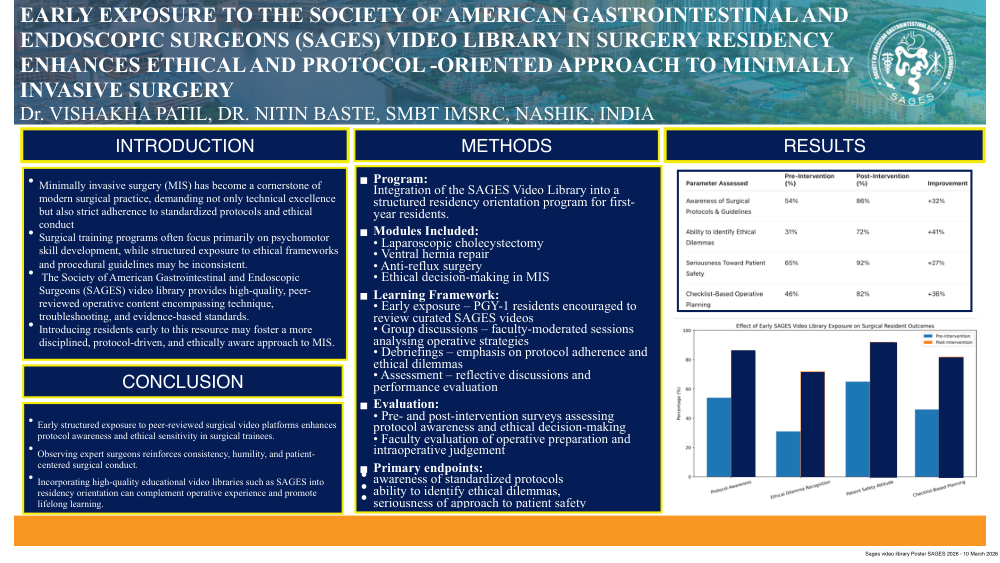
Minimally invasive surgery (MIS) has become a cornerstone of modern surgical practice, demanding not only technical excellence but also strict adherence to standardized protocols and ethical conduct. Surgical training programs often focus primarily on psychomotor skill development, while structured exposure to ethical frameworks and procedural guidelines may be inconsistent. The Society of American Gastrointestinal and Endoscopic Surgeons (SAGES) video library provides high-quality, peer-reviewed operative content encompassing technique, troubleshooting, and evidence-based standards. Introducing residents early to this resource may foster a more disciplined, protocol-driven, and ethically aware approach to MIS.
Methods:
We integrated early access to the SAGES video library into a structured residency orientation program for first-year postgraduate trainees. Residents were encouraged to review curated modules on laparoscopic cholecystectomy, ventral hernia repair, anti-reflux surgery, and ethical considerations in surgical decision-making. Group discussions, faculty-moderated debriefings, and reflective assessments were employed to reinforce learning. The impact of early exposure was assessed using pre- and post-intervention surveys, faculty evaluations, and operative performance reviews. Primary endpoints included awareness of standardized protocols, ability to identify ethical dilemmas, and seriousness of approach to patient safety.
Results:
Preliminary findings indicated a significant improvement in residents’ appreciation of structured surgical protocols and their ethical relevance. Post-exposure, 82% of residents demonstrated increased adherence to checklist-based operative planning, compared to 46% at baseline. Faculty noted enhanced preoperative preparation, improved intraoperative decision-making, and greater respect for procedural safety steps. Residents reported that observing international experts through the video library highlighted the importance of consistency, humility, and patient-centered ethics. Qualitative feedback emphasized that early multimedia exposure provided both cognitive reinforcement and a cultural framework for responsible practice in MIS.
Conclusion:
Early integration of the SAGES video library into surgical residency cultivates not only technical understanding but also an ethically grounded, protocol-oriented mindset toward minimally invasive surgery. By aligning residents with international standards from the outset, this strategy enhances surgical seriousness, improves patient safety awareness, and promotes lifelong learning habits. Structured adoption of high-quality educational video platforms such as SAGES should be considered a core component of residency training curricula to complement hands-on operative experience.