875 posters, 25 topics, 3,440 authors, 1,061 institutions
ePostersLive by SciGen Technologies S.A. All rights reserved.
SAGES 2026 Annual Meeting Emerging Technology Session
March 25-28, 2026 | Tampa, FL, USA

P511
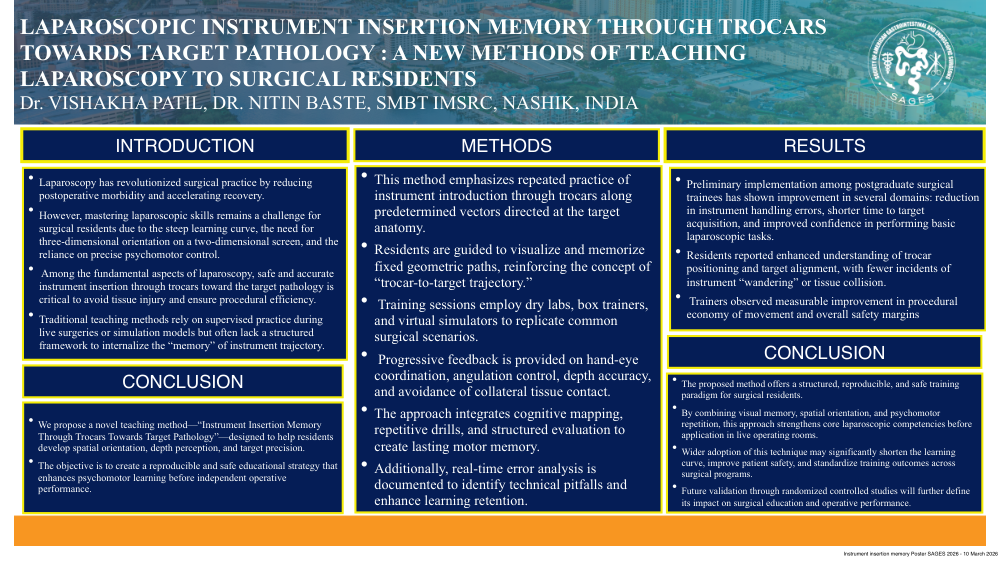
Laparoscopic Instrument Insertion Memory Through Trocars Towards Target Pathology: A New Method of Teaching Laparoscopy to Surgical Residents
Poster Presenter
Authors
Vishakha Patil, Nitin Baste, Kalpa Sinha, Shubham Shelke, Kunal Agade
Affiliations
Part of Topic
Education / Simulation
Background:
Laparoscopy has revolutionized surgical practice by reducing postoperative morbidity and accelerating recovery. However, mastering laparoscopic skills remains a challenge for surgical residents due to the steep learning curve, the need for three-dimensional orientation on a two-dimensional screen, and the reliance on precise psychomotor control. Among the fundamental aspects of laparoscopy, safe and accurate instrument insertion through trocars toward the target pathology is critical to avoid tissue injury and ensure procedural efficiency. Traditional teaching methods rely on supervised practice during live surgeries or simulation models but often lack a structured framework to internalize the “memory” of instrument trajectory.
Objective:
We propose a novel teaching method—“Instrument Insertion Memory Through Trocars Towards Target Pathology”—designed to help residents develop spatial orientation, depth perception, and target precision. The objective is to create a reproducible and safe educational strategy that enhances psychomotor learning before independent operative performance.
Methods:
This method emphasizes repeated practice of instrument introduction through trocars along predetermined vectors directed at the target anatomy. Residents are guided to visualize and memorize fixed geometric paths, reinforcing the concept of “trocar-to-target trajectory.” Training sessions employ dry labs, box trainers, and virtual simulators to replicate common surgical scenarios. Progressive feedback is provided on hand-eye coordination, angulation control, depth accuracy, and avoidance of collateral tissue contact. The approach integrates cognitive mapping, repetitive drills, and structured evaluation to create lasting motor memory. Additionally, real-time error analysis is documented to identify technical pitfalls and enhance learning retention.
Results:
Preliminary implementation among postgraduate surgical trainees has shown improvement in several domains: reduction in instrument handling errors, shorter time to target acquisition, and improved confidence in performing basic laparoscopic tasks. Residents reported enhanced understanding of trocar positioning and target alignment, with fewer incidents of instrument “wandering” or tissue collision. Trainers observed measurable improvement in procedural economy of movement and overall safety margins.
Conclusion:
The proposed method of teaching laparoscopic instrument insertion through trocars toward target pathology offers a structured, reproducible, and safe training paradigm for surgical residents. By combining visual memory, spatial orientation, and psychomotor repetition, this approach strengthens core laparoscopic competencies before application in live operating rooms. Wider adoption of this technique may significantly shorten the learning curve, improve patient safety, and standardize training outcomes across surgical programs. Future validation through randomized controlled studies will further define its impact on surgical education and operative performance.