875 posters, 25 topics, 3,440 authors, 1,061 institutions
ePostersLive by SciGen Technologies S.A. All rights reserved.
SAGES 2026 Annual Meeting Emerging Technology Session
March 25-28, 2026 | Tampa, FL, USA

P495
Editing Your Surgery Videos yourself: A Tool to Improve Surgical Skills by Recognising and Learning from One's Own Mistakes
Poster Presenter
Authors
Affiliations
Part of Topic
Education / Simulation
Editing Your Surgery Videos: A Tool to Improve Surgical Skills by Recognizing and Learning from One’s Own Mistakes
Abstract
Background: Video recording of surgical procedures has become increasingly common with advances in minimally invasive technologies. Although surgical videos are widely used for teaching and conference presentations, their potential as a structured self-reflection tool remains underexplored. This study investigates whether editing one’s own surgical videos enhances technical skill development, error recognition, and reflective learning among surgeons.
Methods: A prospective observational study was conducted among general surgery residents and early-career faculty performing laparoscopic procedures. Participants recorded their surgeries and subsequently edited the recordings to produce a 10–15-minute summary highlighting key operative steps, errors, and decision-making points. Faculty reviewers evaluated both raw and edited videos. Outcomes included improvement in error recognition, changes in technical skill assessed using the Global Operative Assessment of Laparoscopic Skills (GOALS), and qualitative analysis of reflective comments. Pre- and post-intervention self-assessment questionnaires were analyzed. Statistical analysis included paired t-tests and Wilcoxon signed-rank tests.
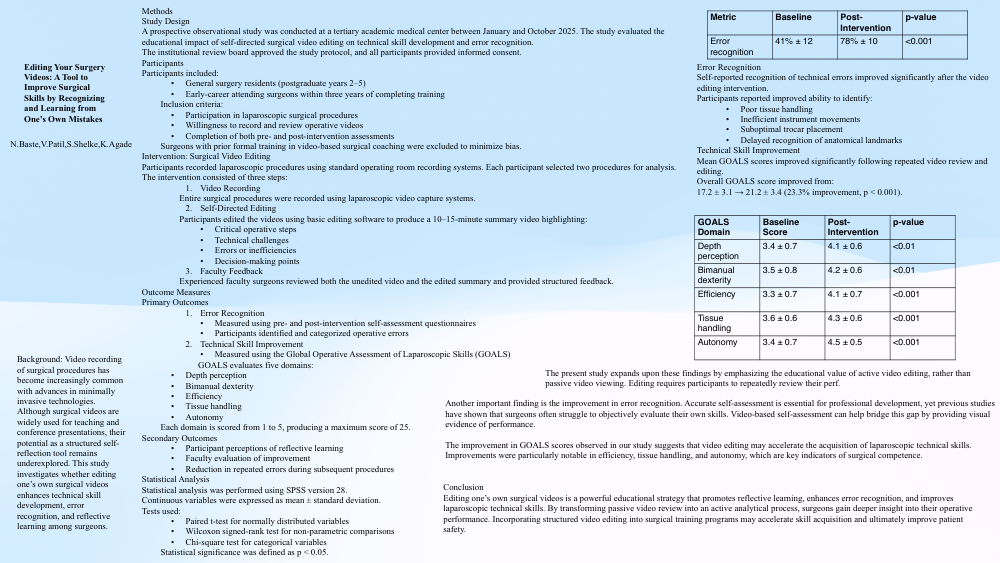
Results: Thirty-two participants completed the study. Self-reported error recognition increased significantly from 41% ± 12% at baseline to 78% ± 10% post-intervention (p < 0.001). Mean GOALS score improved from 17.2 ± 3.1 to 21.2 ± 3.4, representing a 23.3% improvement (p < 0.001). Participants demonstrated notable improvements in tissue handling, instrument control, trocar positioning, and energy device use. Faculty evaluation confirmed fewer repeated technical errors in subsequent procedures. Qualitative analysis revealed themes of deliberate practice, improved situational awareness, and enhanced intraoperative decision-making.
Conclusion: Editing one’s own surgical videos is an effective educational intervention that promotes active reflection, improves technical performance, and enhances error recognition. Incorporating structured video editing into surgical training curricula may accelerate skill acquisition and contribute to safer surgical practice.
Keywords: surgical education, video review, self-assessment, laparoscopic surgery, GOALS score, reflective learning
⸻
Introduction
The acquisition of surgical competence requires continuous technical refinement, reflective learning, and structured feedback. Traditionally, surgical training relies on apprenticeship models in which trainees learn through direct observation and supervised practice in the operating room. However, this approach can be limited by time constraints, variability in supervision, and restricted opportunities for self-reflection.
Advances in minimally invasive surgery have made intraoperative video recording routine, particularly in laparoscopic and endoscopic procedures. These recordings provide an objective record of the surgical process and can serve as valuable educational resources. Previous studies have demonstrated that video-based assessment improves surgical education, allows objective skill evaluation, and facilitates remote feedback. For example, Herrera-Almario et al. demonstrated that reviewing surgical videos can improve self-assessment accuracy and technical skill awareness among residents. Similarly, systematic reviews highlight that video-based coaching and assessment are effective methods for improving operative performance.
Despite these advantages, most surgical video recordings are used for teaching presentations rather than self-directed reflective learning. Passive viewing of surgical videos may provide limited educational benefit compared with active engagement with the content. The process of editing one’s own surgical videos may offer a more powerful learning experience by forcing surgeons to analyze each operative step, identify mistakes, and critically assess their decision-making.
Video editing requires the surgeon to repeatedly review operative footage, identify key moments, and decide which steps are most relevant for summarization. This process may facilitate deliberate practice, a concept widely recognized as essential for expertise development. Through deliberate practice, individuals actively analyze their performance and focus on improving specific weaknesses.
Previous research has demonstrated the benefits of video-based feedback and self-assessment in surgical training. Randomized trials have shown that video review improves laparoscopic performance in simulation environments, while systematic reviews suggest that video-based coaching can significantly enhance operative outcomes. However, little research has specifically examined the educational value of surgeons editing their own operative videos.
This study aims to evaluate whether editing surgical videos improves technical skill acquisition, enhances error recognition, and promotes reflective learning among general surgery residents and early-career surgeons. We hypothesize that structured video editing will lead to measurable improvements in operative performance as assessed by standardized technical skill scores.
⸻
Methods
Study Design
A prospective observational study was conducted at a tertiary academic medical center between January and October 2025. The study evaluated the educational impact of self-directed surgical video editing on technical skill development and error recognition.
The institutional review board approved the study protocol, and all participants provided informed consent.
Participants
Participants included:
•General surgery residents (postgraduate years 2–5)
•Early-career attending surgeons within three years of completing training
Inclusion criteria:
•Participation in laparoscopic surgical procedures
•Willingness to record and review operative videos
•Completion of both pre- and post-intervention assessments
Surgeons with prior formal training in video-based surgical coaching were excluded to minimize bias.
Intervention: Surgical Video Editing
Participants recorded laparoscopic procedures using standard operating room recording systems. Each participant selected two procedures for analysis.
The intervention consisted of three steps:
1.Video Recording
Entire surgical procedures were recorded using laparoscopic video capture systems.
2.Self-Directed Editing
Participants edited the videos using basic editing software to produce a 10–15-minute summary video highlighting:
•Critical operative steps
•Technical challenges
•Errors or inefficiencies
•Decision-making points
3.Faculty Feedback
Experienced faculty surgeons reviewed both the unedited video and the edited summaryand provided structured feedback.
Outcome Measures
Primary Outcomes
1.Error Recognition
•Measured using pre- and post-intervention self-assessment questionnaires
•Participants identified and categorized operative errors
2.Technical Skill Improvement
•Measured using the Global Operative Assessment of Laparoscopic Skills (GOALS)
GOALS evaluates five domains:
•Depth perception
•Bimanual dexterity
•Efficiency
•Tissue handling
•Autonomy
Each domain is scored from 1 to 5, producing a maximum score of 25.
Secondary Outcomes
•Participant perceptions of reflective learning
•Faculty evaluation of improvement
•Reduction in repeated errors during subsequent procedures
Statistical Analysis
Statistical analysis was performed using SPSS version 28.
Continuous variables were expressed as mean ± standard deviation.
Tests used:
•Paired t-test for normally distributed variables
•Wilcoxon signed-rank test for non-parametric comparisons
•Chi-square test for categorical variables
Statistical significance was defined as p < 0.05.
Results
Participant Characteristics
A total of 32 participants completed the study:
•Residents: 24 (75%)
•Early-career faculty: 8 (25%)
Mean surgical experience:
•Residents: 3.6 ± 1.2 years
•Faculty: 1.8 ± 0.9 years post-training
A total of 64 laparoscopic procedures were analyzed.
M
Faculty Assessment
Faculty reviewers observed measurable improvements in subsequent procedures:
•Reduced repetition of previously identified errors
•Improved instrument coordination
•Greater confidence in operative decision-making
Qualitative Findings
Three major themes emerged from participant reflections:
1. Deliberate Practice
Participants reported that editing forced them to slow down and critically analyze each step of the operation.
2. Error Awareness
Many surgeons identified mistakes they had not noticed during the live operation.
3. Improved Decision-Making
Repeated video review helped surgeons better understand difficult intraoperative decisions.
Discussion
This study demonstrates that editing one’s own surgical videos significantly improves technical performance and error recognition among surgical trainees and early-career surgeons.
Our findings support previous research indicating that video-based feedback enhances surgical education. Video assessment allows surgeons to objectively evaluate their performance outside the time pressure of the operating room.
Systematic reviews have shown that video-based coaching can improve surgical skill acquisition and patient outcomes. Augestad et al. reported that structured video feedback improves operative performance and technical proficiency. Similarly, randomized trials have demonstrated that video review improves laparoscopic suturing and simulation performance.
The present study expands upon these findings by emphasizing the educational value of active video editing, rather than passive video viewing. Editing requires participants to repeatedly review their performance and intentionally select critical moments for analysis. This process likely enhances reflective learning and reinforces deliberate practice.
Another important finding is the improvement in error recognition. Accurate self-assessment is essential for professional development, yet previous studies have shown that surgeons often struggle to objectively evaluate their own skills. Video-based self-assessment can help bridge this gap by providing visual evidence of performance.
The improvement in GOALS scores observed in our study suggests that video editing may accelerate the acquisition of laparoscopic technical skills. Improvements were particularly notable in efficiency, tissue handling, and autonomy, which are key indicators of surgical competence.
Importantly, faculty reviewers also observed fewer repeated errors during subsequent procedures, indicating that the intervention translated into real-world performance improvements.
⸻
Educational Implications
Integrating video editing into surgical curricula may offer several benefits:
•Enhanced reflective learning
•Objective performance evaluation
•Improved error recognition
•Accelerated skill development
Such interventions could be incorporated into:
•residency training programs
•surgical coaching initiatives
•continuing professional development for practicing surgeons
⸻
Limitations
This study has several limitations.
First, it was conducted at a single academic institution with a relatively small sample size. Second, self-reported measures of error recognition may be subject to bias. Third, improvements in GOALS scores may partly reflect learning from repeated procedures rather than the video editing intervention alone.
Future studies should include randomized controlled designs and larger multicenter cohorts.
⸻
Conclusion
Editing one’s own surgical videos is a powerful educational strategy that promotes reflective learning, enhances error recognition, and improves laparoscopic technical skills. By transforming passive video review into an active analytical process, surgeons gain deeper insight into their operative performance. Incorporating structured video editing into surgical training programs may accelerate skill acquisition and ultimately improve patient safety.
⸻
References
Herrera-Almario, G., Kirk, K., Guerrero, V., et al. (2016). The effect of video review of resident laparoscopic surgical skills measured by self- and external assessment. American Journal of Surgery. https://www.sciencedirect.com/science/article/pii/S000296101500567X
Grüter, A. A. J., Van Lieshout, A. S., Van Oostendorp, S. E., et al. (2023). Video-based tools for surgical quality assessment of technical skills in laparoscopic procedures: A systematic review. Surgical Endoscopy. https://link.springer.com/article/10.1007/s00464-023-10076-z
Balvardi, S., Semsar-Kazerooni, K., Kaneva, P., et al. (2023). Validity of video-based self-assessment tools for surgical trainees in laparoscopic cholecystectomy. Surgical Endoscopy. https://link.springer.com/article/10.1007/s00464-022-09466-6
McQueen, S., McKinnon, V., VanderBeek, L., et al. (2019). Video-based assessment in surgical education: A scoping review. Journal of Surgical Education. https://www.sciencedirect.com/science/article/pii/S1931720419303083
Nayar, S., Musto, L., Baruah, G., et al. (2020). Self-assessment of surgical skills: A systematic review. Journal of Surgical Education. https://www.sciencedirect.com/science/article/pii/S1931720419304386
Prebay, Z., Peabody, J., Miller, D., & Ghani, K. (2019). Video review for measuring and improving skill in urological surgery. Nature Reviews Urology. https://www.nature.com/articles/s41585-018-0138-2
Halim, J., Jelley, J., Zhang, N., et al. (2021). The effect of verbal feedback, video feedback, and self-assessment on laparoscopic suturing skills. Surgical Endoscopy. https://link.springer.com/article/10.1007/s00464-020-07871-3
Augestad, K., Butt, K., Ignjatovic, D., & Keller, D. (2020). Video-based coaching in surgical education: A systematic review and meta-analysis. Surgical Endoscopy. https://link.springer.com/article/10.1007/s00464-019-07265-0
Chartrand, G., Soucisse, M., Dubé, P., & Trépanier, J. (2021). Self-directed learning by video as a means to improve technical skills in surgery residents. BMC Medical Education. https://link.springer.com/article/10.1186/s12909-021-02524-y
Pattni, C., Scaffidi, M., Li, J., et al. (2023). Video-based interventions to improve self-assessment accuracy among physicians. PLOS ONE. https://journals.plos.org/plosone/article?id=10.1371/journal.pone.0288474