875 posters, 25 topics, 3,440 authors, 1,061 institutions
ePostersLive by SciGen Technologies S.A. All rights reserved.
SAGES 2026 Annual Meeting Emerging Technology Session
March 25-28, 2026 | Tampa, FL, USA

P487
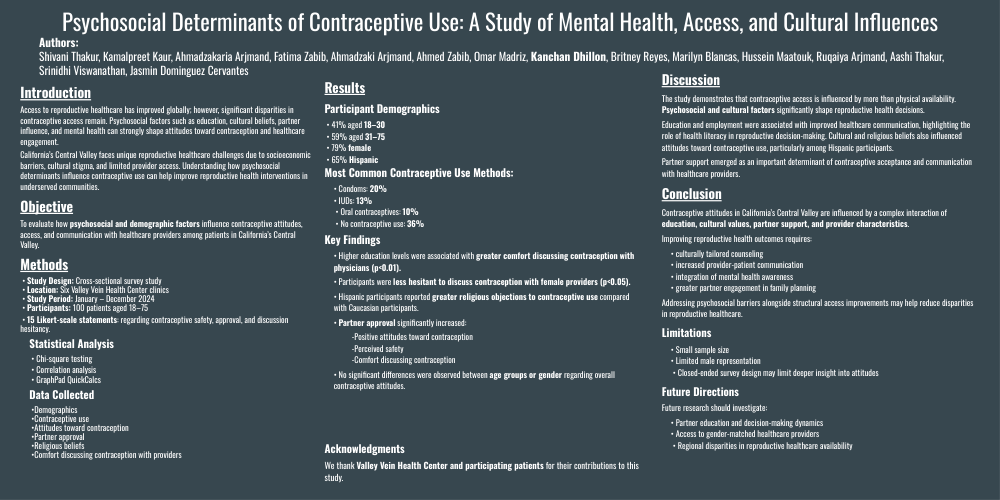
Psychosocial Determinants of Contraceptive Use: A Study of Mental Health, Access, and Cultural Influences
Poster Presenter
Part of Topic
Diversity and Inclusion
Psychosocial Determinants of Contraceptive Use: A Study of Mental Health, Access, and Cultural Influences
Authors:
Shivani Thakur, Kamalpreet Kaur, Ahmadzakaria Arjmand, Fatima Zabib, Ahmadzaki Arjmand, Ahmed Zabib, Omar Madriz, Kanchan Dhillon, Britney Reyes, Marilyn Blancas, Hussein Maatouk, Ruqaiya Arjmand, Aashi Thakur, Srinidhi Viswanathan, Jasmin Dominguez CervantesIntroduction
Access to reproductive healthcare has improved globally; however, significant disparities in contraceptive access remain. Psychosocial factors such as education, cultural beliefs, partner influence, and mental health can strongly shape attitudes toward contraception and healthcare engagement.
California’s Central Valley faces unique reproductive healthcare challenges due to socioeconomic barriers, cultural stigma, and limited provider access. Understanding how psychosocial determinants influence contraceptive use can help improve reproductive health interventions in underserved communities.
Objective
To evaluate how psychosocial and demographic factors influence contraceptive attitudes, access, and communication with healthcare providers among patients in California’s Central Valley.
Methods
• Study Design: Cross-sectional survey study
• Location: Six Valley Vein Health Center clinics
• Study Period: January – December 2024
• Participants: 100 patients aged 18–75
• 15 Likert-scale statements: regarding contraceptive safety, approval, and discussion hesitancy.
Statistical Analysis
• Chi-square testing
• Correlation analysis
• GraphPad QuickCalcs
Data Collected
•Demographics•Contraceptive use
•Attitudes toward contraception
•Partner approval
•Religious beliefs
•Comfort discussing contraception with providers
Results
Participant Demographics
• 41% aged 18–30
• 59% aged 31–75
• 79% female
• 65% Hispanic
Most Common Contraceptive Use Methods:
• Condoms: 20%
• IUDs: 13%
• Oral contraceptives: 10%
• No contraceptive use: 36%
Key Findings
• Higher education levels were associated with greater comfort discussing contraception with physicians (p<0.01).
• Participants were less hesitant to discuss contraception with female providers (p<0.05).
• Hispanic participants reported greater religious objections to contraceptive use compared with Caucasian participants.
• Partner approval significantly increased:
-Positive attitudes toward contraception
-Perceived safety
-Comfort discussing contraception
• No significant differences were observed between age groups or gender regarding overall contraceptive attitudes.
Discussion
The study demonstrates that contraceptive access is influenced by more than physical availability. Psychosocial and cultural factors significantly shape reproductive health decisions.
Education and employment were associated with improved healthcare communication, highlighting the role of health literacy in reproductive decision-making. Cultural and religious beliefs also influenced attitudes toward contraceptive use, particularly among Hispanic participants.
Partner support emerged as an important determinant of contraceptive acceptance and communication with healthcare providers.
Conclusion
Contraceptive attitudes in California’s Central Valley are influenced by a complex interaction of education, cultural values, partner support, and provider characteristics.
Improving reproductive health outcomes requires:
• culturally tailored counseling
• increased provider-patient communication
• integration of mental health awareness
• greater partner engagement in family planning
Addressing psychosocial barriers alongside structural access improvements may help reduce disparities in reproductive healthcare.
Limitations
• Small sample size
• Limited male representation
• Closed-ended survey design may limit deeper insight into attitudes
Future Directions
Future research should investigate:
• Partner education and decision-making dynamics
• Access to gender-matched healthcare providers
• Regional disparities in reproductive healthcare availability
Acknowledgments
We thank Valley Vein Health Center and participating patients for their contributions to this study.