816 posters, 24 topics, 3,314 authors, 1,012 institutions
ePostersLive by SciGen Technologies S.A. All rights reserved.
SAGES 2026 Annual Meeting Emerging Technology Session
March 25-28, 2026 | Tampa, FL, USA

P477
Chronic Terminal Ileum Dilation and a New Diagnosis of Crohn's
Poster Presenter
Part of Topic
Colorectal
Case: The patient is a 45 year old female who initially presented with diarrhea in 2023. Upon her index admission, she was diagnosed with nephrotic syndrome, suspected secondary to protein losing enteropathy. She was also found to have low fecal alpha-1 antitrypsin, low fecal pancreatic lipase, and iron deficiency anemia. CT scan performed in 2023 showed a loop of distal ileum dilated up to 11cm with abrupt caliber change. The patient was started on TPN and pancrelipase for nutritional optimization given albumin <3 and was planned for surgical resection in 2 weeks. EGD and Colonoscopy with biopsies were performed and found to be normal. At this time, the patient was lost to follow up.
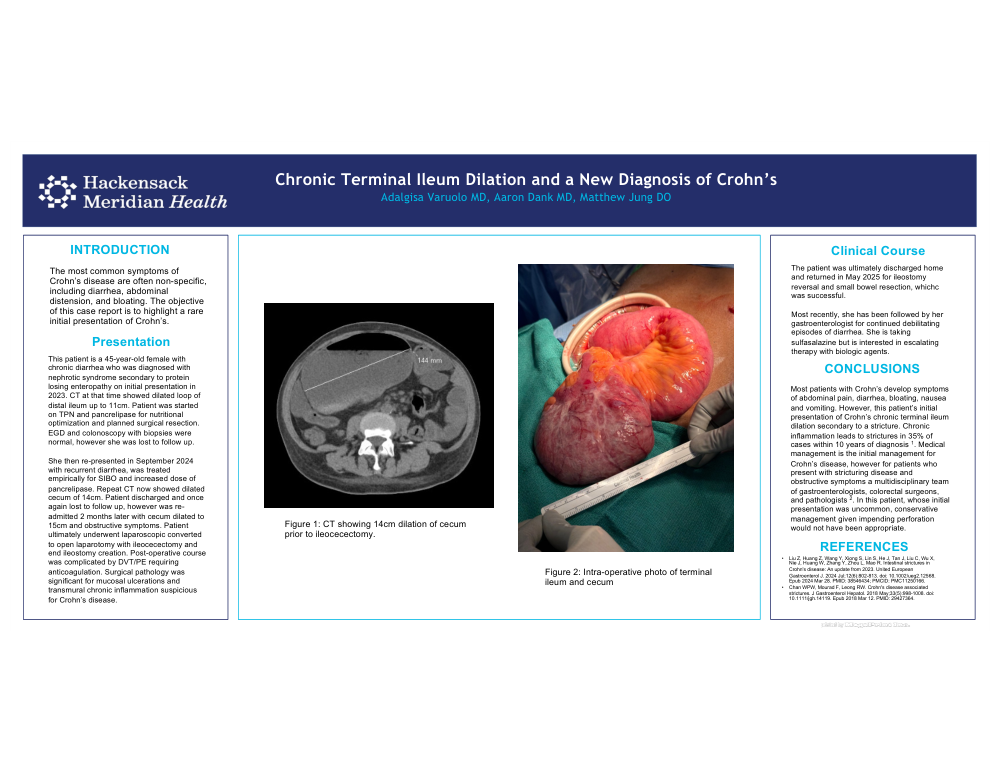
The patient then re-presented in September of 2024 with recurrent diarrhea and malnutrition. The patient was treated empirically for SIBO with rifaximin and increased doses of pancrelipase. Repeat CT at this time was consistent with her prior scans and the cecum was dilated up to 14cm (Fig.1). A capsule endoscopy was performed but patency was unsuccessful. Again, due to poor nutritional status, the patient was discharged home with outpatient follow up. She returned to the hospital 2 months later in November of 2024 with similar symptoms. Repeat imaging at this time showed that the previously dilated portion of small bowel had progressed to 15cm. During this admission the patient had also started developing obstructive symptoms of bloating, nausea, and vomiting. She was subsequently started on Total Parenteral Nutrition with plans for surgical intervention at this time.The patient underwent a laparoscopic exploration which subsequently was converted to an open laparotomy with ileocecectomy with end ileostomy. The patient’s postoperative course was complicated by PE/DVT requiring anticoagulation. Surgical pathology was significant for mucosal ulcerations and transmural chronic inflammation highly suspicious for Crohn’s disease.
Most patients with Crohn’s develop symptoms of abdominal pain, diarrhea, bloating, nausea and vomiting. However, this patient’s initial presentation of Crohn’s chronic terminal ileum dilation secondary to a stricture. Chronic inflammation leads to strictures in 35% of cases within 10 years of diagnosis. Medical management is the initial management for Crohn’s disease, however for patients who present with stricturing disease and obstructive symptoms a multidisciplinary team of gastroenterologists, colorectal surgeons, and pathologists. In this patient, whose initial presentation was uncommon, conservative management given impending perforation would not have been appropriate.