816 posters, 24 topics, 3,314 authors, 1,012 institutions
ePostersLive by SciGen Technologies S.A. All rights reserved.
SAGES 2026 Annual Meeting Emerging Technology Session
March 25-28, 2026 | Tampa, FL, USA

P476
NECROTIZING CENTRAL NERVOUS SYSTEM INFECTION WITH BRAIN HERNIATION IN A PATIENT WITH CLOSTRIDIUM SEPTICUM BACTEREMIA AND A SMALL BOWEL OBSTRUCTION
Part of Topic
Colorectal
Necrotizing Central Nervous System Infection with Brain Herniation in a Patient with Clostridium septicum Bacteremia and a Small Bowel Obstruction
Erika C Levy, DO1 and Robert A Malizia, MD2
1University of Pittsburgh Medical Center (UPMC) Central Pennsylvania Department of General Surgery; 2UPMC Central Pennsylvania Department of Colon and Rectal Surgery
Background:
-Clostridium septicum bacteremia is rare, rapidly fatal, and strongly associated with gastrointestinal pathology and colorectal or hematologic malignancy.1-2
-Central nervous system (CNS) involvement is exceedingly rare and almost uniformly fatal.4
-Here we present a patient with rapidly progressive, fulminant CNS associated C. septicum bacteremia in the setting of a small bowel obstruction (SBO) and IgG kappa smoldering multiple myeloma (SMM).
Case Details:
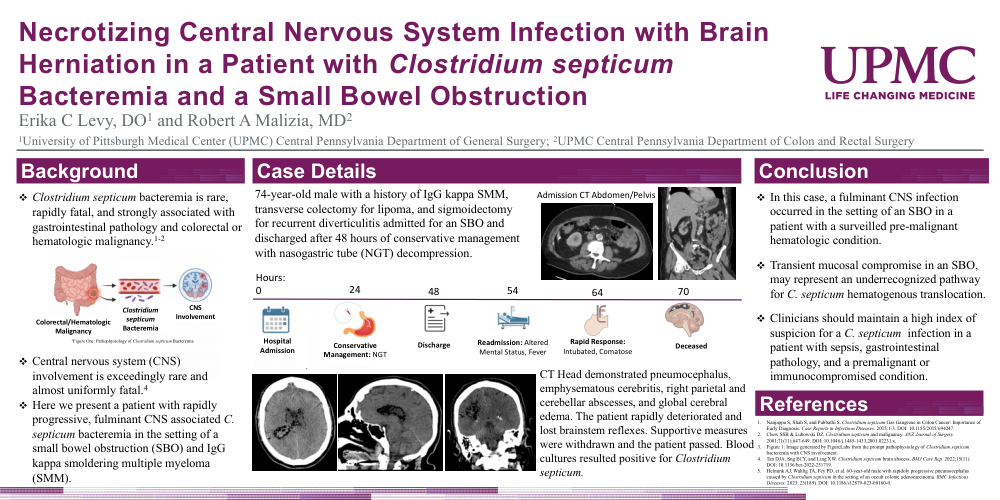
-74-year-old male with a history of IgG kappa SMM, transverse colectomy for lipoma, and sigmoidectomy for recurrent diverticulitis admitted for an SBO and discharged after 48 hours of conservative management with nasogastric tube (NGT) decompression.
-CT Head demonstrated pneumocephalus, emphysematous cerebritis, right parietal and cerebellar abscesses, and global cerebral edema. The patient rapidly deteriorated and lost brainstem reflexes. Supportive measures were withdrawn and the patient passed. Blood cultures resulted positive for Clostridium septicum.
Conclusion:
-In this case, a fulminant CNS infection occurred in the setting of an SBO in a patient with a surveilled pre-malignant hematologic condition.
-Transient mucosal compromise in an SBO, may represent an underrecognized pathway for C. septicum hematogenous translocation.
-Clinicians should maintain a high index of suspicion for a C. septicum infection in a patient with sepsis, gastrointestinal pathology, and a premalignant or immunocompromised condition.
References:
1.Nanjappa S, Shah S, and Pabbathi S. Clostridium septicum Gas Gangrene in Colon Cancer: Importance of Early Diagnosis. Case Reports in Infectious Diseases. 2015:1-3. DOI: 10.1155/2015/694247.
2.Chew SSB & Lubowski DZ. Clostridium septicum and malignancy. ANZ Journal of Surgery. 2001;71(11);647-649. DOI: 10.1046/j.1445-1433.2001.02231.x.
3.Figure 1: Image generated by FigureLabs from the prompt pathophysiology of Clostridium septicum bacteremia with CNS involvement.
4.Tan DJA, Sng ECY, and Ling XW. Clostridium septicum brain abscess. BMJ Case Rep. 2022;15(11). DOI: 10.1136/bcr-2022-251719.
5.Helmink AJ, Wahlig TA, Fey PD, et al. 60-year-old male with rapidolyprogressive pneumocephalus caused by Clostridium septicum in the setting of an occult colonic adenocarcinoma. BMC Infectious Diseases. 2023; 23(189). DOI: 10.1186/s12879-023-08160-0.