816 posters, 24 topics, 3,314 authors, 1,012 institutions
ePostersLive by SciGen Technologies S.A. All rights reserved.
SAGES 2026 Annual Meeting Emerging Technology Session
March 25-28, 2026 | Tampa, FL, USA

P474
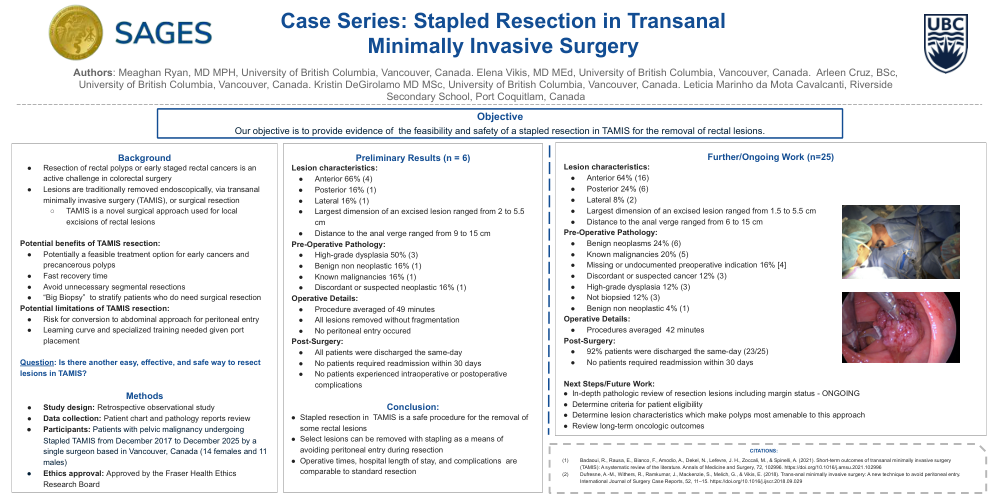
Case Series: Stapled Resection in Transanal Minimally Invasive Surgery
Poster Presenter
Authors
Arleen Cruz, Teagan Sacre, Meaghan Ryan, Elena Vikis, Kristin DeGiralamo, Jiri Melich
Affiliations
Part of Topic
Colorectal
Case Series: Stapled Resection in Transanal Minimally Invasive Surgery
Authors: Meaghan Ryan, MD MPH, University of British Columbia, Vancouver, Canada. Elena Vikis, MD MEd, University of British Columbia, Vancouver, Canada. Arleen Cruz, BSc, University of British Columbia, Vancouver, Canada. Kristin DeGirolamo MD MSc, University of British Columbia, Vancouver, Canada. Leticia Marinho da Mota Cavalcanti, Riverside Secondary School, Port Coquitlam, Canada
Objective
Our objective is to provide evidence of the feasibility and safety of a stapled resection in TAMIS for the removal of rectal lesions.
Background
-
Resection of rectal polyps or early staged rectal cancers is an active challenge in colorectal surgery
-
Lesions are traditionally removed endoscopically, via transanal minimally invasive surgery (TAMIS), or surgical resection
-
TAMIS is a novel surgical approach used for local excisions of rectal lesions
Potential benefits of TAMIS resection:
-
Potentially a feasible treatment option for early cancers and precancerous polyps
-
Fast recovery time
-
Avoid unnecessary segmental resections
-
“Big Biopsy” to stratify patients who do need surgical resection
Potential limitations of TAMIS resection:
-
Risk for conversion to abdominal approach for peritoneal entry
-
Learning curve and specialized training needed given port placement
Question: Is there another easy, effective, and safe way to resect lesions in TAMIS?
Methods
-
Study design: Retrospective observational study
-
Data collection: Patient chart and pathology reports review
-
Participants: Patients with pelvic malignancy undergoing Stapled TAMIS from December 2017 to December 2025 by a single surgeon based in Vancouver, Canada (14 females and 11 males)
-
Ethics approval: Approved by the Fraser Health Ethics Research Board
Preliminary Results (n = 6)
Lesion characteristics:
-
Anterior 66% (4)
-
Posterior 16% (1)
-
Lateral 16% (1)
-
Largest dimension of an excised lesion ranged from 2 to 5.5 cm
-
Distance to the anal verge ranged from 9 to 15 cm
Pre-Operative Pathology:
-
High-grade dysplasia 50% (3)
-
Benign non neoplastic 16% (1)
-
Known malignancies 16% (1)
-
Discordant or suspected neoplastic 16% (1)
Operative Details:
-
Procedure averaged of 49 minutes
-
All lesions removed without fragmentation
-
No peritoneal entry occured
Post-Surgery:
-
All patients were discharged the same-day
-
No patients required readmission within 30 days
-
No patients experienced intraoperative or postoperative complications
Conclusion:
-
Stapled resection in TAMIS is a safe procedure for the removal of some rectal lesions
-
Select lesions can be removed with stapling as a means of avoiding peritoneal entry during resection
-
Operative times, hospital length of stay, and complications are comparable to standard resection
Further/Ongoing Work (n=25)
Lesion characteristics:
-
Anterior 64% (16)
-
Posterior 24% (6)
-
Lateral 8% (2)
-
Largest dimension of an excised lesion ranged from 1.5 to 5.5 cm
-
Distance to the anal verge ranged from 6 to 15 cm
Pre-Operative Pathology:
-
Benign neoplasms 24% (6)
-
Known malignancies 20% (5)
-
Missing or undocumented preoperative indication 16% [4]
-
Discordant or suspected cancer 12% (3)
-
High-grade dysplasia 12% (3)
-
Not biopsied 12% (3)
-
Benign non neoplastic 4% (1)
Operative Details:
-
Procedures averaged 42 minutes
Post-Surgery:
-
92% patients were discharged the same-day (23/25)
-
No patients required readmission within 30 days
Next Steps/Future Work:
-
In-depth pathologic review of resection lesions including margin status - ONGOING
-
Determine criteria for patient eligibility
-
Determine lesion characteristics which make polyps most amenable to this approach
-
Review long-term oncologic outcomes
CITATIONS:
-
Badaoui, R., Rausa, E., Bianco, F., Amodio, A., Dekel, N., Lefevre, J. H., Zoccali, M., & Spinelli, A. (2021). Short-term outcomes of transanal minimally invasive surgery (TAMIS): A systematic review of the literature. Annals of Medicine and Surgery, 72, 102996. https://doi.org/10.1016/j.amsu.2021.102996
-
Dufresne, A.-M., Withers, R., Ramkumar, J., Mackenzie, S., Melich, G., & Vikis, E. (2018). Trans-anal minimally invasive surgery: A new technique to avoid peritoneal entry. International Journal of Surgery Case Reports, 52, 11–15. https://doi.org/10.1016/j.ijscr.2018.09.029