816 posters, 24 topics, 3,314 authors, 1,012 institutions
ePostersLive by SciGen Technologies S.A. All rights reserved.
SAGES 2026 Annual Meeting Emerging Technology Session
March 25-28, 2026 | Tampa, FL, USA

P468
LOW ANASTOMOTIC LEAK INCIDENCE AFTER LAPAROSCOPIC COLON RESECTIONS: A 70-PATIENT PROSPECTIVE SERIES
Poster Presenter
Authors
Jorge Gonzalez, Jesus A Bahena, Cindy B Larumbe, Monica de Jesus, Sari N Mejía, Jeanette Jimenez, Quintin H Gonzalez
Affiliations
Universidad Anáhuac México, Mexico City, Mexico, Hospital Médica Sur, Mexico City, Mexico, Hospital San Angel Inn HMG, Mexico City, Mexico, Hospital Central Militar, Mexico City, Mexico
Part of Topic
Colorectal
TITLE:
LOW ANASTOMOTIC LEAK INCIDENCE AFTER LAPAROSCOPIC COLON RESECTIONS: A 70-PATIENT PROSPECTIVE SERIES
Introduction
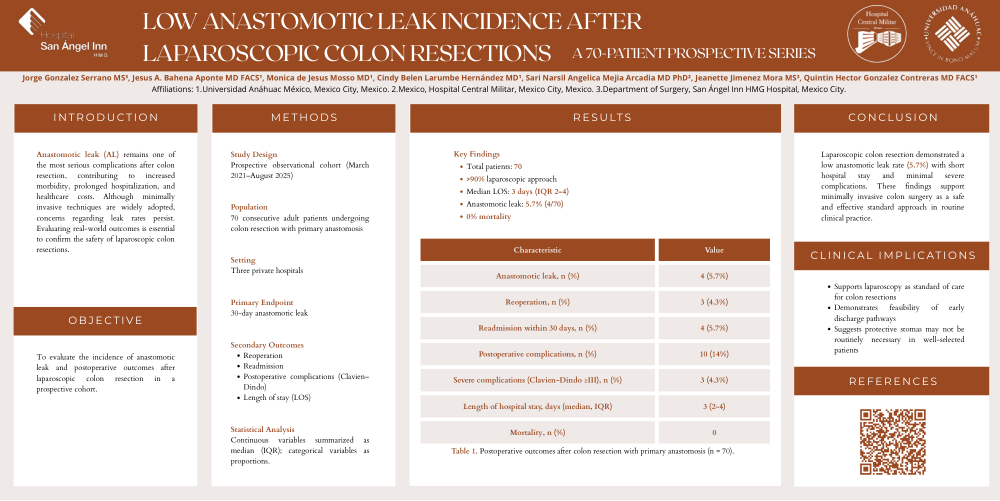
Anastomotic leak (AL) remains one of the most feared complications in colorectal surgery, directly impacting morbidity, mortality, and healthcare utilization. Although laparoscopy is increasingly adopted worldwide, concerns about leak rates persist and occasionally lead surgeons to employ protective diversions or prolong hospital stays. The objective of this study was to evaluate the safety of laparoscopic colon resections in a consecutive series of patients and to report the incidence of AL and other postoperative outcomes in a real-world prospective cohort.
Methods and Procedures
We conducted a prospective observational study from March 2021 to August 2025, enrolling 70 consecutive adult patients undergoing colon resection with primary anastomosis in three private hospitals. Demographics, operative approach, intraoperative findings, and postoperative outcomes were systematically recorded. The primary endpoint was 30-day AL. Secondary outcomes included reoperation, readmission, postoperative complications (Clavien–Dindo classification), and length of stay (LOS). Continuous variables were summarized as medians and interquartile ranges (IQR), while categorical data were presented as proportions.
Results
A total of 70 patients were analyzed, with more than 90% treated laparoscopically, reflecting contemporary institutional practice. The median age was in the mid-50s, with a balanced sex distribution and common indications including complicated diverticular disease and colon cancer. Median LOS was 3 days (IQR 2–4), demonstrating rapid recovery and early discharge. Overall complication rates were low, and severe complications were infrequent. Only four patients developed AL (5.7%), a rate well below the upper range reported in international literature (1–40%). All leaks required clinical intervention, but none resulted in mortality. Subgroup analysis of laparoscopic cases showed similarly favorable results, confirming that the minimally invasive approach did not increase the risk of leak.
Conclusions
This prospective series provides strong evidence of the safety and efficacy of laparoscopic colon resection in routine practice. The AL incidence of 5.7% is low and comparable to, or better than, benchmark international reports. Combined with short LOS, minimal reoperation, and absence of leak-related mortality, these data reinforce laparoscopy as the standard of care for colon resection. Importantly, they support the adoption of early discharge protocols and limit the need for protective stomas in well-selected patients. This study highlights the role of prospective local data in confirming global evidence and provides reassurance to surgeons, patients, and institutions that laparoscopic colon resection can be performed with excellent outcomes and a low risk of catastrophic complications.