816 posters, 24 topics, 3,314 authors, 1,012 institutions
ePostersLive by SciGen Technologies S.A. All rights reserved.
SAGES 2026 Annual Meeting Emerging Technology Session
March 25-28, 2026 | Tampa, FL, USA

P457
MINIMALLY INVASIVE TRANS-ANAL REPAIR (MITAR) FOR RECTOVAGINAL FISTULA: A NOVEL TECHNIQUE
Poster Presenter
Part of Topic
Colorectal
MINIMALLY INVASIVE TRANS-ANAL REPAIR (MITAR) FOR RECTOVAGINAL FISTULA: A NOVEL TECHNIQUE
Mohit Kaushik, MBBS; Hemanga K Bhattacharjee, MBBS, MS, MCH; Mohammad Motiwala, MBBS, MS; Durgeshwari Nalamwad, MBBS; Washim F Khan, MBBS, MS, MCH; Rajinder Parshad, MBBS, MS, MCH
All India Institute of Medical Sciences, New Delhi
INTRODUCTION: Rectovaginal fistula (RVF) is a rare condition. Surgical management, particularly for fistulas located in mid and lower rectum is challenging as the access for traditional trans-perineal or transabdominal procedures is limited. Herein, we describe a novel minimally invasive trans-anal technique for management of RVF.
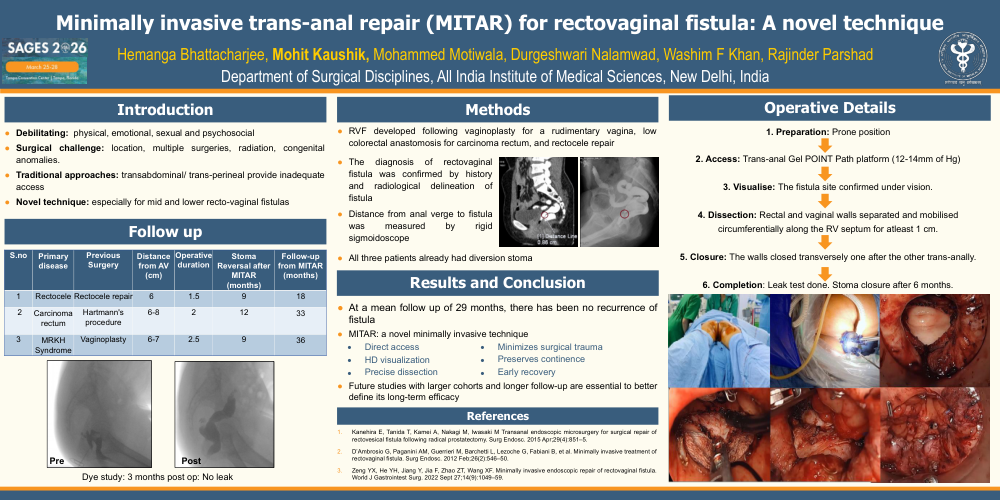
METHODS AND PROCEDURES: The patient was positioned prone and transanal access was established using a GelPOINT Path platform and rectum was inflated with CO2. Under endoscopic visualization, the rectal and vaginal wall at the fistula site were separated by sharp and blunt dissection along the rectovaginal septum. The rectal and vaginal wall first separated cranially, then both sides and finally the caudal end. Mobilization was achieved for at least 1 cm all around . Following adequate mobilization, the vaginal defect was closed using a 3-0 V-Loc suture through trans-anal platform. Vascularity at the closure site was assessed using indocyanine green (ICG) fluorescence, and a watertight closure was confirmed. Subsequently, the rectal wall was closed in a similar fashion.
RESULT: Three patients were operated. Patients developed RVF following vaginoplasty for rudimentary vagina, one following low colorectal anastomosis and other following rectocele repair. All pre-operatively had diversion stoma. Recovery following MITAR was uneventful and stomas were closed after 3 months. At a median follow-up of 29 months, there are no recurrences.
CONCLUSION: MITAR is a safe, feasible, and effective minimally invasive approach for the repair of rectovaginal fistulas, particularly those difficult to access via conventional techniques. The technique provide good access to the fistula site, enables precise dissection of rectal and vaginal walls under enhanced endoscopic visualization and facilitates tension-free closure. As such, MITAR can be a valuable addition to the surgical armamentarium for managing complex RVFs.
Table 1: Demographics, clinical, radiological, intra operative and follow up details
|
Variable |
Patient 1 |
Patient 2 |
Patient 3 |
|
Age ( years) |
50 |
42 |
30 |
|
Primary disease |
Rectocele |
Carcinoma rectum |
MRKH syndrome |
|
Primary surgery |
Rectocele repair |
Laparoscopic low anterior resection with end colostomy |
Vaginoplasty |
|
Distance from anal verge (cm) |
6 |
6-8 |
6-7 |
|
Operative duration (hrs) |
1.5 |
2 |
2.5 |
|
Stoma Reversal after MITAR (months) |
9 |
12 |
9 |
|
Follow-up from MITAR (months) |
18 |
33 |
36 |