816 posters, 24 topics, 3,314 authors, 1,012 institutions
ePostersLive by SciGen Technologies S.A. All rights reserved.
SAGES 2026 Annual Meeting Emerging Technology Session
March 25-28, 2026 | Tampa, FL, USA

P435
Trends In Emergent Colectomy By Age Group In Colorectal Cancer: A New York State Analysis (2018-2023)
Part of Topic
Colorectal
TRENDS IN EMERGENT COLECTOMY BY AGE GROUP IN COLORECTAL CANCER: A NEW YORK STATE ANALYSIS (2018-2023)
Nadia F. Linton, BS., Adyasha Pradhan, BS., Shadi Arjmand, DO., Paula Rivera Millán, MD., Maya Hamaker, BS., Indraneil Mukherjee, MD.
BACKGROUND
Colorectal cancer (CRC) primarily affects older adults, with the proportion of emergent colectomies increasing substantially in those aged 80 years and above, likely due to delayed presentation, higher rates of bowel obstruction or perforation, and a higher comorbidity burden. In contrast, the incidence of early-onset CRC is rising significantly among younger adults (aged <50 years) in high-income western countries, with those born in the 1990s facing at least a five-fold higher risk than previous generations. This study examines whether age group influences the likelihood of emergent versus elective colectomy in patients with colorectal cancer in New York State from 2018-2023.
METHODS AND PROCEDURES
This retrospective analysis utilized statewide discharge data from the Statewide Planning and Research Cooperative System (SPARCS) Inpatient De-Identified dataset from 2018-2023. Patients with the Clinical Classifications Software Refined (CCSR) diagnosis code of “Gastrointestinal cancers - colorectal” and CCSR procedure code of “colectomy” were stratified into five age groups (0-17, 18-29, 30-49, 50-69, ≥70) and admission status was classified as emergent/urgent or elective. Chi-square tests were performed to assess overall association between age group and colectomy type and logistic regression was used to estimate odds ratios (OR) with 95% confidence intervals (CI) using the 50-69 year age group as reference.
RESULTS
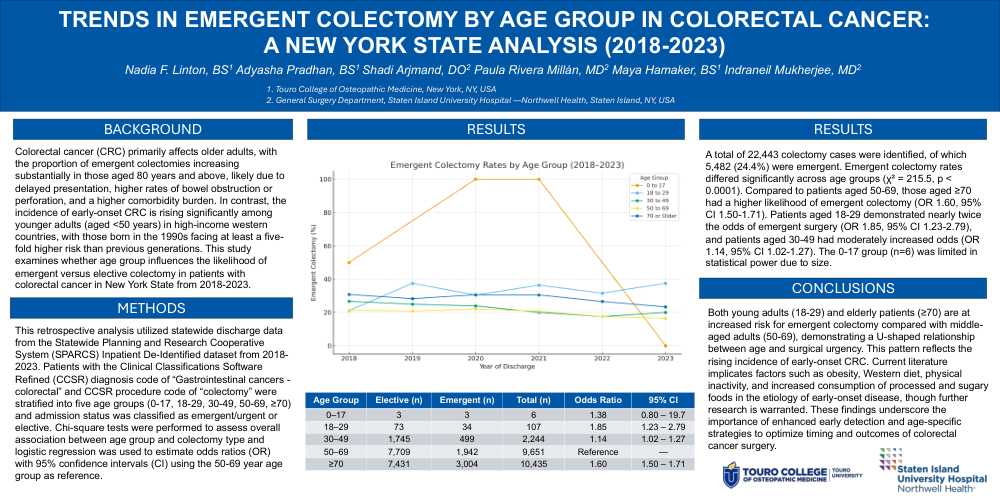
A total of 22,443 colectomy cases were identified, of which 5,482 (24.4%) were emergent. Emergent colectomy rates differed significantly across age groups (χ² = 215.5, p < 0.0001). Compared to patients aged 50-69, those aged ≥70 had a higher likelihood of emergent colectomy (OR 1.60, 95% CI 1.50-1.71). Patients aged 18-29 demonstrated nearly twice the odds of emergent surgery (OR 1.85, 95% CI 1.23-2.79), and patients aged 30-49 had moderately increased odds (OR 1.14, 95% CI 1.02-1.27). The 0-17 group (n=6) was limited in statistical power due to size.
CONCLUSIONS
Both young adults (18-29) and elderly patients (≥70) are at increased risk for emergent colectomy compared with middle-aged adults (50-69), demonstrating a U-shaped relationship between age and surgical urgency. This pattern reflects the rising incidence of early-onset CRC. Current literature implicates factors such as obesity, Western diet, physical inactivity, and increased consumption of processed and sugary foods in the etiology of early-onset disease, though further research is warranted. These findings underscore the importance of enhanced early detection and age-specific strategies to optimize timing and outcomes of colorectal cancer surgery.