816 posters, 24 topics, 3,314 authors, 1,012 institutions
ePostersLive by SciGen Technologies S.A. All rights reserved.
SAGES 2026 Annual Meeting Emerging Technology Session
March 25-28, 2026 | Tampa, FL, USA

P433
Sustained Elevation of MMP-7 in plasma and wound fluid for two weeks after colorectal cancer resection
Part of Topic
Colorectal
Introduction
MMP-7, also referred to as matrilysin, is a member of the Matrix metalloproteinase (MMP) family. It is expressed in epithelial cells and has been associated with colorectal and other cancers (1-6). MMP-7 degrades extracellular matrix (ECM) proteins including collagen IV and participates in connective tissue remodeling and activation of other MMP-2 and MMP-9 (7,8). Moreover, MMP-7 activates α-defensins which enhances intestinal antibacterial activity (9,10). MMP-7 also promotes tumor invasion and metastasis through the degradation of extracellular matrix components and activation of pro-tumorigenic signaling pathways. Expression of MMP-7 by cancers correlates with progression and metastasis (11-15). MMP-7 plays a role in wound healing by facilitating the recruitment/activation of immune cells and enhancing endothelial cell migration, proliferation, and tube formation (via activation of VEGF and pro-TNF-α (16) We have previously shown that after MIS colorectal resection plasma levels of MMP-7 are significantly elevated from the preoperative baseline for a month after surgery. This study’s aim was to assess perioperative levels of MMP-7 in both plasma and wound fluid (WF) in patients(pts) with colorectal cancer (CRC) undergoing colorectal resection. Our hypothesis is that wound fluid levels would be substantially higher than post op blood levels.
Methods
Elective CRC resection patients enrolled in an IRB-approved plasma/data bank in whom multiple postoperative (postop) blood and wound fluid (WF) samples were obtained were eligible provided there were sufficient volumes of plasma and WF (collected from abdominal or pelvic Jackson Pratt drains). A review of clinical, and pathologic data was conducted. Blood samples were taken preoperatively (preop) and postop blood and WF were collected simultaneously on postop day (POD)-1, POD-3, and at a time point between POD-7 and POD-13; the latter were bundled into a 7-day time block and considered as a single time point. Postop samples were collected during post-discharge office appointments or follow-up visits, contingent upon the presence of the JP drain. Plasma was extracted from blood through centrifugation at 450 G, while clear wound fluid was obtained by centrifuging at 16,000 G for 10 minutes at 60C. The centrifuged samples were stored at -800C. The levels of MMP7 (ng/ml) were quantified in duplicate through the use of ELISA; statistical analyses were performed utilizing the Wilcoxon and Mann-Whitney tests, with significance set at p<0.05.
Results
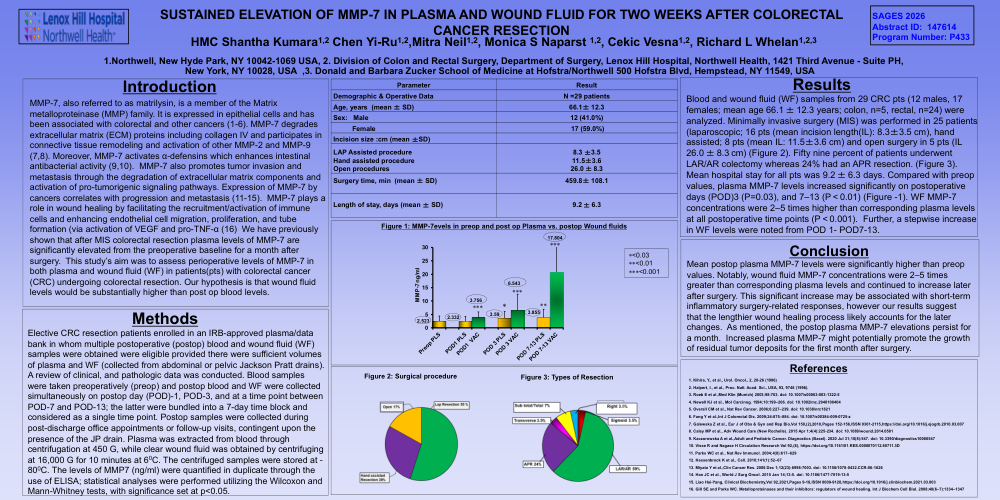
Blood and wound fluid (WF) samples from 29 CRC pts (12 males, 17 females; mean age 66.1 ± 12.3 years; colon, n=5, rectal, n=24) were analyzed. Minimally invasive surgery (MIS) was performed in 25 patients (laparoscopic; 16 pts (mean incision length(IL): 8.3±3.5 cm), hand assisted; 8 pts (mean IL: 11.5±3.6 cm) and open surgery in 5 pts (IL 26.0 ± 8.3 cm) (Figure 2). Fifty nine percent of patients underwent LAR/AR colectomy whereas 24% had an APR resection. (Figure 3). Mean hospital stay for all pts was 9.2 ± 6.3 days. Compared with preop values, plasma MMP-7 levels increased significantly on postoperative days (POD)3 (P=0.03), and 7–13 (P < 0.01) (Figure -1). WF MMP-7 concentrations were 2–5 times higher than corresponding plasma levels at all postoperative time points (P < 0.001). Further, a stepwise increase in WF levels were noted from POD 1- POD7-13.
Conclusion
Mean postop plasma MMP-7 levels were significantly higher than preop values. Notably, wound fluid MMP-7 concentrations were 2–5 times greater than corresponding plasma levels and continued to increase later after surgery. This significant increase may be associated with short-term inflammatory surgery-related responses, however our results suggest that the lengthier wound healing process likely accounts for the later changes. As mentioned, the postop plasma MMP-7 elevations persist for a month. Increased plasma MMP-7 might potentially promote the growth of residual tumor deposits for the first month after surgery.
References
1. Kihira, Y., et al., Urol. Oncol., 2, 20-26 (1996)
2. Halpert, I., et al., Proc. Natl. Acad. Sci., USA, 93, 9748 (1996).
3. Roeb E et al.,Med Klin (Munich) 2003;98:763. doi: 10.1007/s00063-003-1322-5
4. Newell KJ et al., Mol Carcinog. 1994;10:199–206. doi: 10.1002/mc.2940100404
5. Overall CM et al., Nat Rev Cancer. 2006;6:227–239. doi: 10.1038/nrc1821
6. Fang Y et al.,Int J Colorectal Dis. 2009;24:875–884. doi: 10.1007/s00384-009-0725-z
7. Galewska Z et al., Eur J of Obs & Gyn and Rep Bio,Vol 150,(2),2010,Pages 152-156,ISSN 0301-2115,https://doi.org/10.1016/j.ejogrb.2010.03.007
8. Caley MP et al., Adv Wound Care (New Rochelle). 2015 Apr 1;4(4):225-234. doi: 10.1089/wound.2014.0581
9. Kaczorowska A et al.,Adult and Pediatric Cancer. Diagnostics (Basel). 2020 Jul 31;10(8):547. doi: 10.3390/diagnostics10080547
10. Visse R and Nagase H Circulation Research Vol 92,(8), https://doi.org/10.1161/01.RES.0000070112.80711.3D
11. Parks WC et al., Nat Rev Immunol. 2004;4(8):617–629
12. Kessenbrock K et al., Cell. 2010;141(1):52–67
13. Miyata Y et al.,Clin Cancer Res. 2006 Dec 1;12(23):6998-7003. doi: 10.1158/1078-0432.CCR-06-1626
14. Han JC et al., World J Surg Oncol. 2015 Jan 14;13:5. doi: 10.1186/1477-7819-13-5
15. Liao Hai-Yang, Clinical Biochemistry,Vol 92,2021,Pages 9-18,ISSN 0009-9120,https://doi.org/10.1016/j.clinbiochem.2021.03.003
16. Gill SE and Parks WC. Metalloproteinases and their inhibitors: regulators of wound healing. Int J Biochem Cell Biol. 2008;40(6–7):1334–1347