816 posters, 24 topics, 3,314 authors, 1,012 institutions
ePostersLive by SciGen Technologies S.A. All rights reserved.
SAGES 2026 Annual Meeting Emerging Technology Session
March 25-28, 2026 | Tampa, FL, USA

P428
Monthlong plasma elevations of 7 proangiogenic proteins, both early and late peaking, were noted following minimally invasive colorectal cancer resection; these systemic changes have the potential to facilitate the growth of residual tumor deposits
Part of Topic
Colorectal
Introduction
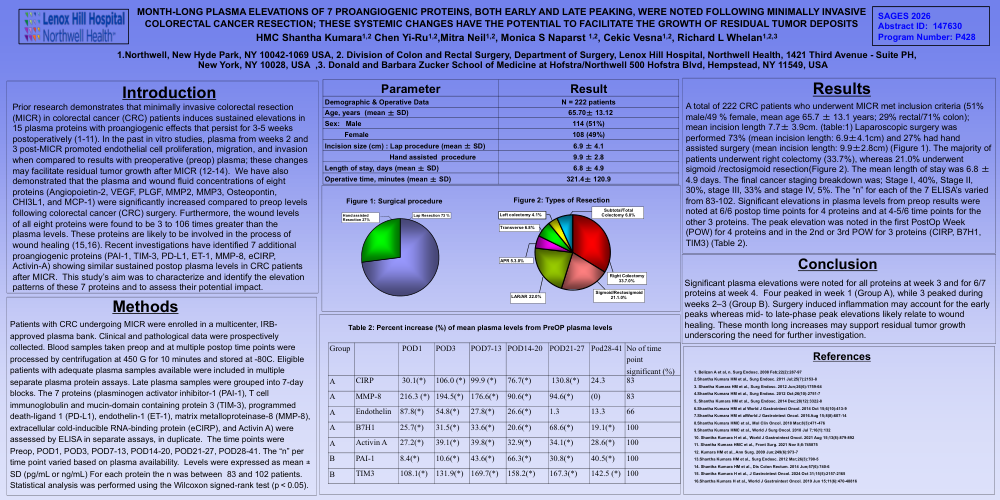
Prior research demonstrates that minimally invasive colorectal resection (MICR) in colorectal cancer (CRC) patients induces sustained elevations in 15 plasma proteins with proangiogenic effects that persist for 3-5 weeks postoperatively (1-11). In the past in vitro studies, plasma from weeks 2 and 3 post-MICR promoted endothelial cell proliferation, migration, and invasion when compared to results with preoperative (preop) plasma; these changes may facilitate residual tumor growth after MICR (12-14). We have also demonstrated that the plasma and wound fluid concentrations of eight proteins (Angiopoietin-2, VEGF, PLGF, MMP2, MMP3, Osteopontin, CHI3L1, and MCP-1) were significantly increased compared to preop levels following colorectal cancer (CRC) surgery. Furthermore, the wound levels of all eight proteins were found to be 3 to 106 times greater than the plasma levels. These proteins are likely to be involved in the process of wound healing (15,16). Recent investigations have identified 7 additional proangiogenic proteins (PAI‑1, TIM‑3, PD‑L1, ET‑1, MMP‑8, eCIRP, Activin‑A) showing similar sustained postop plasma levels in CRC patients after MICR. This study’s aim was to characterize and identify the elevation patterns of these 7 proteins and to assess their potential impact.
Methods
Patients with CRC undergoing MICR were enrolled in a multicenter, IRB-approved plasma bank. Clinical and pathological data were prospectively collected. Blood samples taken preop and at multiple postop time points were processed by centrifugation at 450 G for 10 minutes and stored at -80C. Eligible patients with adequate plasma samples available were included in multiple separate plasma protein assays. Late plasma samples were grouped into 7‑day blocks. The 7 proteins (plasminogen activator inhibitor-1 (PAI-1), T cell immunoglobulin and mucin-domain containing protein 3 (TIM-3), programmed death-ligand 1 (PD-L1), endothelin-1 (ET-1), matrix metalloproteinase-8 (MMP-8), extracellular cold-inducible RNA-binding protein (eCIRP), and Activin A) were assessed by ELISA in separate assays, in duplicate. The time points were Preop, POD1, POD3, POD7-13, POD14-20, POD21-27, POD28-41. The “n” per time point varied based on plasma availability. Levels were expressed as mean ± SD (pg/mL or ng/mL) For each protein the n was between 83 and 102 patients. Statistical analysis was performed using the Wilcoxon signed-rank test (p < 0.05).
Results
A total of 222 CRC patients who underwent MICR met inclusion criteria (51% male/49 % female, mean age 65.7 ± 13.1 years; 29% rectal/71% colon); mean incision length 7.7± 3.9cm. (table:1) Laparoscopic surgery was performed 73% (mean incision length: 6.9±4.1cm) and 27% had hand assisted surgery (mean incision length: 9.9±2.8cm) (Figure 1). The majority of patients underwent right colectomy (33.7%), whereas 21.0% underwent sigmoid /rectosigmoid resection(Figure 2). The mean length of stay was 6.8 ± 4.9 days. The final cancer staging breakdown was; Stage I, 40%, Stage II, 30%, stage III, 33% and stage IV, 5%. The “n” for each of the 7 ELISA’s varied from 83-102. Significant elevations in plasma levels from preop results were noted at 6/6 postop time points for 4 proteins and at 4-5/6 time points for the other 3 proteins. The peak elevation was noted in the first PostOp Week (POW) for 4 proteins and in the 2nd or 3rd POW for 3 proteins (CIRP, B7H1, TIM3) (Table 2).
Conclusion
Significant plasma elevations were noted for all proteins at week 3 and for 6/7 proteins at week 4. Four peaked in week 1 (Group A), while 3 peaked during weeks 2–3 (Group B). Surgery induced inflammation may account for the early peaks whereas mid- to late-phase peak elevations likely relate to wound healing. These month long increases may support residual tumor growth underscoring the need for further investigation.
Table 1: Present (%) increase of mean plasma levels from paired PreOP plasma levels
|
Group |
|
POD1 |
POD3 |
POD7-13 |
POD14-20 |
POD21-27 |
Pod28-41 |
No of time point significant (%) |
|
A |
CIRP |
30.1(*) |
106.0 (*) |
99.9 (*) |
76.7(*) |
130.8(*) |
24.3 |
83 |
|
A |
MMP-8 |
216.3 (*) |
194.5(*) |
176.6(*) |
90.6(*) |
94.6(*) |
(0) |
83 |
|
A |
Endothelin |
87.8(*) |
54.8(*) |
27.8(*) |
26.6(*) |
1.3 |
13.3 |
66 |
|
A |
B7H1 |
25.7(*) |
31.5(*) |
33.6(*) |
20.6(*) |
68.6(*) |
19.1(*) |
100 |
|
A |
Activin A |
27.2(*) |
39.1(*) |
39.8(*) |
32.9(*) |
34.1(*) |
28.6(*) |
100 |
|
B |
PAI-1 |
8.4(*) |
10.6(*) |
43.6(*) |
66.3(*) |
30.8(*) |
40.5(*) |
100 |
|
B |
TIM3 |
108.1(*) |
131.9(*) |
169.7(*) |
158.2(*) |
167.3(*) |
142.5 (*) |
100 |
References
1. Belizon A et al, n. Surg Endosc. 2008 Feb;22(2):287-97
2.Shantha Kumara HM et al., Surg Endosc. 2011 Jul;25(7):2153-8
3. Shantha Kumara HM et al., Surg Endosc. 2012 Jun;26(6):1759-64
4.Shantha Kumara HM et al., Surg Endosc. 2012 Oct;26(10):2751-7
5..Shantha Kumara HM et al., Surg Endosc. 2014 Dec;28(12):3322-8
6.Shantha Kumara HM et al World J Gastrointest Oncol. 2014 Oct 15;6(10):413-9
7.Shantha Kumara HM et alWorld J Gastrointest Oncol. 2016 Aug 15;8(8):607-14
8.Shantha Kumara HMC et al., Mol Clin Oncol. 2018 Mar;8(3):471-476
9.Shantha Kumara HMC et al., World J Surg Oncol. 2018 Jul 7;16(1):132
10. Shantha Kumara H et al., World J Gastrointest Oncol. 2021 Aug 15;13(8):879-892
11. Shantha Kumara HMC et al., Front Surg. 2021 Nov 8;8:745875
12. Kumara HM et al., Ann Surg. 2009 Jun;249(6):973-7
13.Shantha Kumara HM et al., Surg Endosc. 2012 Mar;26(3):790-5
14. Shantha Kumara HM et al., Dis Colon Rectum. 2014 Jun;57(6):740-6
15. Shantha Kumara H et al., J Gastrointest Oncol. 2024 Oct 31;15(5):2157-2165
16.Shantha Kumara H et al., World J Gastrointest Oncol. 2019 Jun 15;11(6):470-48816