816 posters, 24 topics, 3,314 authors, 1,012 institutions
ePostersLive by SciGen Technologies S.A. All rights reserved.
SAGES 2026 Annual Meeting Emerging Technology Session
March 25-28, 2026 | Tampa, FL, USA

P398
Adhesions as an Independent Predictor of Postoperative Ileus Following Robotic Colorectal Cancer Surgery Within an ERAS Protocol
Part of Topic
Colorectal
ADHESIONS AS AN INDEPENDENT PREDICTOR OF POSTOPERATIVE ILEUS FOLLOWING ROBOTIC COLORECTAL CANCER SURGERY WITHIN AN ERAS PROTOCOL
Melik Kagan Aktas, MD; Syed Husain, MBBS; Alessandra C Gasior, DO; Lisa A Cunningham, MD; Matthew F Kalady, MD
Division of Colon and Rectal Surgery, Department of Surgery, The Ohio State University
Introduction
Postoperative ileus (POI) is a common complication after colorectal surgery, even with a robotic approach. Identifying perioperative risk factors is critical for improving patient outcomes. This study investigates clinical and intraoperative predictors of POI in patients undergoing robotic colorectal surgery.
Methods
Results
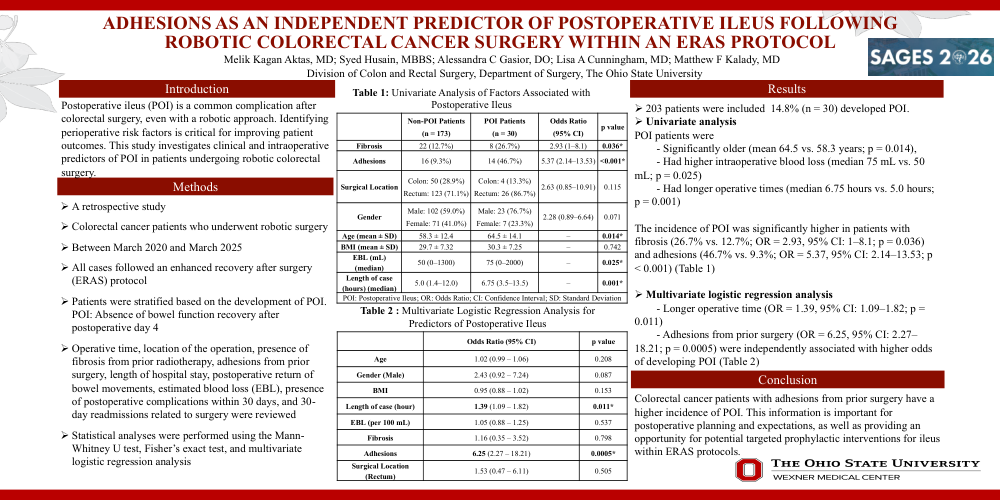
POI patients were
- Significantly older (mean 64.5 vs. 58.3 years; p = 0.014),
- Had higher intraoperative blood loss (median 75 mL vs. 50 mL; p = 0.025)
- Had longer operative times (median 6.75 hours vs. 5.0 hours; p = 0.001)
The incidence of POI was significantly higher in patients with fibrosis (26.7% vs. 12.7%; OR = 2.93, 95% CI: 1–8.1; p = 0.036) and adhesions (46.7% vs. 9.3%; OR = 5.37, 95% CI: 2.14–13.53; p < 0.001) (Table 1)
- Longer operative time (OR = 1.39, 95% CI: 1.09–1.82; p = 0.011)
- Adhesions from prior surgery (OR = 6.25, 95% CI: 2.27–18.21; p = 0.0005) were independently associated with higher odds of developing POI (Table 2)
Conclusion
Colorectal cancer patients with adhesions from prior surgery have a higher incidence of POI. This information is important for postoperative planning and expectations, as well as providing an opportunity for potential targeted prophylactic interventions for ileus within ERAS protocols.
Table 1: Univariate Analysis of Factors Associated with Postoperative Ileus
Table 2 : Multivariate Logistic Regression Analysis for Predictors of Postoperative Ileus