816 posters, 24 topics, 3,314 authors, 1,012 institutions
ePostersLive by SciGen Technologies S.A. All rights reserved.
SAGES 2026 Annual Meeting Emerging Technology Session
March 25-28, 2026 | Tampa, FL, USA

P388
The Wandering Stone: A Rare Culprit of Bowel Obstruction
Poster Presenter
Part of Topic
Biliary
THE WANDERING STONE: A RARE CULPRIT OF BOWEL OBSTRUCTION
Dr Chinmaya Dashᵃ, Dr Vinay Kumar Tripathiᵇ
ᵃDepartment of General Surgery
ᵇDepartment of Surgical Gastroenterology
Command Hospital (Eastern Command), Kolkata, India
PRESENTATION
- 64-year-old male
- Known hypertensive and diabetic
- 4-day history of abdominal pain associated with fever, vomiting and obstipation
EXAMINATION
- Tachycardia
- Elevated blood pressure
- Periumbilical tenderness
INVESTIGATIONS
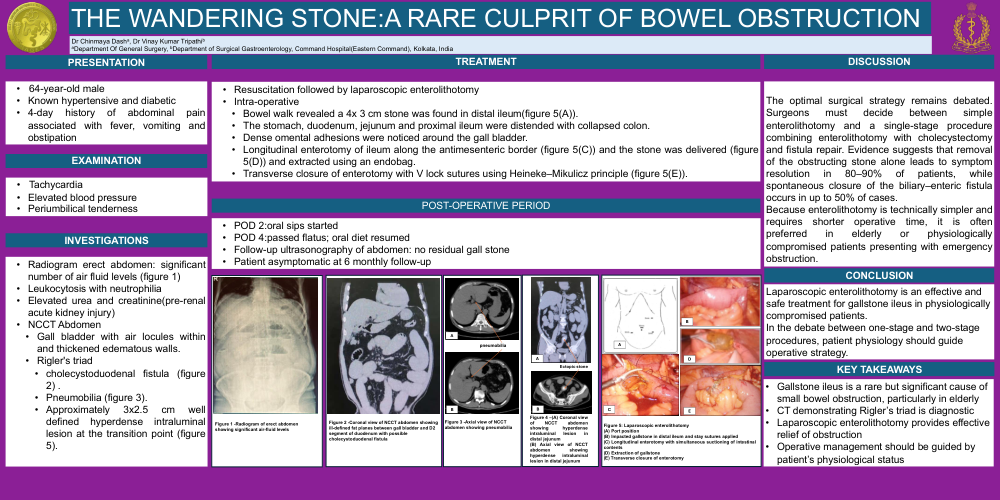
- Radiogram erect abdomen: significant number of air-fluid levels (Figure 1)
- Leukocytosis with neutrophilia
- Elevated urea and creatinine (pre-renal acute kidney injury)
- NCCT Abdomen:
- Gall bladder with air locules within and thickened edematous walls
- Rigler’s triad
- Cholecystoduodenal fistula (Figure 2)
- Pneumobilia (Figure 3)
- Approximately 3 × 2.5 cm well-defined hyperdense intraluminal lesion at the transition point (Figure 5)
TREATMENT
- Resuscitation followed by laparoscopic enterolithotomy
Intra-operative findings
- Bowel walk revealed a 4 × 3 cm stone in distal ileum (Figure 5A)
- Stomach, duodenum, jejunum and proximal ileum were distended with collapsed colon
- Dense omental adhesions around the gall bladder
- Longitudinal enterotomy of ileum along the antimesenteric border (Figure 5C)
- Stone delivered and extracted using an endobag (Figure 5D)
- Transverse closure of enterotomy with V-Loc sutures using Heineke–Mikulicz principle (Figure 5E)
POST-OPERATIVE PERIOD
- POD 2: Oral sips started
- POD 4: Passed flatus; oral diet resumed
- Follow-up ultrasonography abdomen: no residual gallstone
- Patient asymptomatic at 6-month follow-up
DISCUSSION
The optimal surgical strategy remains debated. Surgeons must decide between simple enterolithotomy and a single-stage procedure combining enterolithotomy with cholecystectomy and fistula repair.
Evidence suggests that removal of the obstructing stone alone leads to symptom resolution in 80–90% of patients, while spontaneous closure of the biliary–enteric fistula occurs in up to 50% of cases.
Because enterolithotomy is technically simpler and requires shorter operative time, it is often preferred in elderly or physiologically compromised patients presenting with emergency obstruction.
CONCLUSION
Laparoscopic enterolithotomy is an effective and safe treatment for gallstone ileus in physiologically compromised patients.
In the debate between one-stage and two-stage procedures, patient physiology should guide operative strategy.
KEY TAKEAWAYS
- Gallstone ileus is a rare but significant cause of small bowel obstruction, particularly in elderly patients
- CT demonstrating Rigler’s triad is diagnostic
- Laparoscopic enterolithotomy provides effective relief of obstruction
- Operative management should be guided by patient’s physiological status