816 posters, 24 topics, 3,314 authors, 1,012 institutions
ePostersLive by SciGen Technologies S.A. All rights reserved.
SAGES 2026 Annual Meeting Emerging Technology Session
March 25-28, 2026 | Tampa, FL, USA

P381
Gallstone Ileus as a Delayed Complication Following Pancreaticoduodenectomy: A Rare Cause of Small Bowel Obstruction
Poster Presenter
Part of Topic
Biliary
Gallstone Ileus as a Delayed Complication Following Pancreaticoduodenectomy: A Rare Cause of Small Bowel Obstruction
Julia Alexieva, DO; Samantha Betman, MD; Kristine Makiewicz MD; Gavin Helmi, MS;
Department of Surgery, John H. Stroger Jr., Hospital of Cook County
Introduction
Gallstone ileus is a rare cause of mechanical intestinal obstruction, occurring when gallstones migrate into the gastrointestinal tract, usually via a cholecystoenteric fistula. It accounts for 0.095% of small bowel obstructions (SBO), mostly in elderly women [1]. Though uncommon after pancreaticoduodenectomy, gallstone ileus post-Whipple has been documented a few times in the literature [2,3].
Case Presentation
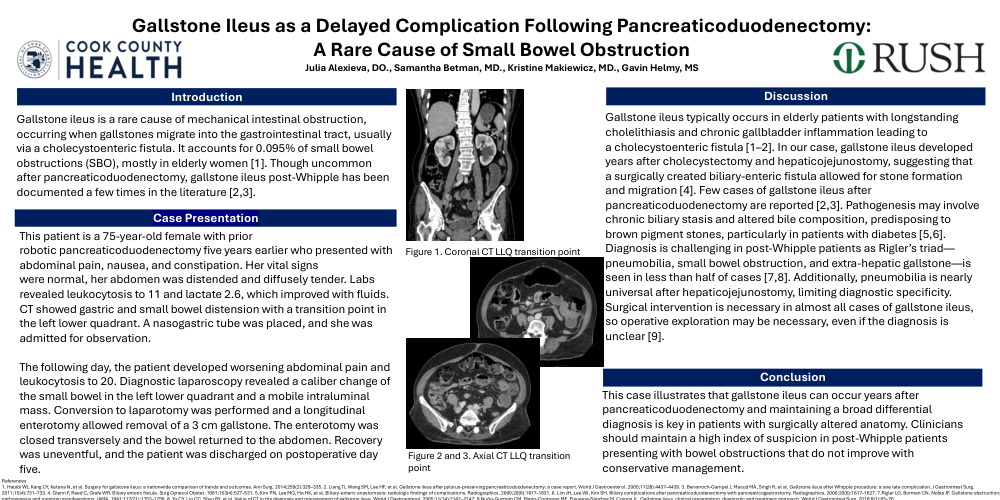
This patient is a 75-year-old female with prior robotic pancreaticoduodenectomy five years earlier who presented with abdominal pain, nausea, and constipation. Her vital signs were normal, her abdomen was distended and diffusely tender. Labs revealed leukocytosis to 11 and lactate 2.6, which improved with fluids. CT showed gastric and small bowel distension with a transition point in the left lower quadrant. A nasogastric tube was placed, and she was admitted for observation.
The following day, the patient developed worsening abdominal pain and leukocytosis to 20. Diagnostic laparoscopy revealed a caliber change of the small bowel in the left lower quadrant and a mobile intraluminal mass. Conversion to laparotomy was performed and a longitudinal enterotomy allowed removal of a 3 cm gallstone. The enterotomy was closed transversely and the bowel returned to the abdomen. Recovery was uneventful, and the patient was discharged on postoperative day five.
Discussion
Gallstone ileus typically occurs in elderly patients with longstanding cholelithiasis and chronic gallbladder inflammation leading to a cholecystoenteric fistula [1–2]. In our case, gallstone ileus developed years after cholecystectomy and hepaticojejunostomy, suggesting that a surgically created biliary-enteric fistula allowed for stone formation and migration [4]. Few cases of gallstone ileus after pancreaticoduodenectomy are reported [2,3]. Pathogenesis may involve chronic biliary stasis and altered bile composition, predisposing to brown pigment stones, particularly in patients with diabetes [5,6]. Diagnosis is challenging in post-Whipple patients as Rigler’s triad—pneumobilia, small bowel obstruction, and extra-hepatic gallstone—is seen in less than half of cases [7,8]. Additionally, pneumobilia is nearly universal after hepaticojejunostomy, limiting diagnostic specificity. Surgical intervention is necessary in almost all cases of gallstone ileus, so operative exploration may be necessary, even if the diagnosis is unclear [9].
Conclusion
This case illustrates that gallstone ileus can occur years after pancreaticoduodenectomy and maintaining a broad differential diagnosis is key in patients with surgically altered anatomy. Clinicians should maintain a high index of suspicion in post-Whipple patients presenting with bowel obstructions that do not improve with conservative management.
References
1. Halabi WJ, Kang CY, Ketana N, et al. Surgery for gallstone ileus: a nationwide comparison of trends and outcomes. Ann Surg. 2014;259(2):329–335.
2. Liang TJ, Wang SM, Lee HF, et al. Gallstone ileus after pylorus-preserving pancreaticoduodenectomy: a case report. World J Gastroenterol. 2005;11(28):4437–4439.
3. Benarroch-Gampel J, Masud MA, Singh R, et al. Gallstone ileus after Whipple procedure: a rare late complication. J Gastrointest Surg. 2011;15(4):731–733.
4. Glenn F, Reed C, Grafe WR. Biliary enteric fistula. Surg Gynecol Obstet. 1981;153(4):527–531.
5. Kim PN, Lee MG, Ha HK, et al. Biliary-enteric anastomosis: radiologic findings of complications. Radiographics. 2000;20(6):1617–1631.
6. Lim JH, Lee WJ, Kim SH. Biliary complications after pancreaticoduodenectomy with pancreaticogastrostomy. Radiographics. 2000;20(6):1617–1627.
7. Rigler LG, Borman CN, Noble JF. Gallstone obstruction: pathogenesis and roentgen manifestations. JAMA. 1941;117(21):1753–1759.
8. Yu CY, Lin CC, Shyu RY, et al. Value of CT in the diagnosis and management of gallstone ileus. World J Gastroenterol. 2005;11(14):2142–2147.
9. Nuño-Guzmán CM, Marín-Contreras ME, Figueroa-Sánchez M, Corona JL. Gallstone ileus, clinical presentation, diagnostic and treatment approach. World J Gastrointest Surg. 2016;8(1):65–76.