816 posters, 24 topics, 3,314 authors, 1,012 institutions
ePostersLive by SciGen Technologies S.A. All rights reserved.
SAGES 2026 Annual Meeting Emerging Technology Session
March 25-28, 2026 | Tampa, FL, USA

P371
Anatomy Matters: Aberrant Biliary Anatomy Identified During Laparoscopic Cholecystectomy
Poster Presenter
Authors
Vaishnavi Kavirayani, Sinong Qian, Megan Nelson, Irving Jorge
Affiliations
Part of Topic
Biliary
Anatomy Matters: Aberrant Biliary Anatomy Identified During Laparoscopic Cholecystectomy
Vaishnavi Kavirayani MBBS, Sinong Qian MB, Megan Nelson MD, Irving Jorge MD
BACKGROUND
Aberrant biliary anatomy, including structures such as the duct of Luschka, accessory hepatic ducts, and subvesical bile ducts, significantly contributes to bile duct injuries during laparoscopic cholecystectomy. Recognizing these anomalies, along with implementing appropriate intraoperative management and postoperative strategies, is crucial for preventing complications.
CASE PRESENTATION
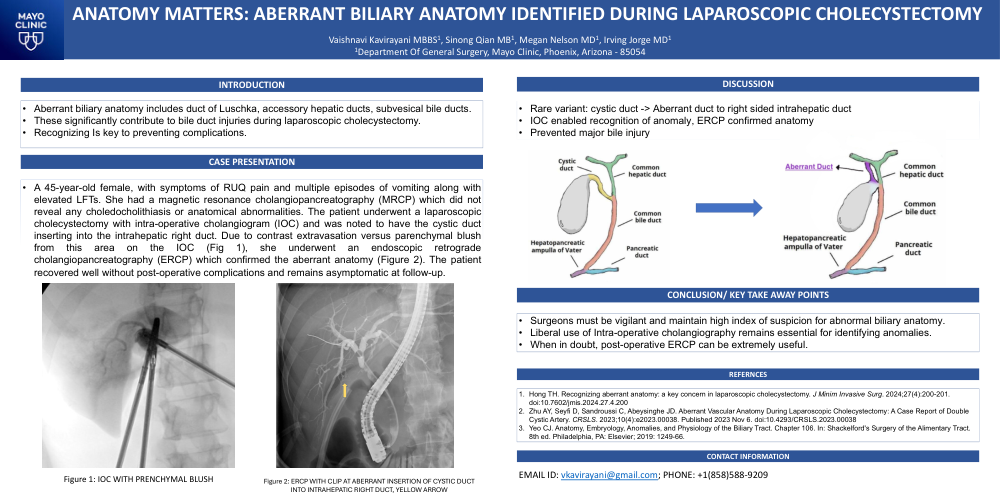
A 45-year-old female presented with symptoms of right upper abdominal pain and multiple episodes of vomiting and elevated liver function tests. She had a magnetic resonance cholangiopancreatography (MRCP) which did not reveal any choledocholithiasis or anatomical abnormalities. The patient underwent a laparoscopic cholecystectomy with intra-operative cholangiogram (IOC) and was noted to have the cystic duct inserting into the intrahepatic right duct. Due to contrast extravasation versus parenchymal blush from this area on the IOC, she underwent an endoscopic retrograde cholangiopancreatography (ERCP) which confirmed the aberrant anatomy. The patient recovered well without post-operative complications and remains asymptomatic at follow-up.
DISCUSSION
This case presents a rare instance of abnormal biliary anatomy identified intra-operatively during cholecystectomy. It emphasizes the need for surgeons to maintain a high level of awareness regarding potential biliary anomalies. The use of IOC and post-op ERCP were crucial in identifying the abnormal duct, which helped prevent a bile duct injury.
CONCLUSION
Surgeons must be vigilant for abnormal biliary anatomy. Liberal use of Intra-operative cholangiography remains essential for identifying such anomalies and guiding a safe surgical plan when the critical view of safety cannot be obtained.