816 posters, 24 topics, 3,314 authors, 1,012 institutions
ePostersLive by SciGen Technologies S.A. All rights reserved.
SAGES 2026 Annual Meeting Emerging Technology Session
March 25-28, 2026 | Tampa, FL, USA

P184
A FULLY-AUTOMATED MACHINE LEARNING-DRIVEN 3D MODEL HELPS PREDICT DIFFICULTY IN ELECTIVE SPLENECTOMY
Poster Presenter
Authors
Affiliations
Part of Topic
Artificial Intelligence
Background: Laparoscopic elective splenectomy (LS) is commonly performed for hematologic disorders, however there is a size threshold above which Open Splenectomy (OS) may offer superior clinical outcomes than a laparoscopic approach. The size threshold at which OS should be considered is not clear. Surgeons typically rely on single-axis, CT-derived measurements of spleen length to guide clinical decision-making. We developed and evaluated a fully automated, machine learning (ML) driven model that created 3D model of the spleen and tested anatomic features that could predict operative difficulty in cases of splenomegaly.
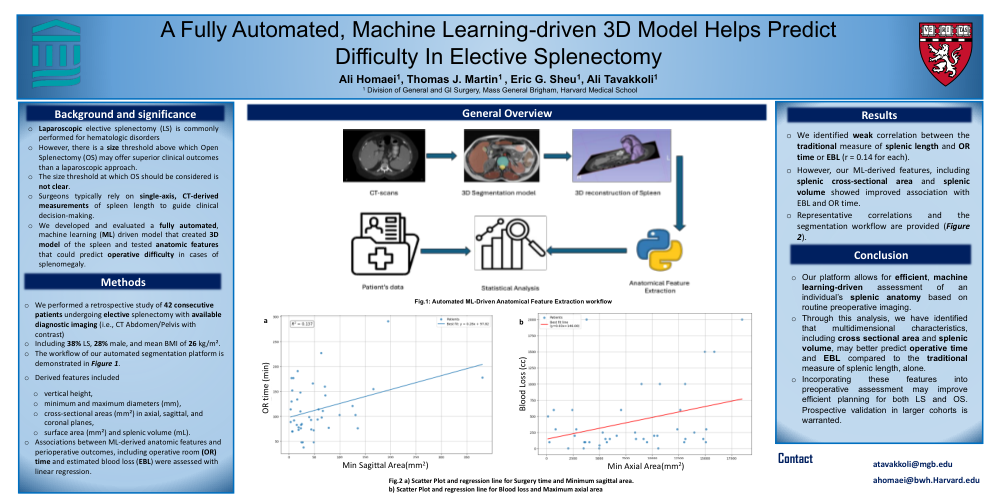
Methods: We performed a retrospective study of 42 consecutive patients undergoing elective splenectomy with available diagnostic imaging (i.e., CT Abdomen/Pelvis with contrast), including 38% LS, 28% male, and mean BMI of 26 kg/m². The workflow of our automated segmentation platform is demonstrated in Figure 1. Derived features included vertical height, minimum and maximum diameters (mm) and cross-sectional areas (mm²) in axial, sagittal, and coronal planes, as well as calculated surface area (mm²) and splenic volume (mL). Associations between ML-derived anatomic features and perioperative outcomes, including operative room (OR) time and estimated blood loss (EBL) were assessed with linear regression.
Results: We identified weak correlation between the traditional measure of splenic length and OR time or EBL (r = 0.14 for each). However, our ML-derived features, including splenic cross-sectional area and splenic volume showed improved association with EBL and OR time. Representative correlations and the segmentation workflow are provided (Figure 2).
Conclusion: Our platform allows for efficient, machine learning-driven assessment of an individual’s splenic anatomy based on routine preoperative imaging. Through this analysis, we have identified that multidimensional characteristics, including cross sectional area and splenic volume, may better predict operative time and EBL compared to the traditional measure of splenic length, alone. Incorporating these features into preoperative assessment may improve efficient planning for both LS and OS. Prospective validation in larger cohorts is warranted.