816 posters, 24 topics, 3,314 authors, 1,012 institutions
ePostersLive by SciGen Technologies S.A. All rights reserved.
SAGES 2026 Annual Meeting Emerging Technology Session
March 25-28, 2026 | Tampa, FL, USA

P182
Artificial Intelligence (AI) as a 'Second Pair of Eyes': Surgeons' Perceptions of Gaze Guidance
Poster Presenter
Part of Topic
Artificial Intelligence
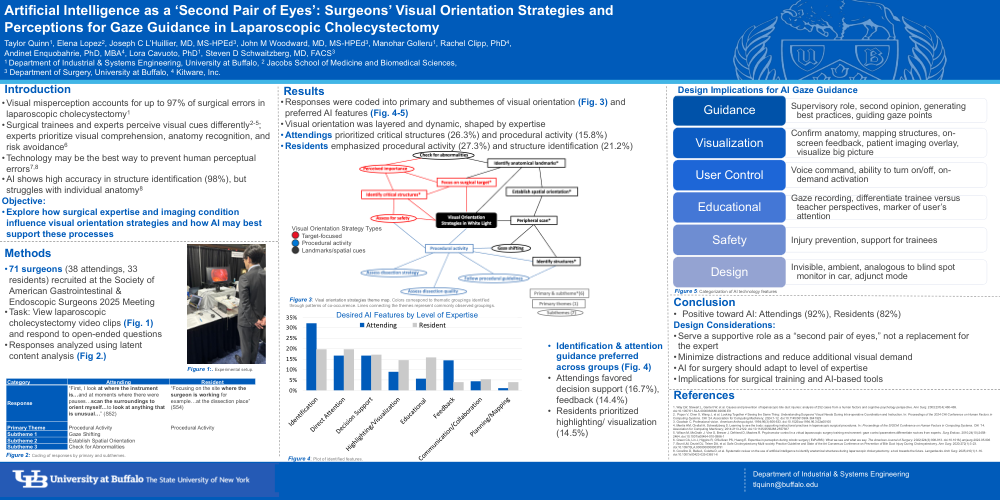
Artificial Intelligence as a ‘Second Pair of Eyes’: Surgeons’ Visual Orientation Strategies and Perceptions for Gaze Guidance in Laparoscopic Cholecystectomy
Introduction: Visual misperception accounts for up to 97% of surgical errors in laparoscopic cholecystectomy1
Surgical trainees and experts perceive visual cues differently2-5; experts prioritize visual comprehension, anatomy recognition, and risk avoidance6
Technology may be the best way to prevent human perceptual errors7,8
AI shows high accuracy in structure identification (98%), but struggles with individual anatomy8
Objective: Explore how surgical expertise and imaging condition influence visual orientation strategies and how AI may best support these processes
Methods: 71 surgeons (38 attendings, 33 residents) recruited at the Society of American Gastrointestinal & Endoscopic Surgeons 2025 Meeting
Task: View laparoscopic cholecystectomy video clips (Fig. 1) and respond to open-ended questions
Responses analyzed using latent content analysis (Fig 2.)
Results: Responses were coded into primary and subthemes of visual orientation (Fig. 3) and preferred AI features (Fig. 4-5)
Visual orientation was layered and dynamic, shaped by expertise. Attendings prioritized critical structures (26.3%) and procedural activity (15.8%).
Residents emphasized procedural activity (27.3%) and structure identification (21.2%). Identification & attention guidance preferred across groups (Fig. 4)
Attendings favored decision support (16.7%), feedback (14.4%). Residents prioritized highlighting/ visualization (14.5%).
Design Considerations: Serve a supportive role as a “second pair of eyes,” not a replacement for the expert. Minimize distractions and reduce additional visual demand. AI for surgery should adapt to level of expertise. Implications for surgical training and AI-based tools