816 posters, 24 topics, 3,314 authors, 1,012 institutions
ePostersLive by SciGen Technologies S.A. All rights reserved.
SAGES 2026 Annual Meeting Emerging Technology Session
March 25-28, 2026 | Tampa, FL, USA

P179
AI TOOLS AND WEIGHT LOSS ACCURACY: MATCHING PROJECTIONS WITH OUTCOMES IN SLEEVE GASTRECTOMY AT 3, 6, 9 AND 12 MONTHS
Poster Presenter
Authors
Amanda Angel Ayala Castillo, Karla D Chavez, Younan Nowzaradan, Julio Cesar Flores Cabrera, Sindya Yadira Castillo Ortiz, Miguel Angel Ayala Castillo
Affiliations
Universidad Anahuac Puebla, Universidad Autónoma de Chihuahua, St. Joseph Medical Center, Tecnológico Nacional de México / Instituto Tecnológico de Iguala
Part of Topic
Artificial Intelligence
AI TOOLS AND WEIGHT LOSS ACCURACY: MATCHING PROJECTIONS WITH OUTCOMES IN SLEEVE GASTRECTOMY AT 3, 6, 9 AND 12 MONTHS
Amanda Angel Ayala Castillo1; Karla D Chavez2; Younan Nowzaradan, MD, FACS, ASMBS3; Julio Cesar Flores Cabrera, Doctor in Administration4; Sindya Yadira Castillo Ortiz, Doctor in Administration4; Miguel Angel Ayala Castillo4; 1Universidad Anahuac Puebla; 2Universidad Autónoma de Chihuahua; 3St. Joseph Medical Center; 4Tecnológico Nacional de México / Instituto Tecnológico de Iguala
INTRODUCTION
- Conversational AI (Artificial Intelligence, ChatGPT), as an adaptive non-linear predictive platform, demonstrates higher accuracy compared to a standardized tool such as the American College of Surgeons (ACS) Bariatric Surgical Risk/Benefit Calculator, in benchmarking postoperative weight loss following sleeve gastrectomy.
- Unlike traditional, static calculators based on population-averaged regression models, AI tools adapt continuously to changes in individuals over time like diet, caloric intake, physical activity, comorbidities, ethnicity, etc. to confidently predict postoperative weight loss at 3, 6, 9, 12 months.
- This is important for effective patient counseling, optimizing follow-up care and managing expectations.
- A retrospective analysis included 22 patients who underwent sleeve gastrectomy (2022-2024), with ≥2 postoperative follow-ups.
- Preoperative data included age, sex, height, weight, and BMI. All received standardized nutrition suggestion (approximately 1200 kcal/day).
- Predictions were generated with two methods: (1) ChatGPT prompts incorporating %EWL benchmarks and (2) the ACS calculator. Predicted weights and BMI were compared with real postoperative outcomes.
- Accuracy was assessed at each timepoint using forecast error metrics, including mean metrics and percentages. Bland-Altman plots were obtained using the Python programming language.
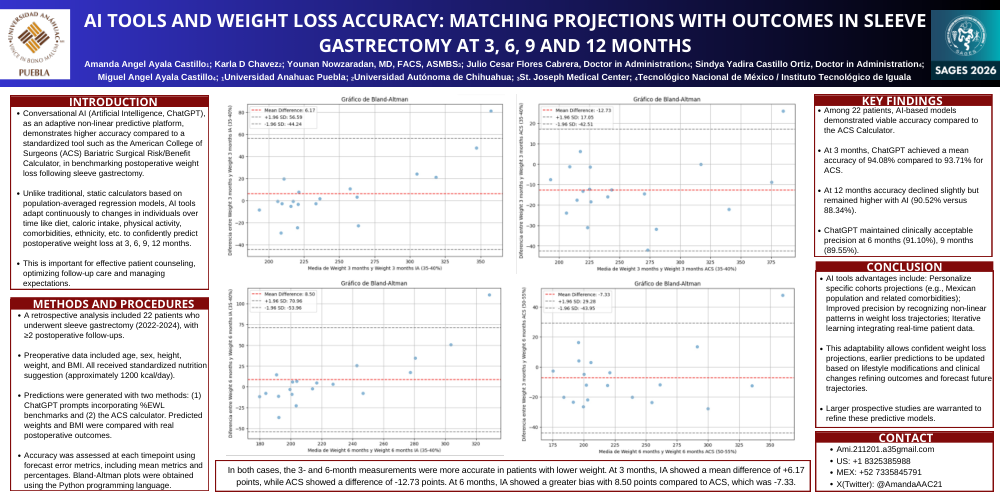
- Among 22 patients, AI-based models demonstrated viable accuracy compared to the ACS Calculator.
- At 3 months, ChatGPT achieved a mean accuracy of 94.08% compared to 93.71% for ACS.
- At 12 months accuracy declined slightly but remained higher with AI (90.52% versus 88.34%).
- ChatGPT maintained clinically acceptable precision at 6 months (91.10%), 9 months (89.55%).
- AI tools advantages include: Personalize specific cohorts projections (e.g., Mexican population and related comorbidities); Improved precision by recognizing non-linear patterns in weight loss trajectories; Iterative learning integrating real-time patient data.
- This adaptability allows confident weight loss projections, earlier predictions to be updated based on lifestyle modifications and clinical changes refining outcomes and forecast future trajectories.
- Larger prospective studies are warranted torefine these predictive models.
- Ami.211201.a35gmail.com
- US: +1 8325385988
- MEX: +52 7335845791
- X(Twitter): @AmandaAAC21