816 posters, 24 topics, 3,314 authors, 1,012 institutions
ePostersLive by SciGen Technologies S.A. All rights reserved.
SAGES 2026 Annual Meeting Emerging Technology Session
March 25-28, 2026 | Tampa, FL, USA

P142
SMALL BOWEL DIVERTICULITIS PRESENTING WITH VOLVULUS AND MASSIVE RESECTION: A CASE REPORT
Poster Presenter
Authors
Rubayet Kamal, Kevin J Herbert, Autumn Pak, Christopher Huffman, Justin Allard, Adrian Dan, Laura Crankshaw
Affiliations
Part of Topic
Acute Care
SMALL BOWEL DIVERTICULITIS PRESENTING WITH VOLVULUS AND MASSIVE RESECTION: A CASE REPORT
Introduction:
Small bowel diverticulosis is a rare, often clinically silent but capable of catastrophic complications such as perforation, bleeding, and volvulus. Volvulus secondary to diverticulitis is exceptionally uncommon, with limited reports in the literature. We present a case of extensive small bowel ischemia due to diverticulitis-associated volvulus requiring multiple resections and bedside re-explorations.
Clinical Presentation:
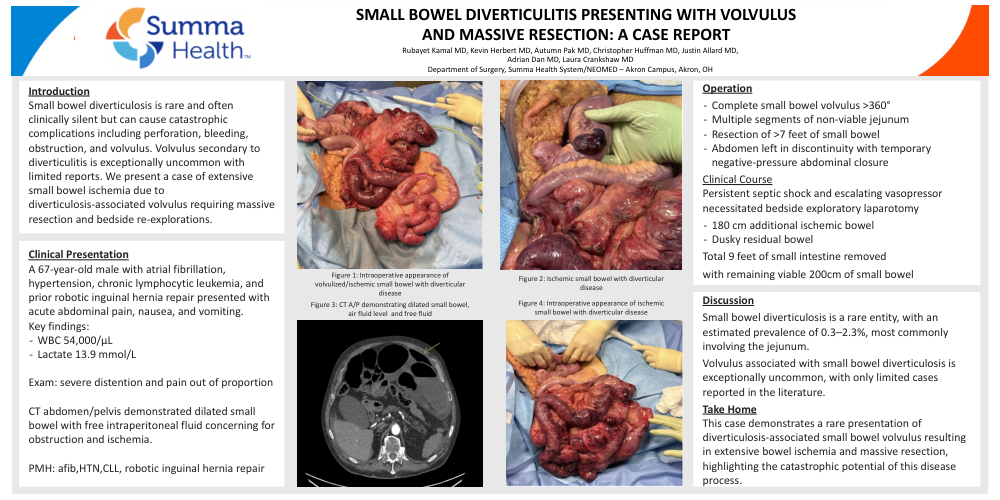
A 67-year-old male with a history of atrial fibrillation, hypertension, chronic lymphocytic leukemia, and robotic inguinal hernia repair presented with acute abdominal pain, nausea, and vomiting. Laboratory evaluation revealed marked leukocytosis (white blood cell count 54,000/µL) and a rising lactic acid level that peaked at 13.9 mmol/L. Computed tomography of the abdomen and pelvis demonstrated dilated small bowel with free intraperitoneal fluid concerning for obstruction and ischemia.
Surgery/Result
The patient underwent emergent exploratory laparotomy, revealing complete small bowel volvulus greater than 360 degrees with ischemic diverticula and multiple segments of nonviable jejunum. Resection of more than seven feet of small bowel was performed, and the abdomen was left in discontinuity with temporary negative-pressure therapy. Persistent septic shock and escalating vasopressor requirements necessitated two subsequent bedside laparotomies in the surgical intensive care unit. An additional 180 cm of ischemic bowel and a jejunal diverticulum were resected. During the third re-exploration, the residual small bowel was dusky with patchy ischemia, and a tense, ischemic-appearing gallbladder required bedside cholecystostomy.
In total, more than nine feet of small intestine were resected, leaving approximately 200 cm of viable small bowel. Despite aggressive fluid resuscitation, broad-spectrum antibiotics, continuous renal replacement therapy, and multi-pressor support, the patient developed refractory septic shock and progressive multiorgan failure. Following multidisciplinary discussions and goals-of-care conversations with the family, care was transitioned to comfort measures.
Conclusion:
Small bowel diverticulitis complicated by volvulus is an exceedingly rare but life-threatening presentation. The combination of diverticular ischemia, volvulus, and massive small bowel resection poses significant surgical and critical care challenges. This case highlights the importance of early recognition, rapid operative intervention, and the role of bedside laparotomy in unstable patients. Even with maximal surgical and critical care support, prognosis remains poor when ischemia is extensive