816 posters, 24 topics, 3,314 authors, 1,012 institutions
ePostersLive by SciGen Technologies S.A. All rights reserved.
SAGES 2026 Annual Meeting Emerging Technology Session
March 25-28, 2026 | Tampa, FL, USA

P124
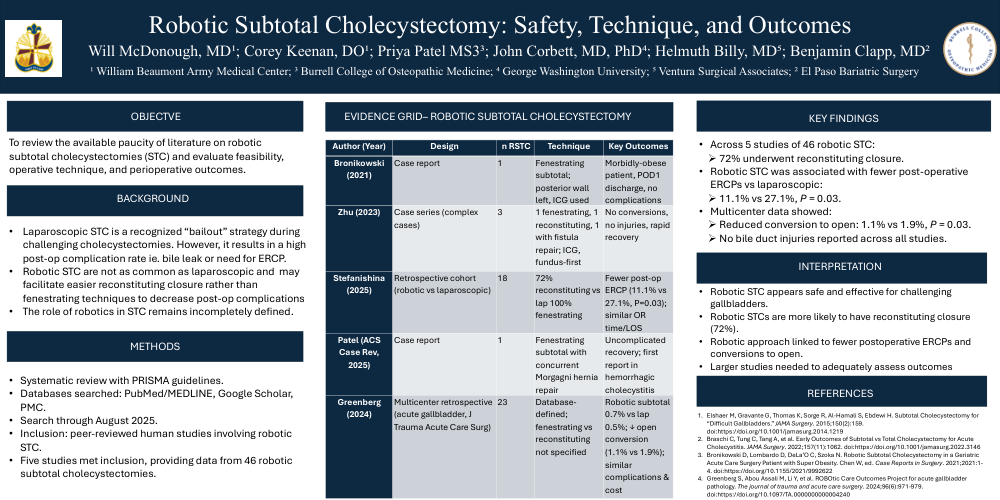
Robotic subtotal cholecystectomies are safe and effective: a systematic review of the literature
Part of Topic
Acute Care
OBJECTVE
To review the available paucity of literature on robotic subtotal cholecystectomies (STC) and evaluate feasibility, operative technique, and perioperative outcomes.
BACKGROUND
• Laparoscopic STC is a recognized “bailout” strategy during challenging cholecystectomies. However, it results in a high post-op complication rate ie. bile leak or need for ERCP.
• Robotic STC are not as common as laparoscopic and may facilitate easier reconstituting closure rather than fenestrating techniques to decrease post-op complications
• The role of robotics in STC remains incompletely defined.
METHODS
• Systematic review with PRISMA guidelines.
• Databases searched: PubMed/MEDLINE, Google Scholar, PMC.
• Search through August 2025.
• Inclusion: peer-reviewed human studies involving robotic STC.
• Five studies met inclusion, providing data from 46 robotic subtotal cholecystectomies.
KEY FINDINGS
• Across 5 studies of 46 robotic STC:
➢ 72% underwent reconstituting closure.
• Robotic STC was associated with fewer post-operative ERCPs vs laparoscopic:
➢ 11.1% vs 27.1%, P = 0.03.
• Multicenter data showed:
➢ Reduced conversion to open: 1.1% vs 1.9%, P = 0.03. ➢ No bile duct injuries reported across all studies.
INTERPRETATION
• Robotic STC appears safe and effective for challenging gallbladders.
• Robotic STCs are more likely to have reconstituting closure (72%).
• Robotic approach linked to fewer postoperative ERCPs and conversions to open.
• Larger studies needed to adequately assess outcomes
REFERENCES
1. Elshaer M, Gravante G, Thomas K, Sorge R, Al-Hamali S, Ebdewi H. Subtotal Cholecystectomy for “Difficult Gallbladders.” JAMA Surgery. 2015;150(2):159. doi:https://doi.org/10.1001/jamasurg.2014.1219
2. Braschi C, Tung C, Tang A, et al. Early Outcomes of Subtotal vs Total Cholecystectomy for Acute Cholecystitis. JAMA Surgery. 2022;157(11):1062. doi:https://doi.org/10.1001/jamasurg.2022.3146
3. Bronikowski D, Lombardo D, DeLa’O C, Szoka N. Robotic Subtotal Cholecystectomy in a Geriatric Acute Care Surgery Patient with Super Obesity. Chen W, ed. Case Reports in Surgery. 2021;2021:1-
4. doi:https://doi.org/10.1155/2021/9992622
4. Greenberg S, Abou Assali M, Li Y, et al. ROBOtic Care Outcomes Project for acute gallbladder pathology. The journal of trauma and acute care surgery. 2024;96(6):971-979. doi:https://doi.org/10.1097/TA.0000000000004240
EVIDENCE GRID– ROBOTIC SUBTOTAL CHOLECYSTECTOMY
|
Author(Year) |
Design |
nRSTC |
Technique |
KeyOutcomes |
|
Bronikowski(2021) |
Casereport |
1 |
Fenestratingsubtotal;posteriorwallleft,ICGused |
Morbidly-obesepatient,POD1discharge,nocomplications |
|
Zhu(2023) |
Caseseries(complexcases) |
3 |
1fenestrating,1reconstituting,1withfistularepair;ICG,fundus-first |
Noconversions,noinjuries,rapidrecovery |
|
Stefanishina(2025) |
Retrospectivecohort(roboticvslaparoscopic) |
18 |
72%reconstitutingvslap100%fenestrating |
Fewerpost-opERCP(11.1%vs27.1%,P=0.03);similarORtime/LOS |
|
Patel(ACSCaseRev,2025) |
Casereport |
1 |
FenestratingsubtotalwithconcurrentMorgagniherniarepair |
Uncomplicatedrecovery;first report in hemorrhagic cholecystitis |
|
Greenberg(2024) |
Multicenterretrospective(acutegallbladder,JTraumaAcuteCareSurg) |
23 |
Database-defined;fenestratingvsreconstitutingnotspecified |
Roboticsubtotal 0.7%vslap 0.5%;↓openconversion(1.1%vs1.9%);similarcomplications&cost |