816 posters, 24 topics, 3,314 authors, 1,012 institutions
ePostersLive by SciGen Technologies S.A. All rights reserved.
SAGES 2026 Annual Meeting Emerging Technology Session
March 25-28, 2026 | Tampa, FL, USA

P118
Clinical Outcomes Following Robotic Appendectomy in Perforated Appendicitis: A Nationwide Analysis
Poster Presenter
Part of Topic
Acute Care
INTRODUCTION
The use of robotic technology in emergency general surgery continues to increase, though its utility remains under-studied. We aimed to compare outcomes in robotic versus non-robotic appendectomy in patients with perforated appendicitis.
METHODS
The 2019 Nationwide Readmissions Database was used to identify patients ≥18 years with perforated appendicitis undergoing appendectomy during index admission. Multivariable logistic regression was used to compare postoperative complications and total charges between robotic and non-robotic appendectomy. Non-surgical complication was defined as any of the following: infectious (sepsis, pneumonia), cardio-respiratory (myocardial infarction, heart failure, respiratory failure), acute kidney injury (AKI), and venous thromboembolism. Composite complications included non-surgical complications as well as surgical site infection, wound dehiscence, and bleeding.
RESULTS
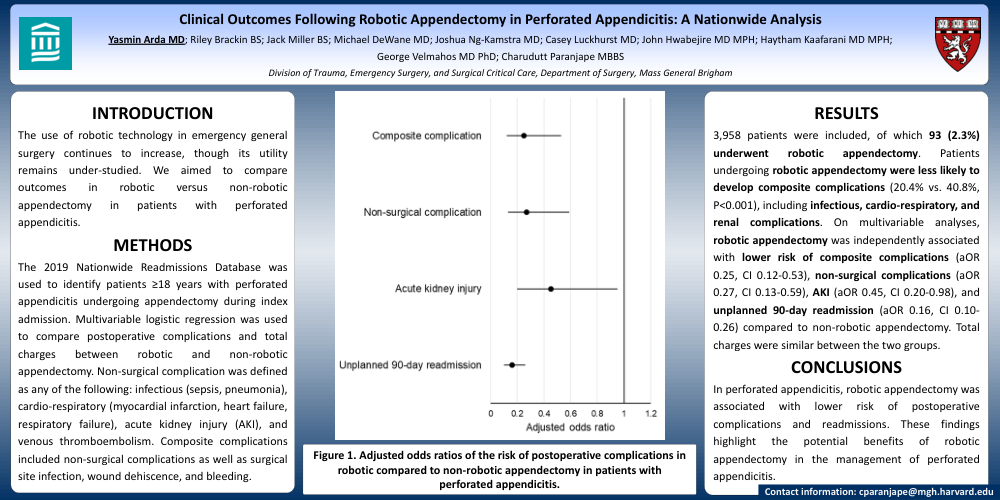
3,958 patients were included, of which 93 (2.3%) underwent robotic appendectomy. Patients undergoing robotic appendectomy were less likely to develop composite complications (20.4% vs. 40.8%, P<0.001), including infectious, cardio-respiratory, and renal complications. On multivariable analyses, robotic appendectomy was independently associated with lower risk of composite complications (aOR 0.25, CI 0.12-0.53), non-surgical complications (aOR 0.27, CI 0.13-0.59), AKI (aOR 0.45, CI 0.20-0.98), and unplanned 90-day readmission (aOR 0.16, CI 0.10-0.26) compared to non-robotic appendectomy. Total charges were similar between the two groups.
CONCLUSIONS
In perforated appendicitis, robotic appendectomy was associated with lower risk of postoperative complications and readmissions. These findings highlight the potential benefits of robotic appendectomy in the management of perforated appendicitis.