816 posters, 24 topics, 3,314 authors, 1,012 institutions
ePostersLive by SciGen Technologies S.A. All rights reserved.
SAGES 2026 Annual Meeting Emerging Technology Session
March 25-28, 2026 | Tampa, FL, USA

P105
Delayed Presentation of Bucket Handle Injury and Morell-Lavallee Lesion after Blunt Abdominal Trauma
Part of Topic
Acute Care
DELAYED PRESENTATION OF BUCKET HANDLE INJURY AND MORELL-LAVALLE LESION AFTER BLUNT ABDOMINAL TRAUMA
•Although blunt abdominal traumas are common, abdominal Morell-Lavallee lesions are a rare occurrence, especially simultaneously with a bucket handle injury.
•Both injuries can be difficult to diagnose early and can be missed during the initial evaluation.
•This case highlights an unusual delayed presentation to emphasize vigilance in evaluating blunt abdominal trauma.
•Patient: 31-year-old male with no PMH, s/p ped struck while riding electric scooter, -HT, -LOC, -AC, VSS, GCS 15.
•Physical exam: right lower extremity deformity, left elbow wound, superficial abdominal abrasions and no other external signs of injury or complaints.
•CT abdomen/pelvis:
•Small volume of intraperitoneal fluid near the sigmoid colon consistent with blood products without definite intra-abdominal injury.
•On hospital day 4, he reported increasing left abdominal pain with persistent tachycardia and leukocytosis.
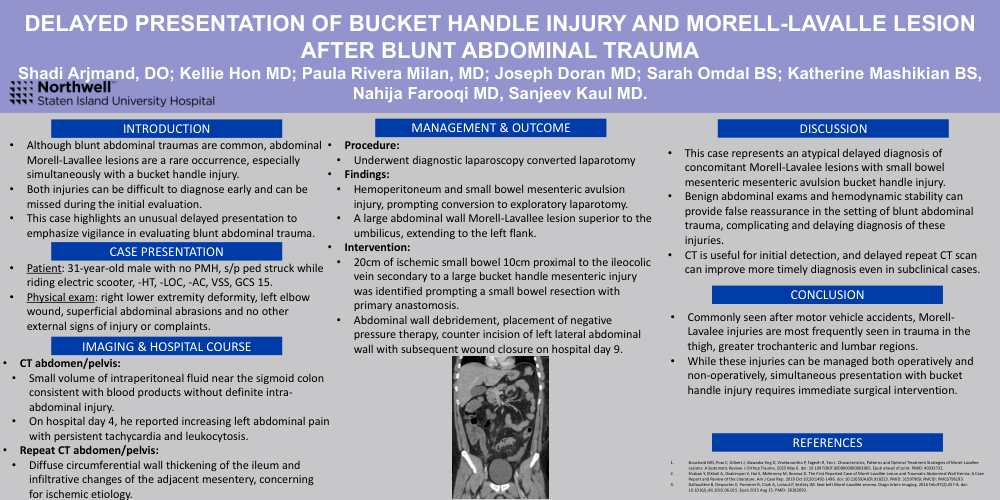
•Repeat CT abdomen/pelvis:
•Diffuse circumferential wall thickening of the ileum and infiltrative changes of the adjacent mesentery, concerning for ischemic etiology.
•Procedure:
•Underwent diagnostic laparoscopy converted laparotomy
•Findings:
•Hemoperitoneum and small bowel mesenteric avulsion injury, prompting conversion to exploratory laparotomy.
•A large abdominal wall Morell-Lavallee lesion superior to the umbilicus, extending to the left flank.
•Intervention:
•20cm of ischemic small bowel 10cm proximal to the ileocolic vein secondary to a large bucket handle mesenteric injury was identified prompting a small bowel resection with primary anastomosis.
•Abdominal wall debridement, placement of negative pressure therapy, counter incision of left lateral abdominal wall with subsequent wound closure on hospital day 9.
•This case represents an atypical delayed diagnosis of concomitant Morell-Lavalee lesions with small bowel mesenteric mesenteric avulsion bucket handle injury.
•Benign abdominal exams and hemodynamic stability can provide false reassurance in the setting of blunt abdominal trauma, complicating and delaying diagnosis of these injuries.
•CT is useful for initial detection, and delayed repeat CT scan can improve more timely diagnosis even in subclinical cases.
•Commonly seen after motor vehicle accidents, Morell-Lavalee injuries are most frequently seen in trauma in the thigh, greater trochanteric and lumbar regions.
•While these injuries can be managed both operatively and non-operatively, simultaneous presentation with bucket handle injury requires immediate surgical intervention.