119 posters, 6 topics, 524 authors, 243 institutions
ePostersLive by SciGen Technologies S.A. All rights reserved.
RCR Global AI Conference 2026
29-30 June, 2026 | QEII Centre, Westminster

44
Whose data, whose ethics? A normative and empirical inquiry into use of patient data for development of AI in radiology
Poster Presenter
Authors
Affiliations
Lahore General Hospital, Eastern Medical Technology Services
Part of Topic
Risk management and compliance: projects around governance, compliance and/or ethics and societal impact
Background:
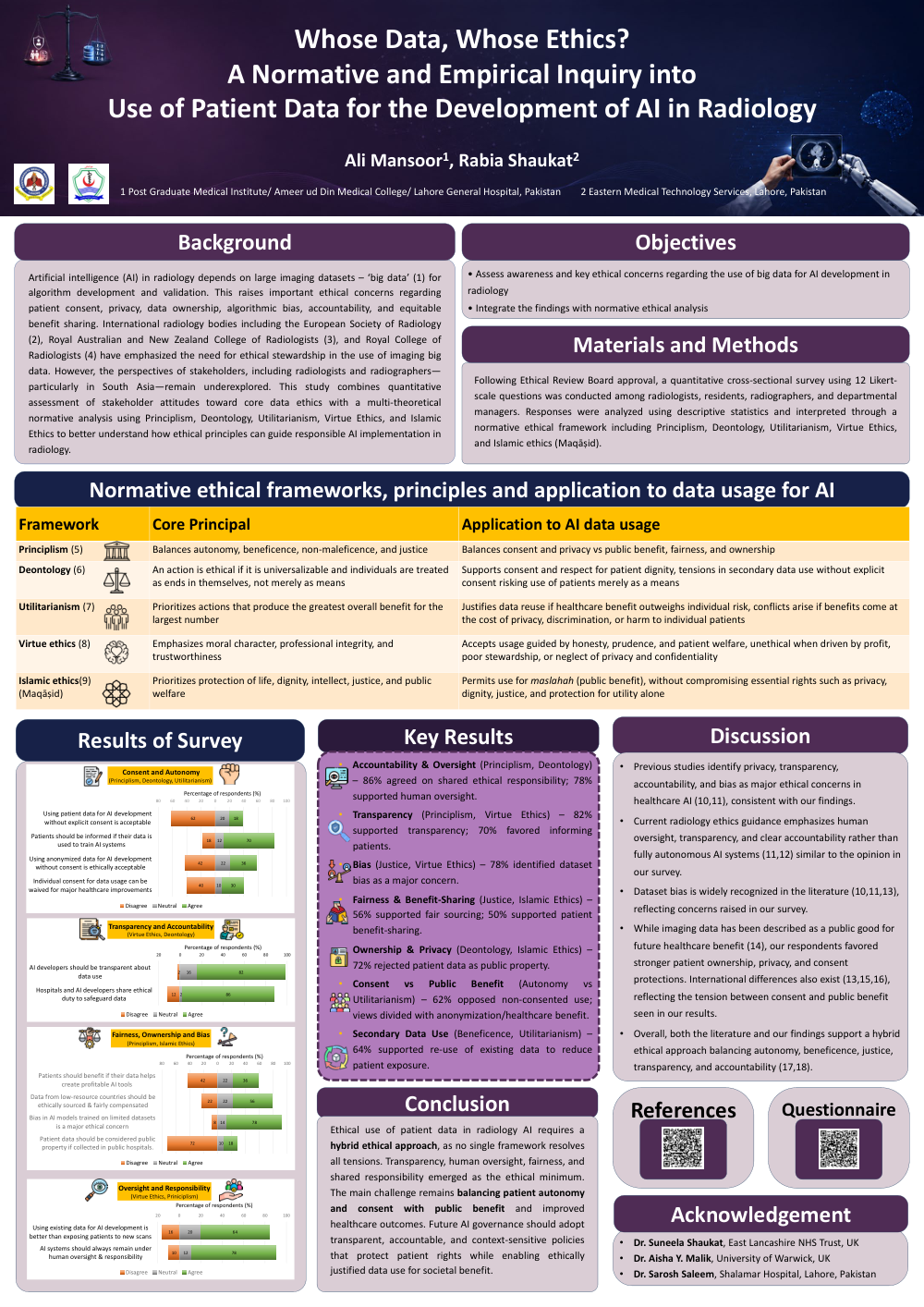
Artificial intelligence (AI) in radiology depends on large imaging datasets – ‘big data’ (1) for algorithm development and validation. This raises important ethical concerns regarding patient consent, privacy, data ownership, algorithmic bias, accountability, and equitable benefit sharing. International radiology bodies including the European Society of Radiology (2), Royal Australian and New Zealand College of Radiologists (3), and Royal College of Radiologists (4) have emphasized the need for ethical stewardship in the use of imaging big data. However, the perspectives of stakeholders, including radiologists and radiographers—particularly in South Asia—remain underexplored. This study combines quantitative assessment of stakeholder attitudes toward core data ethics with a multi-theoretical normative analysis using Principlism, Deontology, Utilitarianism, Virtue Ethics, and Islamic Ethics to better understand how ethical principles can guide responsible AI implementation in radiology.
Objectives:
Assess awareness and key ethical concerns regarding the use of big data for AI development in radiology
Integrate the findings with normative ethical analysis
Materials and Methods:
Following Ethical Review Board approval, a quantitative cross-sectional survey using 12 Likert-scale questions was conducted among radiologists, residents, radiographers, and departmental managers. Responses were analyzed using descriptive statistics and interpreted through a normative ethical framework including Principlism, Deontology, Utilitarianism, Virtue Ethics, and Islamic ethics (Maqāṣid).
Key Results:
Ethical use of patient data in radiology AI requires a hybrid ethical approach, as no single framework resolves all tensions. Transparency, human oversight, fairness, and shared responsibility emerged as the ethical minimum. The main challenge remains balancing patient autonomy and consent with public benefit and improved healthcare outcomes. Future AI governance should adopt transparent, accountable, and context-sensitive policies that protect patient rights while enabling ethically justified data use for societal benefit.