119 posters, 6 topics, 524 authors, 243 institutions
ePostersLive by SciGen Technologies S.A. All rights reserved.
RCR Global AI Conference 2026
29-30 June, 2026 | QEII Centre, Westminster

147
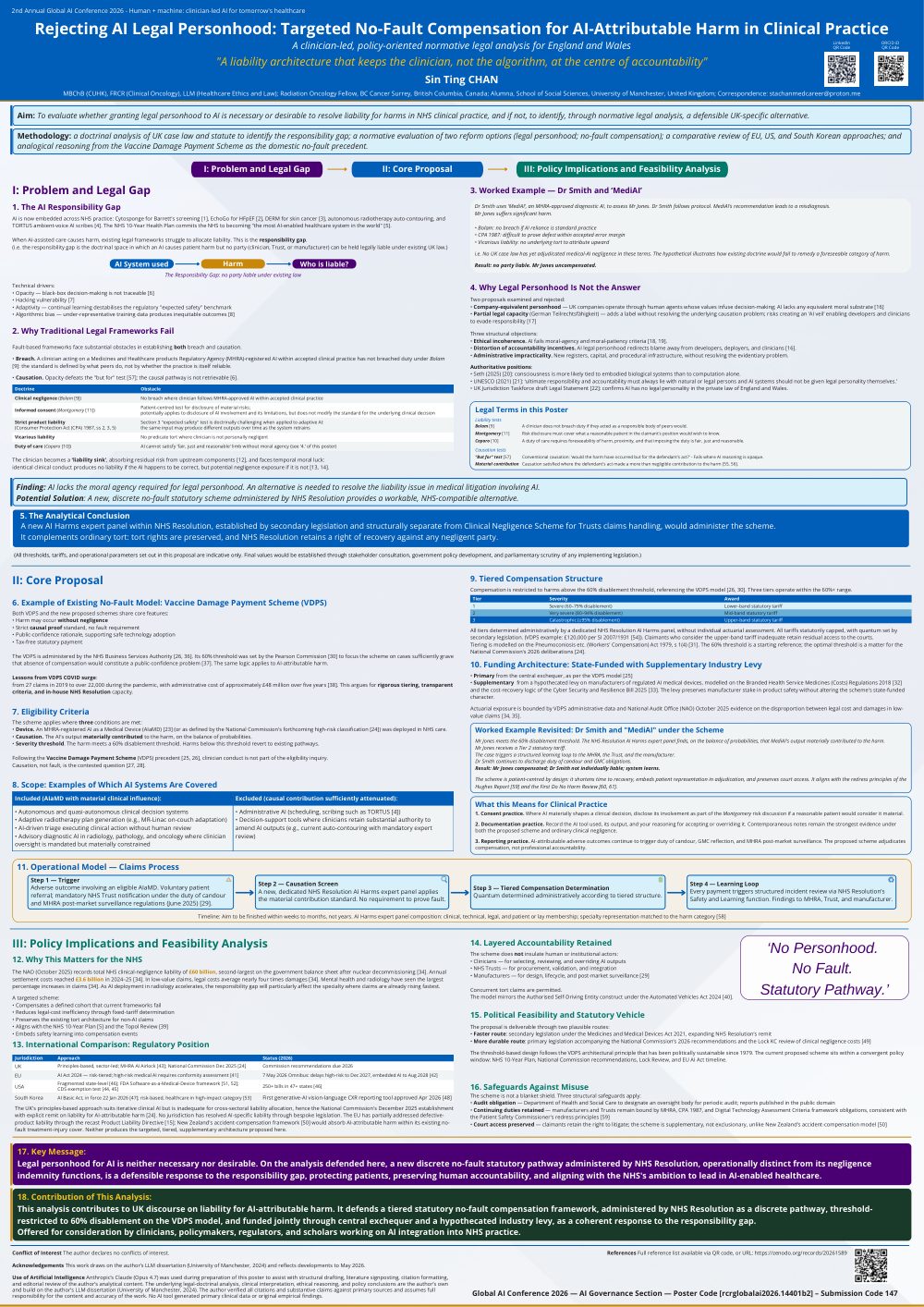
Rejecting AI Legal Personhood: Targeted No-Fault Compensation for AI-Attributable Harm in Clinical Practice
Poster Presenter
Authors
Affiliations
Part of Topic
Risk management and compliance: projects around governance, compliance and/or ethics and societal impact
TITLE
Rejecting AI Legal Personhood: Targeted No-Fault Compensation for AI-Attributable Harm in Clinical Practice
SUBTITLE
A clinician-led, policy-oriented normative legal analysis for England and Wales
TAGLINE
"A liability architecture that keeps the clinician, not the algorithm, at the centre of accountability."
SLOGAN
No Personhood. No Fault. Statutory Pathway.
CONFERENCE
2nd Annual Global AI Conference 2026 — Human + machine: clinician-led AI for tomorrow's healthcare. AI Governance Section. Poster code rcrglobalai2026.14401b2. Submission Code 147.
AUTHOR
Sin Ting CHAN. MBChB (CUHK), FRCR (Clinical Oncology), LLM (Healthcare Ethics and Law). Radiation Oncology Fellow, BC Cancer Surrey, British Columbia, Canada. Alumna, School of Social Sciences, University of Manchester, United Kingdom. Correspondence: stachanmedcareer@proton.me
AIM
To evaluate whether granting legal personhood to AI is necessary or desirable to resolve liability for harms in NHS clinical practice, and if not, to identify, through normative legal analysis, a defensible UK-specific alternative.
METHODOLOGY
A doctrinal analysis of UK case law and statute to identify the responsibility gap; a normative evaluation of two reform options (legal personhood; no-fault compensation); a comparative review of EU, US, and South Korean approaches; and analogical reasoning from the Vaccine Damage Payment Scheme as the domestic no-fault precedent.
PART I — PROBLEM AND LEGAL GAP
1. THE AI RESPONSIBILITY GAP
AI is now embedded across NHS practice: Cytosponge for Barrett's screening, EchoGo for HFpEF, DERM for skin cancer, autonomous radiotherapy auto-contouring, and TORTUS ambient-voice AI scribes. The NHS 10-Year Health Plan commits the NHS to becoming "the most AI-enabled healthcare system in the world". When AI-assisted care causes harm, existing legal frameworks struggle to allocate liability. This is the responsibility gap: the doctrinal space in which an AI causes patient harm but no party (clinician, Trust, or manufacturer) can be held legally liable under existing UK law. Technical drivers: opacity (black-box decision-making is not traceable); hacking vulnerability; adaptivity (continual learning destabilises the regulatory "expected safety" benchmark); algorithmic bias (under-representative training data produces inequitable outcomes).
2. WHY TRADITIONAL LEGAL FRAMEWORKS FAIL
Fault-based frameworks face substantial obstacles in establishing both breach and causation. Breach: a clinician acting on a Medicines and Healthcare products Regulatory Agency (MHRA)-registered AI within accepted clinical practice has not breached duty under Bolam; the standard is defined by what peers do, not by whether the practice is itself reliable. Causation: opacity defeats the "but for" test; the causal pathway is not retrievable. Doctrinal obstacles: Clinical negligence (Bolam) — no breach where clinician follows MHRA-approved AI within accepted clinical practice. Informed consent (Montgomery) — patient-centred test for disclosure of material risks; potentially applies to disclosure of AI involvement and its limitations, but does not modify the standard for the underlying clinical decision. Strict product liability (Consumer Protection Act 1987, sections 2, 3, 5) — Section 3 "expected safety" test is doctrinally challenging when applied to adaptive AI: the same input may produce different outputs over time as the system retrains. Vicarious liability — no predicate tort where clinician is not personally negligent. Duty of care (Caparo) — AI cannot satisfy the 'fair, just and reasonable' limb without moral agency. The clinician becomes a 'liability sink', absorbing residual risk from upstream components, and faces temporal moral luck: identical clinical conduct produces no liability if the AI happens to be correct, but potential negligence exposure if it is not.
LEGAL TERMS IN THIS POSTER
Liability tests: Bolam — a clinician does not breach duty if they acted as a responsible body of peers would. Montgomery — risk disclosure must cover what a reasonable patient in the claimant's position would wish to know. Caparo — a duty of care requires foreseeability of harm, proximity, and that imposing the duty is fair, just and reasonable. Causation tests: "But for" test (Barnett v Chelsea and Kensington Hospital Management Committee) — conventional causation; would the harm have occurred but for the defendant's act? Fails where AI reasoning is opaque. Material contribution (Bonnington Castings Ltd v Wardlaw; Fairchild v Glenhaven Funeral Services Ltd) — causation satisfied where the defendant's act made a more than negligible contribution to the harm.
3. WORKED EXAMPLE — DR SMITH AND 'MEDIAI'
Dr Smith uses 'MediAI', an MHRA-approved diagnostic AI, to assess Mr Jones. Dr Smith follows protocol. MediAI's recommendation leads to a misdiagnosis. Mr Jones suffers significant harm. Bolam: no breach if AI reliance is standard practice. Consumer Protection Act 1987: difficult to prove defect within accepted error margin. Vicarious liability: no underlying tort to attribute upward. Result: no party liable. Mr Jones uncompensated. No UK case law has yet adjudicated medical-AI negligence in these terms.
4. WHY LEGAL PERSONHOOD IS NOT THE ANSWER
Two proposals examined and rejected: Company-equivalent personhood — UK companies operate through human agents whose values infuse decision-making; AI lacks any equivalent moral substrate. Partial legal capacity (German Teilrechtsfähigkeit) — adds a label without resolving the underlying causation problem; risks creating an 'AI veil' enabling developers and clinicians to evade responsibility. Three structural objections: ethical incoherence (AI fails moral-agency and moral-patiency criteria); distortion of accountability incentives (AI legal personhood redirects blame away from developers, deployers, and clinicians); administrative impracticality (new registers, capital, and procedural infrastructure, without resolving the evidentiary problem). Authoritative positions: Seth (2025) — consciousness is more likely tied to embodied biological systems than to computation alone. UNESCO (2021) — "ultimate responsibility and accountability must always lie with natural or legal persons and AI systems should not be given legal personality themselves." UK Jurisdiction Taskforce draft Legal Statement — confirms AI has no legal personality in the private law of England and Wales.
FINDING
AI lacks the moral agency required for legal personhood. An alternative is needed to resolve the liability issue in medical litigation involving AI. A new, discrete no-fault statutory scheme administered by NHS Resolution provides a workable, NHS-compatible alternative.
5. THE ANALYTICAL CONCLUSION
A new AI Harms expert panel within NHS Resolution, established by secondary legislation and structurally separate from Clinical Negligence Scheme for Trusts (CNST) claims handling, would administer the scheme. It complements ordinary tort: tort rights are preserved, and NHS Resolution retains a right of recovery against any negligent party.
PART II — CORE PROPOSAL
6. EXAMPLE OF EXISTING NO-FAULT MODEL: VACCINE DAMAGE PAYMENT SCHEME (VDPS)
Both VDPS and the new proposed scheme share core features: harm may occur without negligence; strict causal proof standard, no fault requirement; public-confidence rationale, supporting safe technology adoption; tax-free statutory payment. The VDPS is administered by the NHS Business Services Authority. Its 60% threshold was set by the Pearson Commission to focus the scheme on cases sufficiently grave that absence of compensation would constitute a public-confidence problem. The same logic applies to AI-attributable harm. Lessons from VDPS COVID surge: from 27 claims in 2019 to over 22,000 during the pandemic, with administrative cost of approximately £48 million over five years. This argues for rigorous tiering, transparent criteria, and in-house NHS Resolution capacity.
7. ELIGIBILITY CRITERIA
The scheme applies where three conditions are met. Device: an MHRA-registered AI as a Medical Device (AIaMD), or as defined by the National Commission's forthcoming high-risk classification, was deployed in NHS care. Causation: the AI's output materially contributed to the harm, on the balance of probabilities. Severity threshold: the harm meets a 60% disablement threshold. Harms below this threshold revert to existing pathways. Following the VDPS precedent, clinician conduct is not part of the eligibility inquiry. Causation, not fault, is the contested question.
8. SCOPE: EXAMPLES OF WHICH AI SYSTEMS ARE COVERED
Included (AIaMD with material clinical influence): autonomous and quasi-autonomous clinical decision systems; adaptive radiotherapy plan generation, for example MR-Linac on-couch adaptation; AI-driven triage executing clinical action without human review; advisory diagnostic AI in radiology, pathology, and oncology where clinician oversight is mandated but materially constrained. Excluded (causal contribution sufficiently attenuated): administrative AI (scheduling, scribing such as TORTUS); decision-support tools where clinicians retain substantial authority to amend AI outputs, for example current auto-contouring with mandatory expert review.
9. TIERED COMPENSATION STRUCTURE
Compensation is restricted to harms above the 60% disablement threshold, referencing the VDPS model. Three tiers operate within the 60%-plus range. Tier 1: severe (60–79% disablement), lower-band statutory tariff. Tier 2: very severe (80–94% disablement), mid-band statutory tariff. Tier 3: catastrophic (≥95% disablement), upper-band statutory tariff. All tiers determined administratively by a dedicated NHS Resolution AI Harms expert panel, without individual actuarial assessment. All tariffs statutorily capped, with quantum set by secondary legislation (VDPS example: £120,000 per Statutory Instrument 2007/1931). Claimants who consider the upper-band tariff inadequate retain residual access to the courts. Tiering is modelled on the Pneumoconiosis etc. (Workers' Compensation) Act 1979, section 1(4). The 60% threshold is a starting reference; the optimal threshold is a matter for the National Commission's 2026 deliberations.
10. FUNDING ARCHITECTURE: STATE-FUNDED WITH SUPPLEMENTARY INDUSTRY LEVY
Primary from the central exchequer, as per the VDPS model. Supplementary from a hypothecated levy on manufacturers of regulated AI medical devices, modelled on the Branded Health Service Medicines (Costs) Regulations 2018 and the cost-recovery logic of the Cyber Security and Resilience Bill 2025. The levy preserves manufacturer stake in product safety without altering the scheme's state-funded character. Actuarial exposure is bounded by VDPS administrative data and National Audit Office (October 2025) evidence on the disproportion between legal cost and damages in low-value claims.
11. OPERATIONAL MODEL — CLAIMS PROCESS
Step 1 — Trigger: adverse outcome involving an eligible AIaMD. Voluntary patient referral; mandatory NHS Trust notification under the duty of candour and MHRA post-market surveillance regulations (June 2025). Step 2 — Causation Screen: a new, dedicated NHS Resolution AI Harms expert panel applies the material contribution standard. No requirement to prove fault. Step 3 — Tiered Compensation Determination: quantum determined administratively according to tiered structure. Step 4 — Learning Loop: every payment triggers structured incident review via NHS Resolution's Safety and Learning function. Findings to MHRA, Trust, and manufacturer. Timeline: aim to be finished within weeks to months, not years. AI Harms expert panel composition: clinical, technical, legal, and patient or lay membership; specialty representation matched to the harm category.
WORKED EXAMPLE REVISITED — DR SMITH AND 'MEDIAI' UNDER THE SCHEME
Mr Jones meets the 60% disablement threshold. The NHS Resolution AI Harms expert panel finds, on the balance of probabilities, that MediAI's output materially contributed to the harm. Mr Jones receives a Tier 2 statutory tariff. The case triggers a structured learning loop to the MHRA, the Trust, and the manufacturer. Dr Smith continues to discharge duty of candour and GMC obligations. Result: Mr Jones compensated; Dr Smith not individually liable; system learns. The scheme is patient-centred by design: it shortens time to recovery, embeds patient representation in adjudication, and preserves court access. It aligns with the redress principles of the Hughes Report and the First Do No Harm Review.
PART III — POLICY IMPLICATIONS AND FEASIBILITY ANALYSIS
12. WHY THIS MATTERS FOR THE NHS
The National Audit Office (October 2025) records total NHS clinical-negligence liability of £60 billion, second-largest on the government balance sheet after nuclear decommissioning. Annual settlement costs reached £3.6 billion in 2024–25. In low-value claims, legal costs average nearly four times damages. Mental health and radiology have seen the largest percentage increases in claims. As AI deployment in radiology accelerates, the responsibility gap will particularly affect the specialty where claims are already rising fastest. A targeted scheme compensates a defined cohort that current frameworks fail; reduces legal-cost inefficiency through fixed-tariff determination; preserves the existing tort architecture for non-AI claims; aligns with the NHS 10-Year Plan and the Topol Review; embeds safety learning into compensation events.
13. INTERNATIONAL COMPARISON: REGULATORY POSITION
UK: principles-based, sector-led; MHRA AI Airlock; National Commission established December 2025. Commission's recommendations due 2026. EU: AI Act 2024, risk-tiered; high-risk medical AI requires conformity assessment. 7 May 2026 Omnibus delays high-risk to 2 December 2027, embedded AI to 2 August 2028. USA: fragmented state-level; FDA Software-as-a-Medical-Device framework; Clinical Decision Support exemption test. Over 250 bills under consideration in 47-plus states. South Korea: AI Basic Act, in force 22 January 2026; risk-based, healthcare in high-impact category. First generative-AI vision-language CXR reporting tool approved April 2026. The UK's principles-based approach suits iterative clinical AI but is inadequate for cross-sectoral liability allocation, hence the National Commission's December 2025 establishment with explicit remit on liability for AI-attributable harm. No jurisdiction has resolved AI-specific liability through bespoke legislation. The EU has partially addressed defective-product liability through the recast Product Liability Directive (Directive (EU) 2024/2853); New Zealand's accident-compensation framework would absorb AI-attributable harm within its existing no-fault treatment-injury cover. Neither produces the targeted, tiered, supplementary architecture proposed here.
14. LAYERED ACCOUNTABILITY RETAINED
The scheme does not insulate human or institutional actors. Clinicians remain accountable for selecting, reviewing, and overriding AI outputs. NHS Trusts remain accountable for procurement, validation, and integration. Manufacturers remain accountable for design, lifecycle, and post-market surveillance. Concurrent tort claims are permitted. The model mirrors the Authorised Self-Driving Entity construct under the Automated Vehicles Act 2024.
WHAT THIS MEANS FOR CLINICAL PRACTICE
Consent practice: where AI materially shapes a clinical decision, disclose its involvement as part of the Montgomery risk discussion if a reasonable patient would consider it material. Documentation practice: record the AI tool used, its output, and your reasoning for accepting or overriding it. Contemporaneous notes remain the strongest evidence under both the proposed scheme and ordinary clinical negligence. Reporting practice: AI-attributable adverse outcomes continue to trigger duty of candour, GMC reflection, and MHRA post-market surveillance. The proposed scheme adjudicates compensation, not professional accountability.
15. POLITICAL FEASIBILITY AND STATUTORY VEHICLE
The proposal is deliverable through two plausible routes. Faster route: secondary legislation under the Medicines and Medical Devices Act 2021, expanding NHS Resolution's remit. More durable route: primary legislation accompanying the National Commission's 2026 recommendations and the Lock KC review of clinical negligence costs. The threshold-based design follows the VDPS architectural principle that has been politically sustainable since 1979. The current proposed scheme sits within a convergent policy window: NHS 10-Year Plan, National Commission recommendations, Lock Review, and EU AI Act timeline.
16. SAFEGUARDS AGAINST MISUSE
The scheme is not a blanket shield. Three structural safeguards apply. Audit obligation: Department of Health and Social Care to designate an oversight body for periodic audit; reports published in the public domain. Continuing duties retained: manufacturers and Trusts remain bound by MHRA, Consumer Protection Act 1987, and Digital Technology Assessment Criteria framework obligations, consistent with the Patient Safety Commissioner's redress principles. Court access preserved: claimants retain the right to litigate; the scheme is supplementary, not exclusionary, unlike New Zealand's accident-compensation model.
17. KEY MESSAGE
Legal personhood for AI is neither necessary nor desirable. On the analysis defended here, a new discrete no-fault statutory pathway administered by NHS Resolution, operationally distinct from its negligence indemnity functions, is a defensible response to the responsibility gap, protecting patients, preserving human accountability, and aligning with the NHS's ambition to lead in AI-enabled healthcare.
18. CONTRIBUTION OF THIS ANALYSIS
This analysis contributes to UK discourse on liability for AI-attributable harm. It defends a tiered statutory no-fault compensation framework, administered by NHS Resolution as a discrete pathway, threshold-restricted to 60% disablement on the VDPS model, and funded jointly through central exchequer and a hypothecated industry levy, as a coherent response to the responsibility gap. Offered for consideration by clinicians, policymakers, regulators, and scholars working on AI integration into NHS practice.
PROVISO
All thresholds, tariffs, and operational parameters set out in this proposal are indicative only. Final values would be established through stakeholder consultation, government policy development, and parliamentary scrutiny of any implementing legislation.
CONFLICT OF INTEREST
The author declares no conflicts of interest.
ACKNOWLEDGEMENTS
This work draws on the author's LLM dissertation (University of Manchester, 2024) and reflects developments to May 2026.
USE OF ARTIFICIAL INTELLIGENCE
Anthropic's Claude (Opus 4.7) was used during preparation of this poster to assist with structural drafting, literature signposting, citation formatting, and editorial review of the author's analytical content. The underlying legal-doctrinal analysis, clinical interpretation, ethical reasoning, and policy conclusions are the author's own and build on the author's LLM dissertation (University of Manchester, 2024). The author verified all citations and substantive claims against primary sources and assumes full responsibility for the content and accuracy of the work. No AI tool generated primary clinical data or original empirical findings.
REFERENCES
Full reference list (61 sources, Vancouver style) available via QR code or at https://zenodo.org/records/20261589
KEYWORDS
AI legal personhood; artificial intelligence in healthcare; medical artificial intelligence; AI as a Medical Device; AIaMD; clinical negligence; no-fault compensation; tiered statutory compensation; NHS Resolution; Clinical Negligence Scheme for Trusts; CNST; responsibility gap; liability sink; temporal moral luck; Vaccine Damage Payment Scheme; VDPS; product liability; Consumer Protection Act 1987; Bolam test; Montgomery v Lanarkshire Health Board; Caparo Industries v Dickman; Bonnington Castings v Wardlaw; Fairchild v Glenhaven; Barnett v Chelsea and Kensington; but-for test; material contribution; Teilrechtsfähigkeit; partial legal capacity; UK Jurisdiction Taskforce; LawtechUK; Hughes Report; First Do No Harm Review; Cumberlege Review; Patient Safety Commissioner; Pearson Commission; Pneumoconiosis Workers Compensation Act 1979; Branded Health Service Medicines Costs Regulations 2018; Cyber Security and Resilience Bill 2025; cost recovery; hypothecated levy; Automated Vehicles Act 2024; Authorised Self-Driving Entity; Medicines and Medical Devices Act 2021; Medicines and Healthcare products Regulatory Agency; MHRA; MHRA AI Airlock; post-market surveillance; Software and AI as a Medical Device Change Programme; National Commission into the Regulation of AI in Healthcare; Topol Review; Lock Review of clinical negligence costs; National Audit Office; Cytosponge; EchoGo; DERM; TORTUS; ambient voice AI; clinical decision support; CDS; radiation oncology; SBRT; MR-Linac; auto-contouring; adaptive radiotherapy; oncology; radiology; pathology; algorithmic bias; black-box AI; opacity; adaptivity; informed consent; duty of candour; GMC reflection; Digital Technology Assessment Criteria; EU AI Act; Regulation (EU) 2024/1689; Product Liability Directive; Directive (EU) 2024/2853; AI Liability Directive; FDA Software-as-a-Medical-Device; 21st Century Cures Act; South Korea AI Basic Act; Framework Act on the Development of Artificial Intelligence; New Zealand ACC; accident compensation; treatment injury; Vancouver citation; OSCOLA; doctrinal analysis; normative legal analysis; comparative law; healthcare ethics and law; NHS 10-Year Health Plan; UK statutory law; secondary legislation; primary legislation; rcrglobalai2026.