2,281 posters, 63 videos, 56 audios, 43 topics, 18 sessions, 6,174 authors, 2,323 institutions
ePostersLive by SciGen Technologies S.A. All rights reserved.
RCOG World Congress 2025
June 23 - 25, 2025 | ExCeL London, UK
EP.1004
The performance of ASPRE based screening in routine clinical practice.
Poster Presenter
Authors
Affiliations
Part of Topic
High risk pregnancy
The performance of ASPRE based screening in routine clinical practice.
Teddy Golob and Ramesh Ganapathy – Epsom and St Helier NHS trust, London UK.
Objective:
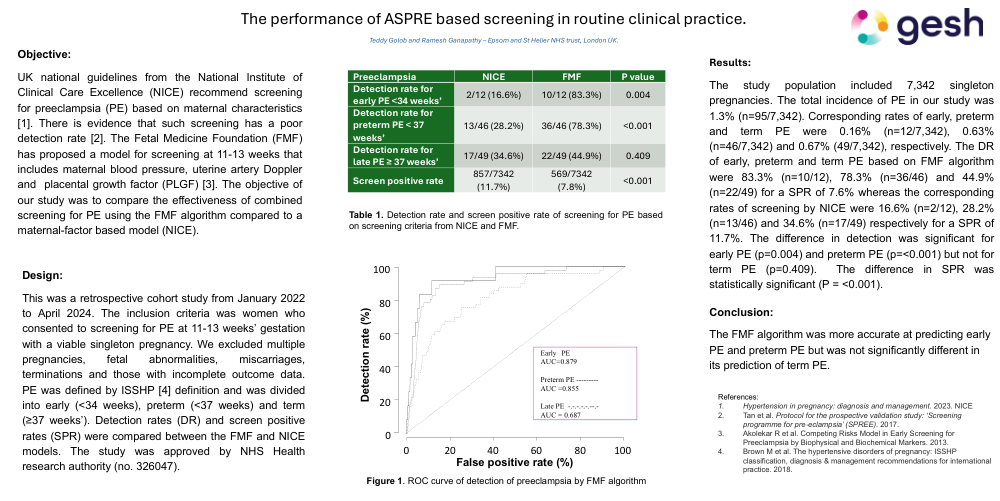
UK national guidelines from the National Institute of Clinical Care Excellence(NICE) recommend screening for preeclampsia (PE) based on maternal characteristics [1]. There is evidence that such screening has a poor detection rate [2]. The FetalMedicine Foundation (FMF) has proposed a model for screening at 11-13 weeks that includes maternal blood pressure, uterine artery Doppler and placental growth factor (PLGF) [3]. The objective of our study was to compare the effectiveness of combined screening for PE using the FMF algorithm compared to a maternal-factor based model (NICE).
Design:
This was a retrospective cohort study from January2022 to April 2024. The inclusion criteria was women who consented to screening for PE at 11-13 weeks’ gestation with a viable singleton pregnancy. We excluded multiple pregnancies, fetalabnormalities, miscarriages, terminations and those with incomplete outcome data. PE was defined by ISSHP [4] definition and was divided into early (<34 weeks), preterm (<37 weeks) and term (≥37 weeks’). Detectionrates (DR) and screen positive rates (SPR) were compared between the FMF and NICE models. The study was approved by NHS Health research authority (no. 326047).
Conclusion:
The FMF algorithm was more accurate at predicting early PE and preterm PE but was not significantly different in its prediction of term PE.
References: