2,281 posters, 63 videos, 56 audios, 43 topics, 18 sessions, 6,174 authors, 2,323 institutions
ePostersLive by SciGen Technologies S.A. All rights reserved.
RCOG World Congress 2025
June 23 - 25, 2025 | ExCeL London, UK
EP.0875
Unmasking the Enigma: A Case Study of Struma Ovary
Poster Presenter
Authors
Affiliations
Part of Topic
High risk pregnancy
Case report
Objective
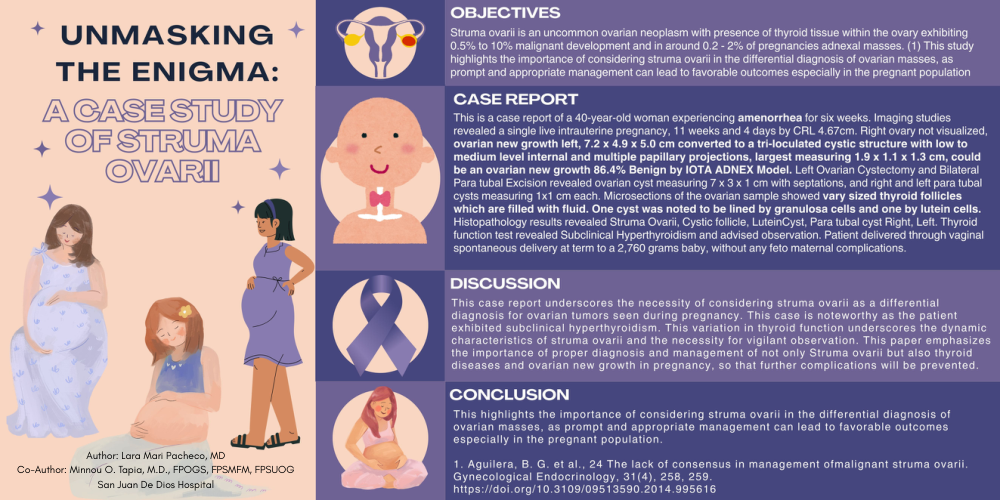
Struma ovarii is an uncommon ovarian neoplasm with presence ofthyroid tissue within the ovary exhibiting 0.5% to 10% malignant developmentand in around 0.2 - 2% of pregnancies adnexal masses. (1) This study highlights the importance of considering struma ovarii in the differential diagnosis of ovarian masses, as prompt and appropriate management can lead to favorable outcomes especially in the pregnant population.
Case Report
This is a case report of a 40-year-old woman experiencing amenorrhea for six weeks. Imaging studies revealed a single live intrauterine pregnancy, 11 weeks and 4 days by CRL 4.67cm. Right ovary not visualized, ovarian new growth left, 7.2 x 4.9 x 5.0 cm converted to a tri-loculated cystic structure with low to medium level internal and multiple papillary projections, largest measuring 1.9 x 1.1 x 1.3 cm, could be an ovarian new growth 86.4% Benign by IOTA ADNEX Model. Left Ovarian Cystectomy and Bilateral Para tubal Excisionrevealed ovarian cyst measuring 7 x 3 x 1 cm with septations, and right andleft para tubal cysts measuring 1x1 cm each. Microsections of the ovariansample showed vary sized thyroid follicles which are filled with fluid. One cyst was noted to be lined by granulosa cells and one by luteincells. Histopathology results revealed Struma Ovarii, Cystic follicle, LuteinCyst, Para tubal cyst Right, Left. Thyroid function test revealed SubclinicalHyperthyroidism and advised observation. Patient delivered through vaginalspontaneous delivery at term to a 2,760 grams baby, without any feto maternal complications.
Discussion
This case report underscores the necessity of considering struma ovarii as a differential diagnosis for ovarian tumors seen during pregnancy. This case is noteworthy as the patient exhibited subclinical hyperthyroidism. This variation in thyroid function underscores the dynamic characteristics of struma ovarii and the necessity for vigilant observation. This paper emphasizes the importance of proper diagnosis and management of not only Struma ovarii but also thyroid diseases and ovarian new growth in pregnancy, so that further complications will be prevented.
Conclusions
This highlights the importance of considering struma ovarii in the differential diagnosis of ovarian masses, as prompt and appropriate management can lead to favorable outcomes especially in the pregnant population.
1. Aguilera, B. G. et al., 24 The lack of consensus in management ofmalignant struma ovarii. Gynecological Endocrinology, 31(4), 258, 259. https://doi.org/10.3109/09513590.2014.995616