2,281 posters, 63 videos, 56 audios, 43 topics, 18 sessions, 6,174 authors, 2,323 institutions
ePostersLive by SciGen Technologies S.A. All rights reserved.
RCOG World Congress 2025
June 23 - 25, 2025 | ExCeL London, UK
EP.1003
Platelet count and platelet indices in pregnancy with preeclampsia and eclampsia
Poster Presenter
Authors
Affiliations
Part of Topic
High risk pregnancy
PLATELET COUNT AND PLATELET INDICES IN PREGNANCY WITH PREECLAMPSA AND ECLAMPSIA – AN OBSERVATIONAL STUDY
DR AKANSHA SETH MS. OBSTETRICS AND GYNECOLOGY
KAHERS’S DR PRABHAKAR KORE HOSPITAL AND MEDICAL RESEARCH CENTRE, BELAGAVI, KARNATAKA
Introduction
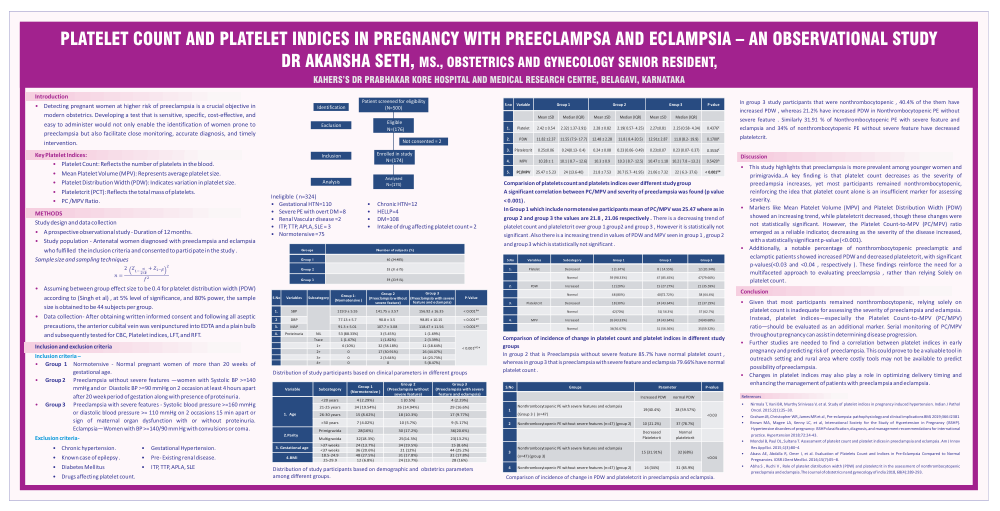
Detecting pregnant women at higher risk of preeclampsia is a crucial objective in modern obstetrics. Developing a test that is sensitive, specific, cost-effective, and easy to administer would not only enable the identification of women prone to preeclampsia but also facilitate close monitoring, accurate diagnosis, and timely intervention
Key platelet indices
Platelet Count: Reflects the number of platelets in the blood.
Mean Platelet Volume (MPV): Represents average platelet size.
Platelet Distribution Width (PDW): Indicates variation in platelet size.
Plateletcrit (PCT): Reflects the total mass of platelets.
PC /MPV Ratio.
Discussion
This study highlights that preeclampsia is more prevalent among younger women and primigravida..A key finding is that platelet count decreases as the severity of preeclampsia increases, yet most participants remained nonthrombocytopenic, reinforcing the idea that platelet count alone is an insufficient marker for assessing severity.
Markers like Mean Platelet Volume (MPV) and Platelet Distribution Width (PDW) showed an increasing trend, while plateletcrit decreased, though these changes were not statistically significant. However, the Platelet Count-to-MPV (PC/MPV) ratio emerged as a reliable indicator, decreasing as the severity of the disease increased, with a statistically significant p-value (<0.001).
Additionally, a notable percentage of nonthrombocytopenic preeclamptic and eclamptic patients showed increased PDW and decreased plateletcrit, with significant p-values(<0.03 and <0.04 , respectively ). These findings reinforce the need for a multifaceted approach to evaluating preeclampsia , rather than relying Solely on platelet count .
Conclusion
Given that most participants remained nonthrombocytopenic, relying solely on platelet count is inadequate for assessing the severity of preeclampsia and eclampsia. Instead, platelet indices—especially the Platelet Count-to-MPV (PC/MPV) ratio—should be evaluated as an additional marker. Serial monitoring of PC/MPV throughout pregnancy can assist in determining disease progression.
Further studies are needed to find a correlation between platelet indices in early pregnancy and predicting risk of preeclampsia. This could prove to be a valuable tool in outreach setting and rural area where costly tools may not be available to predict possibility of preeclampsia.
Changes in platelet indices may also play a role in optimizing delivery timing and enhancing the management of patients with preeclampsia and eclampsia.