2,281 posters, 63 videos, 56 audios, 43 topics, 18 sessions, 6,174 authors, 2,323 institutions
ePostersLive by SciGen Technologies S.A. All rights reserved.
RCOG World Congress 2025
June 23 - 25, 2025 | ExCeL London, UK
EP.1000
Comparison of DIPSI and WHO Criteria for Diagnosing GDM: A Prospective Study
Poster Presenter
Authors
Affiliations
Part of Topic
High risk pregnancy
Comparison of DIPSI and WHO Criteria for Diagnosing GDM: A Prospective Study Dr Shalini Singh, Dr Amita Pandey, Dr Nida Aara
KGMU, Lucknow, India
Primary Objective: To compare DIPSI with WHO 2013 criteria for diagnosis for GDM. Secondary objective: To assess maternal and fetal outcome in patients diagnosed as GDM
Study design: Prospective cohort Study. Study duration: One year. Study setting: Department of Obstetrics & Gynecology, King George’s Medical University, Lucknow. A sample of 202 pregnant women, less than 20 weeks of gestation, were recruited from the antenatal outpatient department and wards. Participants underwent both DIPSI and WHO 2013 tests for GDM diagnosis.Inclusion Criteria: Patients giving written informed consent were taken. Pregnant women 18-40 years of age. Pregnant women < 20 weeks of gestation. Pregnant women willing to come in fasting state in our hospital. Exclusion criteria: Not giving consent. Pregnant women with Pre gestational diabetes, or already diagnosed with GDM.
According to the results of DIPSI and 75-gram OGTT patients were divided into 4 groups and followed for maternal and foetal/neonatal outcome.
Data analysis: Data was analysed using SPSS version 24.0. A receiving operating characteristic curve was constructed for DIPSI criteria predicting GDM and area under the curve, sensitivity, specificity, NPV and PPV was estimated
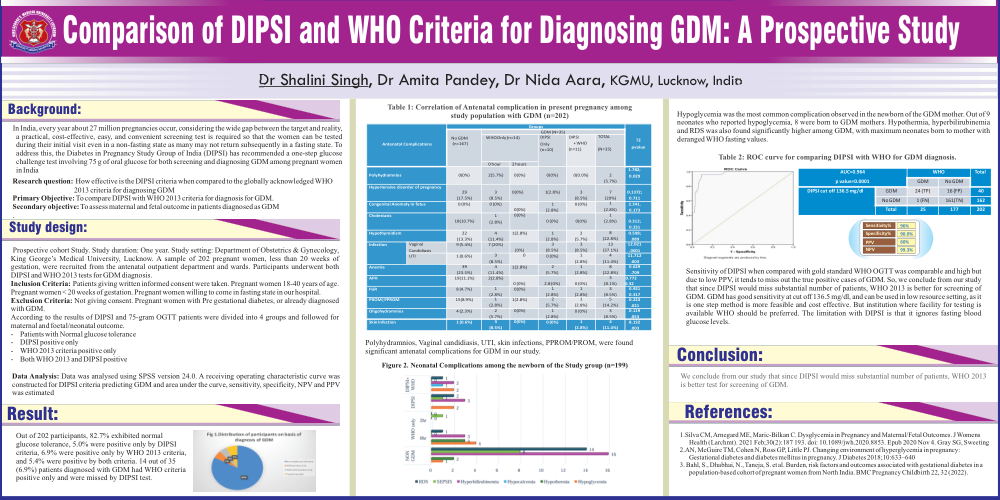
Result: Out of 202 participants, 82.7% exhibited normal glucose tolerance, 5.0% were positive only by DIPSI criteria, 6.9% were positive only by WHO 2013 criteria, and 5.4% were positive by both criteria. 14 out of 35 (6.9%) patients diagnosed with GDM had WHO criteria positive only and were missed by DIPSI test. Polyhydramnios, Vaginal candidiasis, UTI, skin infections, PPROM/PROM, were found significant antenatal complications for GDM in our study. Hypoglycemia was the most common complication observed in the newborn of the GDM mother. Out of 9 neonates who reported hypoglycemia, 8 were born to GDM mothers. Hypothermia, hyperbilirubinemia and RDS was also found significantly higher among GDM, with maximum neonates born to mother with deranged WHO fasting values.
Sensitivity of DIPSI when compared with gold standard WHO OGTT was comparable and high but due to low PPV, it tends to miss out the true positive cases of GDM. So, we conclude from our study that since DIPSI would miss substantial number of patients, WHO 2013 is better for screening of GDM. GDM has good sensitivity at cut off 136.5 mg/dl, and can be used in low resource setting, as it is one step method is more feasible and cost effective. But institution where facility for testing is available WHO should be preferred. The limitation with DIPSI is that it ignores fasting blood glucose levels.
Conclusion: We conclude from our study that since DIPSI would miss substantial number of patients, WHO 2013 is better test for screening of GDM.