2,281 posters, 63 videos, 56 audios, 43 topics, 18 sessions, 6,174 authors, 2,323 institutions
ePostersLive by SciGen Technologies S.A. All rights reserved.
RCOG World Congress 2025
June 23 - 25, 2025 | ExCeL London, UK
EP.0989
Association of polycystic ovarian syndrome (PCOS) phenotypes with pregnancy complications
Poster Presenter
Part of Topic
High risk pregnancy
Association of polycystic ovarian syndrome (PCOS) phenotypes with pregnancy complications
OBJECTIVE:
To determine whether certain phenotypes of PCOS are associated with increased risk of pregnancy complications in Arab women.
BACKGROUND
PCOS is an endocrine disorder that affects women of reproductive age. It is commonly diagnosed using the Rotterdam criteria. PCOS should be considered a high-risk condition in pregnancy with women identified and monitored as per the 2023 International evidence-based guideline for the assessment and management of polycystic ovary syndrome. PCOS phenotype presentations have recently suggested a diversity of etiological factors however there are few studies that have explored distinct phenotypes of PCOS and their association with pregnancy complications in women of Arab ethnicity.
DESIGN:
Prospective case control study.
METHOD:
We conducted a study on 50 PCOS cases and 50 control Omani females from the Gynecology clinic at a tertiary care hospital in Oman. Cases fulfilled Rotterdam criteria for PCOS. Cases were divided into 4 phenotypes (A,B,C,D). Pregnant women, those with congenital adrenal hyperplasia, androgen secreting tumors, Cushing syndrome and hyperprolactinemia were excluded. Clinical and biochemical data was collected over the period of the last 5 years. Statistical analysis was performed using SPSS to compare pregnancy complications and neonatal outcomes as well as their correlation with PCOS phenotypes.
RESULTS:
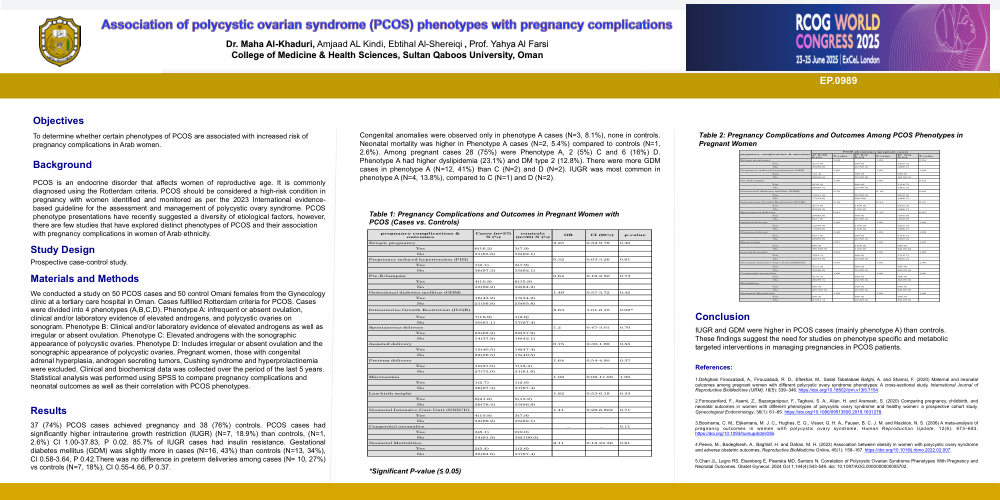
37 (74%) PCOS cases achieved pregnancy and 38 (76%) controls. PCOS cases had significantly higher intrauterine growth restriction (IUGR) (N=7, 18.9%) than controls, (N=1, 2.6%) CI 1.00-37.83, P 0.03. 85.7% of IUGR cases had insulin resistance. Gestational diabetes mellitus (GDM) was slightly more in cases (N=16, 43%) than controls (N=13, 34%), CI 0.58-3.64, P 0.42.There was no difference in preterm deliveries among cases (N= 10, 27%) vs controls (N=7, 18%), CI 0.55-4.66, P 0.37. Congenital anomalies were observed only in phenotype A cases (N=3, 6%), none in controls. Neonatal mortality was higher in Phenotype A cases (N=2, 5.4%) compared to controls (N=1, 2.6%). Among pregnant cases 28 (75%) were Phenotype A, 2 (5%) C and 6 (16%) D. Phenotype A had higher dyslipidemia (23.1%) and DM type 2 (12.8%). There were more GDM cases in phenotype A (N=12, 32%) than C and D (N=2, 5%). IUGR was most common in phenotype A (N=4, 10%), compared to C (N=1, 2.7 %) and D (N=2, 5.4%).
CONCLUSIONS:
IUGR and GDM were higher in PCOS cases (mainly phenotype A) than controls. These findings suggest the need for studies on phenotype specific and metabolic targeted interventions in managing pregnancies in PCOS patients.