2,281 posters, 63 videos, 56 audios, 43 topics, 18 sessions, 6,174 authors, 2,323 institutions
ePostersLive by SciGen Technologies S.A. All rights reserved.
RCOG World Congress 2025
June 23 - 25, 2025 | ExCeL London, UK
EP.0986
SUCCESSFUL PREGNANCY OUTCOME FOLLOWING QUADRUPLETS PREGNANCY: A MANAGEMENT DILEMMA
Poster Presenter
Authors
Sampath Gnanarathne, Hasitha Dissanayake, Naveen Sarathchandra, K Jatheeswaran
Affiliations
Senior Lecturer, Department of Obstetrics and Gynaecology, Faculty of Medicine, University of Peradeniya., Professorial Unit of Obstetrics and Gynaecology, Teaching hospital Peradeniya, Senior lecturer, Department of Obstetrics and Gynaecology, Faculty of Medicine, University of Peradeniya
Part of Topic
High risk pregnancy
Introduction
Case report
Pregnancies with three or more fetuses are referred to as higher order
multiple gestations.
They are more commonly seen nowadays due to development and
availability of assisted reproductive treatments.
It may lead to increased maternal and fetal morbidity due to
exaggerated pregnancy complications, preterm birth and extreme
prematurity.
Evidence on optimum management of higher order multiple
pregnancies are lacking and it is an evolving area in current obstetric
practices.
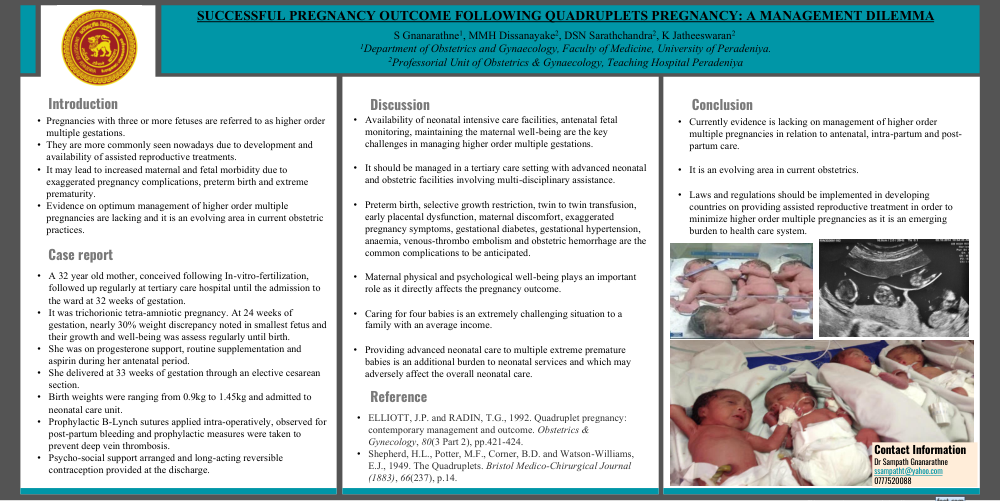
A 32 year old mother, conceived following In-vitro-fertilization,
followed up regularly at tertiary care hospital until the admission to
the ward at 32 weeks of gestation.
It was trichorionic tetra-amniotic pregnancy. At 24 weeks of
gestation, nearly 30% weight discrepancy noted in smallest fetus and
their growth and well-being was assess regularly until birth.
She was on progesterone support, routine supplementation and
aspirin during her antenatal period.
She delivered at 33 weeks of gestation through an elective cesarean
section.
Birth weights were ranging from 0.9kg to 1.45kg and admitted to
neonatal care unit.
Prophylactic B-Lynch sutures applied intra-operatively, observed for
post-partum bleeding and prophylactic measures were taken to
prevent deep vein thrombosis.
Psycho-social support arranged and long-acting reversible
contraception provided at the discharge.
Discussion
Availability of neonatal intensive care facilities, antenatal fetal
monitoring, maintaining the maternal well-being are the key
challenges in managing higher order multiple gestations.
It should be managed in a tertiary care setting with advanced neonatal
and obstetric facilities involving multi-disciplinary assistance.
Preterm birth, selective growth restriction, twin to twin transfusion,
early placental dysfunction, maternal discomfort, exaggerated
pregnancy symptoms, gestational diabetes, gestational hypertension,
anaemia, venous-thrombo embolism and obstetric hemorrhage are the
common complications to be anticipated.
Maternal physical and psychological well-being plays an important
role as it directly affects the pregnancy outcome.
Caring for four babies is an extremely challenging situation to a
family with an average income.
Providing advanced neonatal care to multiple extreme premature
babies is an additional burden to neonatal services and which may
adversely affect the overall neonatal care.
Conclusion
Currently evidence is lacking on management of higher order
multiple pregnancies in relation to antenatal, intra-partum and
post-partum care.
It is an evolving area in current obstetrics.
Laws and regulations should be implemented in developing
countries on providing assisted reproductive treatment in order to
minimize higher order multiple pregnancies as it is an emerging
burden to health care system.
Reference
ELLIOTT, J.P. and RADIN, T.G., 1992. Quadruplet pregnancy:
contemporary management and outcome. Obstetrics &
Gynecology, 80(3 Part 2), pp.421-424.
Shepherd, H.L., Potter, M.F., Corner, B.D. and Watson-Williams,
E.J., 1949. The Quadruplets. Bristol Medico-Chirurgical Journal
(1883), 66(237), p.14.