2,281 posters, 63 videos, 56 audios, 43 topics, 18 sessions, 6,174 authors, 2,323 institutions
ePostersLive by SciGen Technologies S.A. All rights reserved.
RCOG World Congress 2025
June 23 - 25, 2025 | ExCeL London, UK
EP.0981
Impact of pathways on gestational diabetes pregnancy outcomes: 5 year audit
Poster Presenter
Part of Topic
High risk pregnancy
Impact of resources and changes in pathways on outcomes of women with Gestational diabetes (GDM) retrospective audit pre, during and after COVID in a District General Hospital in the UK
Maryam Javed, Caroline Nocera, Kimberley Nash, Vandna Verma and Liliana Grosu
Objective
Our audit examines the outcomes of women with GDM prior, during and after COVID considering changes in resources and pathways. A multicentre retrospective cohort study suggested no differences in maternal and perinatal outcomes during versus pre COVID but there are no reports about outcomes after COVID (1).
Design
This retrospective audit analysed data on women with GDM who delivered between April 2019 to April 2024.
Method
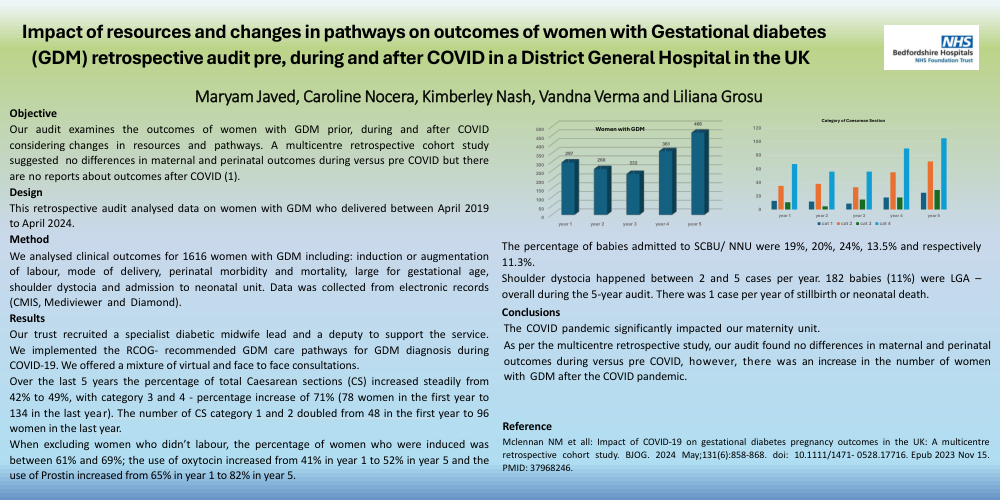
We analysed clinical outcomes for 1616 women with GDM including induction or augmentation of labour, mode of delivery, perinatal morbidity and mortality, large for gestational age, shoulder dystocia and admission to neonatal unit. Data was collected from electronic records (CMIS) and verified with maternity notes available on Mediviewer and Diamond. 297 women with GDM delivered in the first year, the numbers decreased initially, then increased: 260, 232, 361 and respectively 466 women.
Results
Our trust recruited a specialist diabetic midwife lead and a deputy to support the service. We implemented the RCOG- recommended GDM care pathways for GDM diagnosis during COVID-19. We offered a mixture of virtual and face to face consultations.
Our audit showed several emerging trends:
· Over the last 2 years there has been an increase in the number of women diagnosed with GDM (in 2024 the number was double compared to 2022).
· Over the last 5 years the percentage of total Caesarean sections (CS) increased steadily from 42% to 49%, with category 3 and 4 - percentage increase of 71% (78 women in the first year to 134 in the last year). The number of CS category 1 and 2 doubled from 48 in the first year to 96 women in the last year.
· When excluding women who didn’t labour, the percentage of women who were induced was between 61% and 69%; the use of oxytocin increased from 41% in year 1 to 52% in year 5 and the use of Prostin increased from 65% in year 1 to 82% in year 5.
· Stable neonatal outcomes: the percentage of babies admitted to SCBU/ NNU were 19%, 20%, 24%, 13.5% and respectively 11.3%. Shoulder dystocia happened between 2 and 5 cases per year. There was 1 case per year of stillbirth or neonatal death.
Conclusions
COVID pandemic significantly impacted our maternity unit. As per the multicentre retrospective study, our audit found no differences in maternal and perinatal outcomes during versus pre COVID, however, there was an increase in the number of women with GDM after the COVID pandemic.
ImpactofresourcesandchangesinpathwaysonoutcomesofwomenwithGestationaldiabetes (GDM)retrospectiveauditpre,duringandafterCOVIDinaDistrictGeneralHospitalintheUK