2,281 posters, 63 videos, 56 audios, 43 topics, 18 sessions, 6,174 authors, 2,323 institutions
ePostersLive by SciGen Technologies S.A. All rights reserved.
RCOG World Congress 2025
June 23 - 25, 2025 | ExCeL London, UK
EP.0980
The prevalence of shortened cervical length in a specialist preterm birth clinic.
Poster Presenter
Part of Topic
High risk pregnancy
The prevalence of shortened cervical length in a specialist preterm birth clinic
Dr E.Chandler1, Dr A.Newnham1,2, Dr J.Odendaal1,2, Prof S.Quenby1,2, A.Gill1, E. Jones1
University Hospitals Coventry and Warwickshire, Coventry, United Kingdom1
Division of Biomedical Sciences, Clinical Sciences Research Laboratories, Warwick Medical School, University of Warwick, Coventry, United Kingdom2
Introduction
Preterm birth (PTB) is the leading cause of childhood mortality under aged 5 and is responsible for significant lifelong morbidity1. In 2022, 8% of births in England were PTBs2. Those at risk are referred to specialist preterm prevention clinics (PPC) with the goal of improving pregnancy outcomes.
Objectives & aims
The primary objective of this service evaluation was to assess the prevalence of shortened cervical length (<25mm) in patients referred to a high-risk PTB clinic. In those without previous PTB the reported prevalence of short cervix ranges from 1.7% to 7.9%3
Design
Retrospective evaluation of the outcomes of a Tommy’s Specialist PTB Prevention Service based at University Hospital Coventry and Warwickshire.
Methods
Data was collected from 149 women attending PPC at University Hospitals Coventry and Warwickshire between June-November 2024. 13/149 were excluded. Data on referral reason, cervical length, cervical cerclage rates and birth outcomes were obtained.
Results
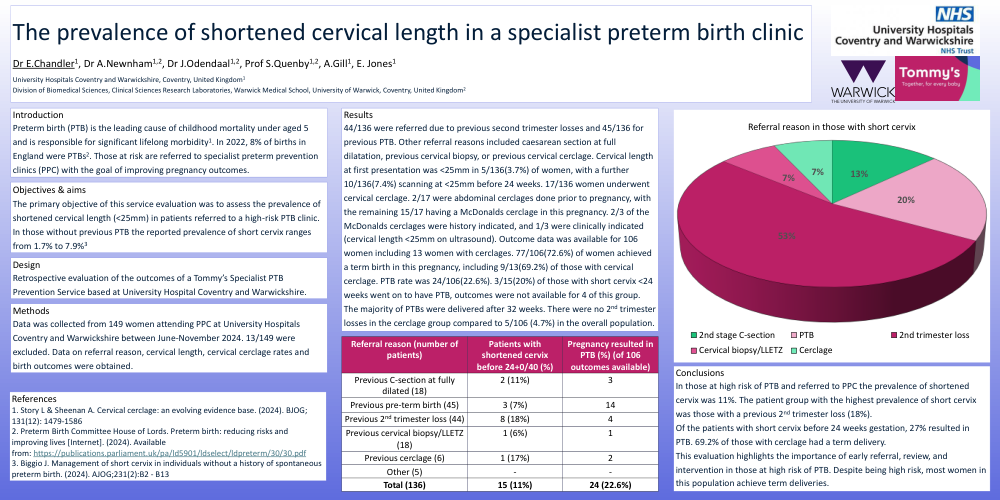
44/136 were referred due to previous second trimester losses and 45/136 for previous PTB. Other referral reasons included caesarean section at full dilatation, previous cervical biopsy, or previous cervical cerclage. Cervical length at first presentation was <25mm in 5/136(3.7%) of women, with a further 10/136(7.4%) scanning at <25mm before 24 weeks. 17/136 women underwent cervical cerclage. 2/17 were abdominal cerclages done prior to pregnancy, with the remaining 15/17 having a McDonalds cerclage in this pregnancy. 2/3 of the McDonalds cerclages were history indicated, and 1/3 were clinically indicated (cervical length <25mm on ultrasound). Outcome data was available for 106 women including 13 women with cerclages. 77/106(72.6%) of women achieved a term birth in this pregnancy, including 9/13(69.2%) of those with cervical cerclage. PTB rate was 24/106(22.6%). 3/15(20%) of those with short cervix <24 weeks went on to have PTB, outcomes were not available for 4 of this group. The majority of PTBs were delivered after 32 weeks. There were no 2nd trimester losses in the cerclage group compared to 5/106 (4.7%) in the overall population.
Conclusions
In those at high risk of PTB and referred to PPC the prevalence of shortened cervix was 11%. The patient group with the highest prevalence of short cervix was those with a previous 2nd trimester loss (18%).Of the patients with short cervix before 24 weeks gestation, 27% resulted in PTB. 69.2% of those with cerclage had a term delivery.This evaluation highlights the importance of early referral, review, and intervention in those at high risk of PTB. Despite being high risk, most women in this population achieve term deliveries.