2,281 posters, 63 videos, 56 audios, 43 topics, 18 sessions, 6,174 authors, 2,323 institutions
ePostersLive by SciGen Technologies S.A. All rights reserved.
RCOG World Congress 2025
June 23 - 25, 2025 | ExCeL London, UK
EP.0974
Maternal and Fetal Outcomes in Women with Sickle Cell Disease: Case Series
Part of Topic
High risk pregnancy
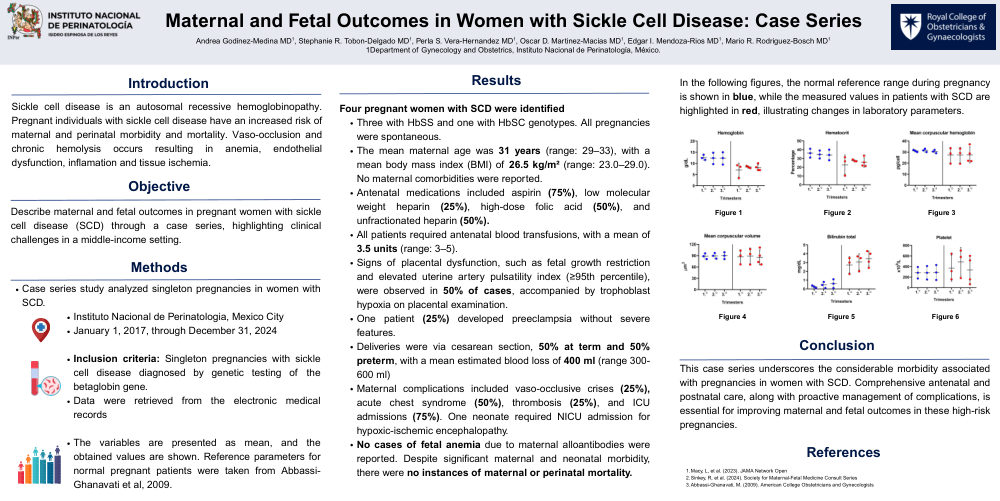
Maternal and Fetal Outcomes in Women with Sickle Cell Disease: Case Series
Introduction: Sickle cell disease is an autosomal recessive hemoglobinopathy. Pregnant individuals with sickle cell disease have an increased risk of maternal and perinatal morbidity and mortality. Vaso-occlusion and chronic hemolysis occurs resulting in anemia, endothelial dysfunction, inflamation and tissue ischemia.
Objective: Describe maternal and fetal outcomes in pregnant women with sickle cell disease (SCD) through a case series, highlighting clinical challenges in a middle-income setting.
Methods: Data were retrieved from the electronic medical records of the Instituto Nacional de Perinatología, covering the period of January 1, 2017, to December 31, 2024.
Results:
- Three with HbSS and one with HbSC genotypes. All pregnancies were spontaneous.
- The mean maternal age was 31 years (range: 29–33), with a mean body mass index (BMI) of 26.5 kg/m² (range: 23.0–29.0). No maternal comorbidities were reported.
- Antenatal medications included aspirin (75%), low molecular weight heparin (25%), high-dose folic acid (50%), and unfractionated heparin (50%).
- All patients required antenatal blood transfusions, with a mean of 3.5 units (range: 3–5).
- Signs of placental dysfunction, such as fetal growth restriction and elevated uterine artery pulsatility index (≥95th percentile), were observed in 50% of cases, accompanied by trophoblast hypoxia on placental examination.
- One patient (25%) developed preeclampsia without severe features.
- Deliveries were via cesarean section, 50% at term and 50% preterm, with a mean estimated blood loss of 400 ml (range 300-600 ml)
- Maternal complications included vaso-occlusive crises (25%), acute chest syndrome (50%), thrombosis (25%), and ICU admissions (75%). One neonate required NICU admission for hypoxic-ischemic encephalopathy.
- No cases of fetal anemia due to maternal alloantibodies were reported. Despite significant maternal and neonatal morbidity, there were no instances of maternal or perinatal mortality.
Conclusions:
This case series highlights the significant morbidity associated with pregnancies in women with SCD. It emphasizes that comprehensive antenatal and postnatal care, along with proactive management of complications, plays a crucial role in enhancing maternal and fetal health in these high-risk pregnancies.