2,281 posters, 63 videos, 56 audios, 43 topics, 18 sessions, 6,174 authors, 2,323 institutions
ePostersLive by SciGen Technologies S.A. All rights reserved.
RCOG World Congress 2025
June 23 - 25, 2025 | ExCeL London, UK
EP.0972
Frequency of Urinary Tract Injuries in Morbidly Adherent Placenta
Poster Presenter
Authors
Affiliations
Part of Topic
High risk pregnancy
Frequency of Urinary Tract Injuries in Morbidly Adherent Placenta
Dr Tayiba Yousaf1, Dr Sabeeha Yousaf2, Dr Humaira Usman3
1 Buckinghamshire NHS Trust 2 PAF Hospital, Islamabad 3 Al-Aleem Medical College , Lahore
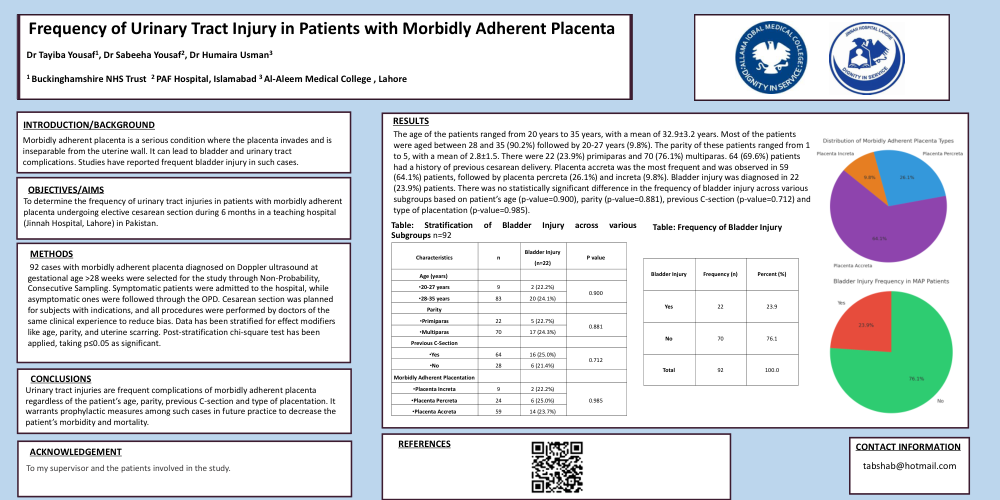
Objective: Morbidly adherent placenta is a serious condition where the placenta invades and is inseparable from the uterine wall. It can lead to bladder and urinary tract complications. Studies have reported frequent bladder injury in such cases. A study aimed to determine the frequency of urinary tract injuries in patients with morbidly adherent placenta undergoing elective cesarean section.
Design: It’s a descriptive case series.
Method: 92 cases with morbidly adherent placenta diagnosed on Doppler ultrasound at gestational age >28 weeks were selected for the study through Non-Probability, Consecutive Sampling. Symptomatic patients were admitted to the hospital, while asymptomatic ones were followed through OPD. Cesarean section was planned for subjects with indications, and all procedures were performed by doctors of the same clinical experience to reduce bias. Data has been stratified for effect modifiers like age, parity, and uterus scarring. Post-stratification chi-square test has been applied, taking p≤0.05 as significant.
Results: The age of the patients ranged from 20 years to 35 years, with a mean of 32.9±3.2 years. Most of the patients were aged between 28 and 35 (90.2%) followed by 20-27 years (9.8%). The parity of these patients ranged from 1 to 5, with a mean of 2.8±1.5. There were 22 (23.9%) primiparas and 70 (76.1%) multiparas. 64 (69.6%) patients had a history of previous cesarean delivery. Placenta accreta was the most frequent and was observed in 59 (64.1%) patients, followed by placenta percreta (26.1%) and increta (9.8%). Bladder injury was diagnosed in 22 (23.9%) patients. There was no statistically significant difference in the frequency of bladder injury across various subgroups based on patient’s age (p-value=0.900), parity (p-value=0.881), previous C-section (p-value=0.712) and type of placentation (p-value=0.985).
Conclusion: Urinary tract injuries are frequent complications of morbidly adherent placenta regardless of patient’s age, parity, previous C-section and type of placentation. It warrants prophylactic measures among such cases in future practice to decrease the patient’s morbidity and mortality.