2,281 posters, 63 videos, 56 audios, 43 topics, 18 sessions, 6,174 authors, 2,323 institutions
ePostersLive by SciGen Technologies S.A. All rights reserved.
RCOG World Congress 2025
June 23 - 25, 2025 | ExCeL London, UK
EP.0971
Prevalence of Iron Deficiency Anemia and its causes in pregnant women
Poster Presenter
Authors
Affiliations
Part of Topic
High risk pregnancy
Video
Prevalence of Iron Deficiency Anemia and its causes in pregnant women visiting OPD of CHK
Abstract:
Introduction:
Anemia during pregnancy is a major issue in many developing countries. The WHO defines anemia during pregnancy as a hemoglobin level of less than 1 1 g/dl or hematocrit level less than 33%, at any point during pregnancy. Iron deficiency is the most common cause of anemia during pregnancy. Anemia usually affects all age groups but it is commonly prevalent among pregnant female. This study may help the stats in local population, some public awareness programs can be arranged for early diagnosis and management of this condition during antenatal period in order to reduce the morbidity and mortality of both mother and fetus.
Objectives:
To determine the frequency and causes of iron deficiency anemia in pregnant women, visiting OPD of CHK.
Design:
Descriptive, cross-sectional study
Setting:
OPD, Department of Obstetrics & Gynecology, Civil Hospital, Karachi.
Duration:
6 months from October 2020. To April 2021.
Subjects and Methods:
A total of 169 women who visited antenatal clinic in 1st, 2nd and 3rd trimesters were included in this study. Then 5ml blood sample was taken by the researcher herself and sent to pathology laboratory for presence or absence of iron deficiency anemia. All the data was recorded on the pre-designed proforma.
Results:
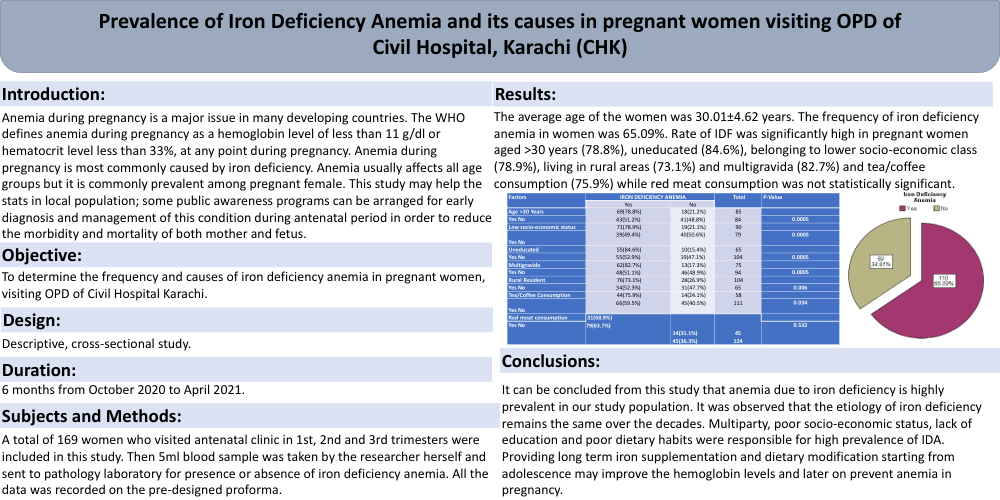
The average age of the women was 30.01±4.62 years. The frequency of iron deficiency anemia in women was 65.09%. Rate of IDF was significantly high in pregnant women who had age >30 years (78.8%; p=0.0005), uneducated (84.6%; p=0.0005), lower socio-economic class (78.9%; p=0.0005), rural area (73.1%; p=0.006) and multigravida (82.7%; p=0.0005) and tea/coffee consumption (75.9%; p=0.0034) while red meat consumption was not statistically significant.
Conclusions:
It can be concluded from this study that anemia due to iron deficiency is highly prevalent in our study population. It was observed that the etiology of iron deficiency remains the same over the decades. Multiparty, poor socio-economic status, lack of education and poor dietary habits were responsible for high prevalence of IDA. Providing long term iron supplementation and dietary modification starting from adolescence may improve the hemoglobin levels and later on prevent anemia in pregnancy.