2,281 posters, 63 videos, 56 audios, 43 topics, 18 sessions, 6,174 authors, 2,323 institutions
ePostersLive by SciGen Technologies S.A. All rights reserved.
RCOG World Congress 2025
June 23 - 25, 2025 | ExCeL London, UK
EP.0963
The impact of specialised care on pregnancy outcomes: Rainbow Placenta Clinic, UHB
Poster Presenter
Part of Topic
High risk pregnancy
The Impact of Specialised Care on Pregnancy Outcomes at RainbowClinic
Dr Oguljemal Redjepova ST7, Fetal Medicine ATSM
Ms Pallavi Karkhanis, Consultant Fetal Medicine
INTRODUCTION
Stillbirth represents an important risk factor for adverse outcome in future pregnancies. Recent reports on specialist clinics and comprehensive care models for managing pregnancies after loss highlight the importance of skilled multi-professional teams focussing on providing individualized care.
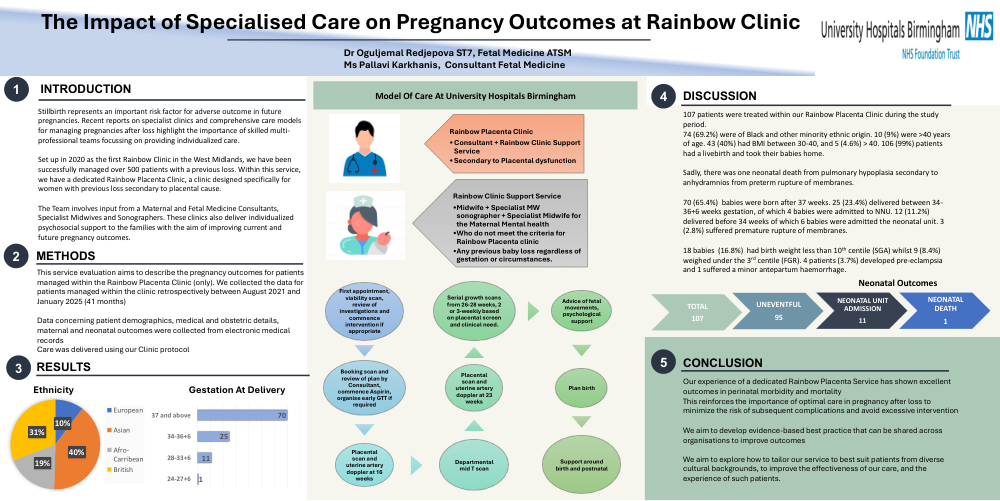
Set up in 2020 as the first Rainbow Clinic in the West Midlands, we have been successfully managed over 500 patients with a previous loss. Within this service, we have a dedicated Rainbow Placenta Clinic, a clinic designed specifically for women with previous loss secondary to placental cause.
The Team involves input from a Maternal and Fetal Medicine Consultants, Specialist Midwives and Sonographers. These clinics also deliver individualized psychosocial support to the families with the aim of improving current and future pregnancy outcomes.
METHODS
This service evaluation aims to describe the pregnancy outcomes for patients managed within the Rainbow Placenta Clinic (only). We collected the data for patients managed within the clinic retrospectively between August 2021 and January 2025 (41 months)
Data concerning patient demographics, medical and obstetric details, maternal and neonatal outcomes were collected from electronic medical records
Care was delivered using our Clinic protocol
RESULTS AND DISCUSSION
107 patients were treated within our Rainbow Placenta Clinic during the study period.
74 (69.2%) were of Black and other minority ethnic origin. 10 (9%) were >40 years of age. 43 (40%) had BMI between 30-40, and 5 (4.6%) > 40. 106 (99%) patients had a livebirth and took their babies home.
Sadly, there was one neonatal death from pulmonary hypoplasia secondary to anhydramnios from preterm rupture of membranes.
70 (65.4%) babies were born after 37 weeks. 25 (23.4%) delivered between 34-36+6 weeks gestation, of which 4 babies were admitted to NNU. 12 (11.2%) delivered before 34 weeks of which 6 babies were admitted the neonatal unit. 3 (2.8%) suffered premature rupture of membranes.
18 babies (16.8%) had birth weight less than 10th centile (SGA) whilst 9 (8.4%) weighed under the 3rd centile (FGR). 4 patients (3.7%) developed pre-eclampsia and 1 suffered a minor antepartum haemorrhage.
CONCLUSION
Our experience of a dedicated Rainbow Placenta Service has shown excellent outcomes in perinatal morbidity and mortality
This reinforces the importance of optimal care in pregnancy after loss to minimize the risk of subsequent complications and avoid excessive intervention
We aim to develop evidence-based best practice that can be shared across organisations to improve outcomes
We aim to explore how to tailor our service to best suit patients from diverse cultural backgrounds, to improve the effectiveness of our care, and the experience of such patients.