2,281 posters, 63 videos, 56 audios, 43 topics, 18 sessions, 6,174 authors, 2,323 institutions
ePostersLive by SciGen Technologies S.A. All rights reserved.
RCOG World Congress 2025
June 23 - 25, 2025 | ExCeL London, UK
EP.0959
Spontaneous Coronary Artery Dissection in a Patient with Refractory Primary Postpartum Haemorrhage
Part of Topic
High risk pregnancy
Spontaneous Coronary Artery Dissection In a Patient with Refractory Primary Postpartum Haemorrhage
R Bharadwaj ; H Brown ; S Al-Juboori ; L Ettinghausen ; E Misiri ; A Mohammed; R Nata. 1 1 1 1 2 131. Obstetrics and Gynaecology Department, Queen Elizabeth Hospital, King’s Lynn, UK. 2. Norwich Medical School, University of East Anglia, Norwich, Norfolk, UK. 3. Cardiology Department, Queen Elizabeth Hospital, King’s Lynn, UK.
Objective:
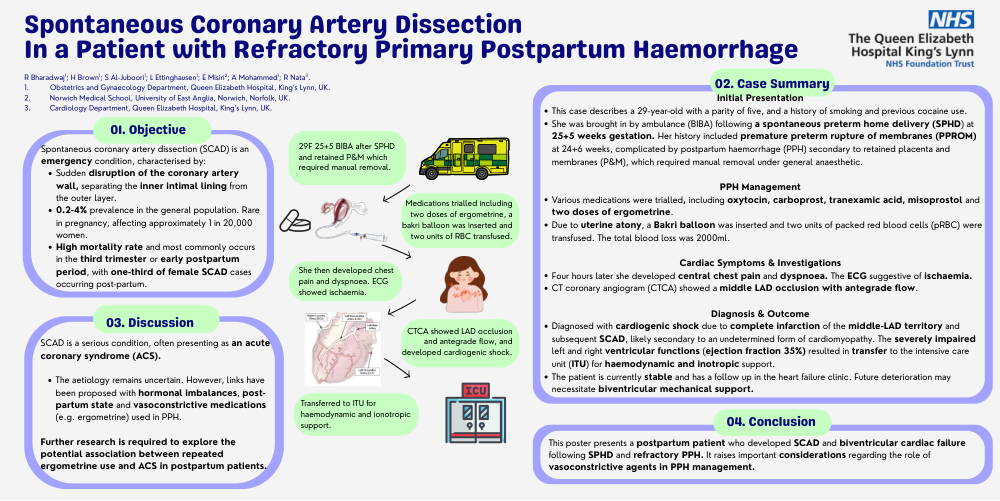
Spontaneous coronary artery dissection (SCAD) is an emergency condition, characterised by: Sudden disruption of the coronary artery wall, separating the inner intimal lining from the outer layer.0.2-4% prevalence in the general population. Rare in pregnancy, affecting approximately 1 in 20,000women. High mortality rate and most commonly occurs in the third trimester or early postpartum period, with one-third of female SCAD cases occurring post-partum.
Case Summary:
Initial Presentation: This case describes a 29-year-old with a parity of five, and a history of smoking and previous cocaine use. She was brought in by ambulance (BIBA) following a spontaneous preterm home delivery (SPHD) at25+5 weeks gestation. Her history included premature preterm rupture of membranes (PPROM)at 24+6 weeks, complicated by postpartum haemorrhage (PPH) secondary to retained placenta and membranes (P&M), which required manual removal under general anaesthetic.
PPH Management: Various medications were trialled, including oxytocin, carboprost, tranexamic acid, misoprostol and two doses of ergometrine. Due to uterine atony, a Bakri balloon was inserted, and two units of packed red blood cells (pRBC) were transfused. The total blood loss was 2000ml.
Cardiac Symptoms & Investigations: Four hours later she developed central chest pain and dyspnoea. The ECG suggestive of ischaemia. CT coronary angiogram (CTCA) showed a middle LAD occlusion with antegrade flow.
Diagnosis & Outcome: diagnosed with cardiogenic shock due to complete infarction of the middle-LAD territory and subsequent SCAD, likely secondary to an undetermined form of cardiomyopathy. The severely impaired left and right ventricular functions (ejection fraction 35%) resulted in transfer to the intensive care unit (ITU) for haemodynamic and inotropic support. The patient is currently stable and has a follow up in the heart failure clinic. Future deterioration may necessitate biventricular mechanical support.
Discussion:
SCAD is a serious condition, often presenting as an acute coronary syndrome (ACS). The aetiology remains uncertain. However, links have been proposed with hormonal imbalances, post-partum state and vasoconstrictive medications (e.g. ergometrine) used in PPH. Further research is required to explore the potential association between repeated ergometrine use and ACS in postpartum patients.
Conclusion:
This poster presents a postpartum patient who developed SCAD and biventricular cardiac failure following SPHD and refractory PPH. It raises important considerations regarding the role of vasoconstrictive agents in PPH management.