2,281 posters, 63 videos, 56 audios, 43 topics, 18 sessions, 6,174 authors, 2,323 institutions
ePostersLive by SciGen Technologies S.A. All rights reserved.
RCOG World Congress 2025
June 23 - 25, 2025 | ExCeL London, UK
EP.0954
Audit of Late pre-term((34-36+6 weeks) deliveries requiring admission to neonatal unit.
Poster Presenter
Authors
Affiliations
Part of Topic
High risk pregnancy
Title:
Audit of Late pre-term((34-36+6 weeks) deliveries requiring admission to neonatal unit.
Objective:
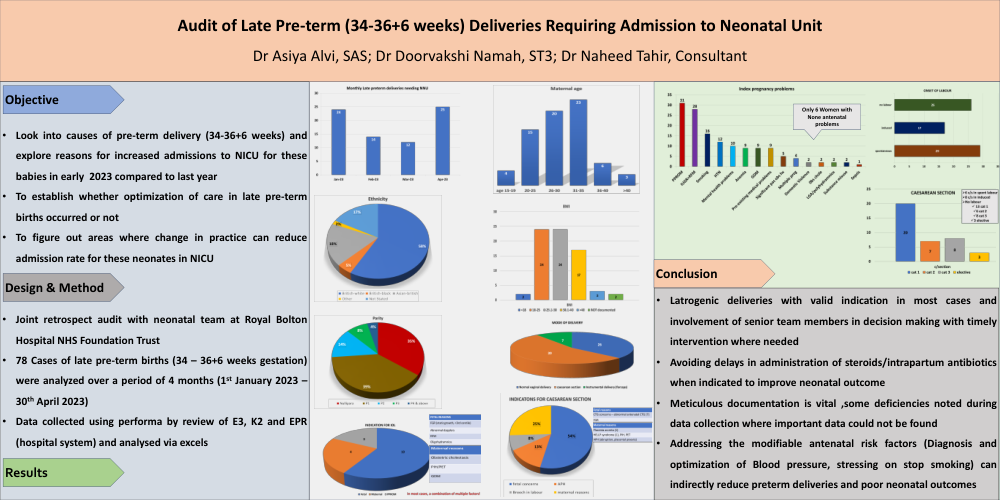
- Look into causes of preterm delivery ( 34-36+6 weeks) and explore reasons for Increased admissions to NICU for these babies in early 2023 compared to last year
- To Establish whether optimization of care in late preterm births occurred or not.
- To figure out areas where change in practice can reduce admission rate for these neonates in NICU
Design:
- Joint retrospect audit with neonatal team at Royal Bolton Hospital NHS Foundation Trust
- Cases of late preterm births (34 – 36+6 weeks gestation) were analyzed over a period of 4 months (1st January 2023 – 30th April 2023)
Method:
- 78 cases of neonatal admissions were identified and all of these deliveries were audited
- Data collected using Performa by Review of E3, K2 and EPR(hospital system)and analysed via excels
Results:
- 93%(70) cases of preterm deliveries had one or multiple complications in index pregnancy (PPROM 41%, IUGR 36% , Smoking 21% and Hypertension 17 % being most common)
- Majority women (58%)were White British with age group (76%) 20-35 years.
- 40% of late preterm births were spontaneous while 22% women were induced ( indications being severe IUGR with abnormal dopplers ,reduced Fetal movements and oligohydramnios)
- 34% delivered without labour (89% emergency c/secions Due to pathological CTG, Abruption , APH with previa ,HELLP ,PET )
- Patient group who were not given steroids contributed 3.9%
- Reasons for not administering steroids included cat 1 c/section , precipitous delivery and maternal choice
Conclusion:
- Iatrogenic deliveries with valid indication in most cases and involvement of senior team members in decision making with timely intervention where needed.
- Avoiding delays in administration of steroids/intrapartum antibiotics when indicated to improve neonatal outcome
- Meticulous documentation is vital ,some deficiencies noted during data collection where important data could not be found
- Addressing the modifiable antenatal risk factors (Diagnosis and optimization of Blood pressure, stressing on stop smoking )can indirectly reduce preterm deliveries and poor neonatal outcomes.