2,281 posters, 63 videos, 56 audios, 43 topics, 18 sessions, 6,174 authors, 2,323 institutions
ePostersLive by SciGen Technologies S.A. All rights reserved.
RCOG World Congress 2025
June 23 - 25, 2025 | ExCeL London, UK
EP.0095
Wider implementation of conservative management for CIN2: A retrospective, cross-sectional audit.
Poster Presenter
Authors
Affiliations
Part of Topic
Colposcopy & cervical pathology
Wider implementation of conservative management for CIN2: A retrospective, cross-sectional audit.
Introduction
- It is recognized that 50 – 60% of cervical intraepithelial neoplasia (CIN)2 will regress within 2 years.
- Risk factors to consider – Age, index cytology, HPV vaccination, genotype, P16 positivity, smoker, immunocompromised, large lesion, compliant patient, fertility status
Conservative management of CIN2 can be offered to individuals as an alternative treatment if the following criteria are met:
(i) Adequate colposcopic examination excludes CIN3, cervical glandular intraepithelial neoplasia and invasive disease.
(ii) CIN2 occupies ≤2 cervical quadrants.
(iii) Histological diagnosis of CIN2 with discussion at the colposcopy multidisciplinary team (MDT) meeting.
(iv) The patient agrees to follow-up for up to 2 years and treatment if no disease resolution or progression.
- Conservative management mitigates the adverse sequelae of excisional treatment including infection, stenosis and increased risk of preterm labour.
Aims and Objectives
This audit aimed to review the number of women eligible for conservative management of CIN2 after MDT discussion and outcomes of those who were offered this management.
Study Design
A retrospective, cross-sectional audit was conducted studying women with a colposcopic or histological diagnosis of CIN2 between January to December 2022, their subsequent 24-month follow-up period and outcomes.
Methods
Electronic patient records were searched. 152 women were identified. Women with more than 2 quadrants involvement on initial colposcopic examination were excluded and 24 women were identified with disease in ≤2 quadrants.
Results
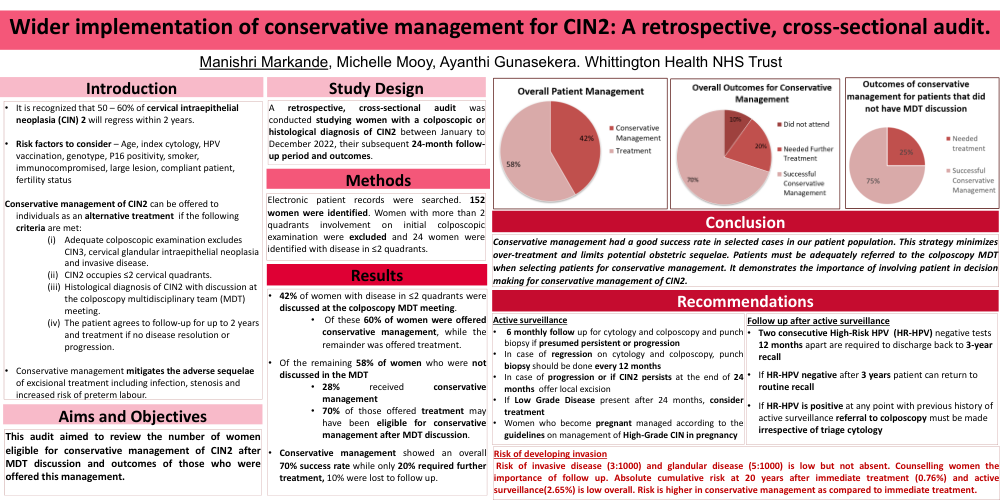
- 42% of women with disease in ≤2 quadrants were discussed at the colposcopy MDT meeting.
- Of these 60% of women were offered conservative management, while the remainder was offered treatment.
- Of the remaining 58% of women who were not discussed in the MDT
- 28% received conservative management
- 70% of those offered treatment may have been eligible for conservative management after MDT discussion.
- Conservative management showed an overall 70% success rate while only 20% required further treatment, 10% were lost to follow up.
Conclusion
Conservative management had a good success rate in selected cases in our patient population. This strategy minimizes over-treatment and limits potential obstetric sequelae. Patients must be adequately referred to the colposcopy MDT when selecting patients for conservative management. It demonstrates the importance of involving patient in decision making for conservative management of CIN2.
Recommendation
Active surveillance
- 6 monthly follow up for cytology and colposcopy and punch biopsy if presumed persistent or progression
- In case of regression on cytology and colposcopy, punch biopsy should be done every 12 months
- In case of progression or if CIN2 persists at the end of 24 months offer local excision
- If Low Grade Disease present after 24 months, consider treatment
- Women who become pregnant managed according to the guidelines on management of High-Grade CIN in pregnancy
Follow up after active surveillance
- Two consecutive High-Risk HPV (HR-HPV) negative tests 12 months apart are required to discharge back to 3-year recall
- If HR-HPV negative after 3 years patient can return to routine recall
- If HR-HPV is positive at any point with previous history of active surveillance referral to colposcopy must be made irrespective of triage cytology
- Risk of developing invasion
- Risk of invasive disease (3:1000) and glandular disease (5:1000) is low but not absent. Counselling women the importance of follow up. Absolute cumulative risk at 20 years after immediate treatment (0.76%) and active surveillance(2.65%) is low overall. Risk is higher in conservative management as compared to immediate treatment.