2,281 posters, 63 videos, 56 audios, 43 topics, 18 sessions, 6,174 authors, 2,323 institutions
ePostersLive by SciGen Technologies S.A. All rights reserved.
RCOG World Congress 2025
June 23 - 25, 2025 | ExCeL London, UK
EP.0083
OUTCOME OF COLPOSCOPY REFERRALS FOR POSTCOITAL BLEEDING OR CLINICALLY SUSPICIOUS CERVIX
Poster Presenter
Authors
Affiliations
Part of Topic
Colposcopy & cervical pathology
OUTCOME OF COLPOSCOPY REFERRALS FOR POSTCOITAL BLEEDING OR SUSPICIOUS CERVIX
Dr Asiya Alvi (Speciality Doctor) , Dr Uzma Batool (Speciality Doctor) ,Dr Nahid M.Siraj (Consultant O&G)
Objective:
To identify if patients are appropriately being referred and those with urgent referrals being seen within 2 weeks of referral.
To identify rates of cervical cancer/ pre invasive disease in this group and how many patients were discharged at first appointment.
Aim is to reduce the number of unnecessary referrals for effective resource management, meanwhile avoiding delays in diagnosis of invasive disease.
Method:
Data collected via Masey Database- colposcopy documentation system
Total of 76 patients recruited based on above Referral criteria
Data collected using a Performa and analyzed via excels.
Design:
A retrospective audit looking at all patients referred to the colposcopy service with clinically suspicious cervix or post coital bleeding between 01/09/2020 to 31/12/2022
Results:
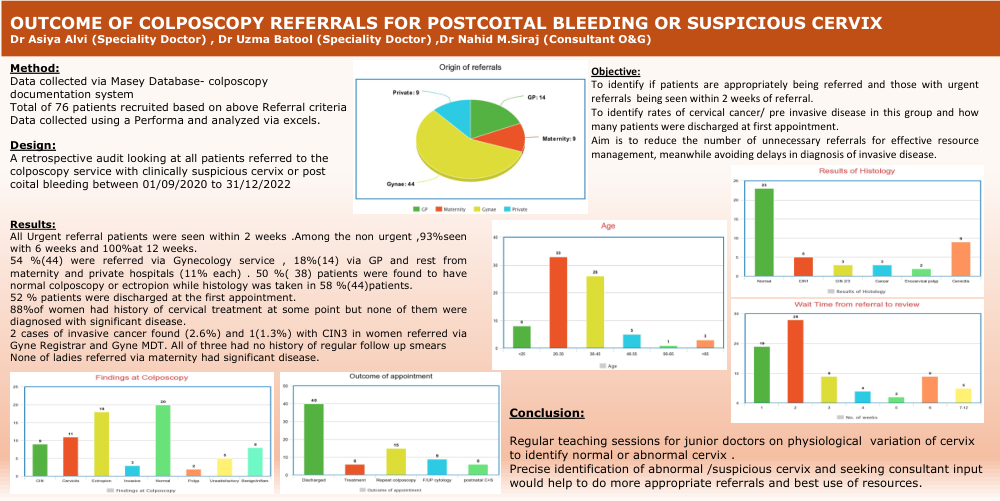
All Urgent referral patients were seen within 2 weeks .Among the non urgent ,93%seen with 6 weeks and 100%at 12 weeks.
54 %(44) were referred via Gynecology service , 18%(14) via GP and rest from maternity and private hospitals (11% each) . 50 %( 38) patients were found to have normal colposcopy or ectropion while histology was taken in 58 %(44)patients.
52 % patients were discharged at the first appointment.
88%of women had history of cervical treatment at some point but none of them were diagnosed with significant disease.
2 cases of invasive cancer found (2.6%) and 1(1.3%) with CIN3 in women referred via Gyne Registrar and Gyne MDT. All of three had no history of regular follow up smears
None of ladies referred via maternity had significant disease.