2,281 posters, 63 videos, 56 audios, 43 topics, 18 sessions, 6,174 authors, 2,323 institutions
ePostersLive by SciGen Technologies S.A. All rights reserved.
RCOG World Congress 2025
June 23 - 25, 2025 | ExCeL London, UK
EP.0951
Preeclampsia prediction before 11 weeks gestation: ASPIRIN trial secondary analysis
Part of Topic
High risk pregnancy
Preeclampsia prediction before 11 weeks gestation: ASPIRIN trial secondary analysis
Objective: To develop a prediction model for preeclampsia/eclampsia before 11.0 weeks of gestation as a proof of concept.
Design: This study is a secondary analysis of the ASPIRIN trial, a multinational, randomized, double-blind, placebo-controlled trial.
Method: The ASPIRIN trial database, obtained from NICHD DASH, included 11,976 nulliparous pregnant women aged 18–40 with gestational ages of 6.0–13.6 weeks at randomization. Participants were assigned to receive either aspirin (81 mg/day) or placebo until 36.0 weeks or delivery. This analysis included pregnancies delivered at ≥20.0 weeks, excluding those in the aspirin group or with gestational ages ≥11.0 weeks at enrollment. The composite outcome was preeclampsia/eclampsia. Predictor variables available in the dataset included maternal age, education (4 categories), body mass index (BMI), gravidity, baseline hemoglobin, baseline systolic blood pressure, and baseline diastolic blood pressure. Logistic regression, with logarithmic transformation for continuous variables, was used to develop the model. The area under the ROC curve with a 95% confidence interval (CI) estimated via bootstrap resampling (1,000 iterations) and the P-value of the Hosmer-Lemeshow statistical test are reported as discrimination and calibration measures. This study used the entire available sample using a complete case approach.
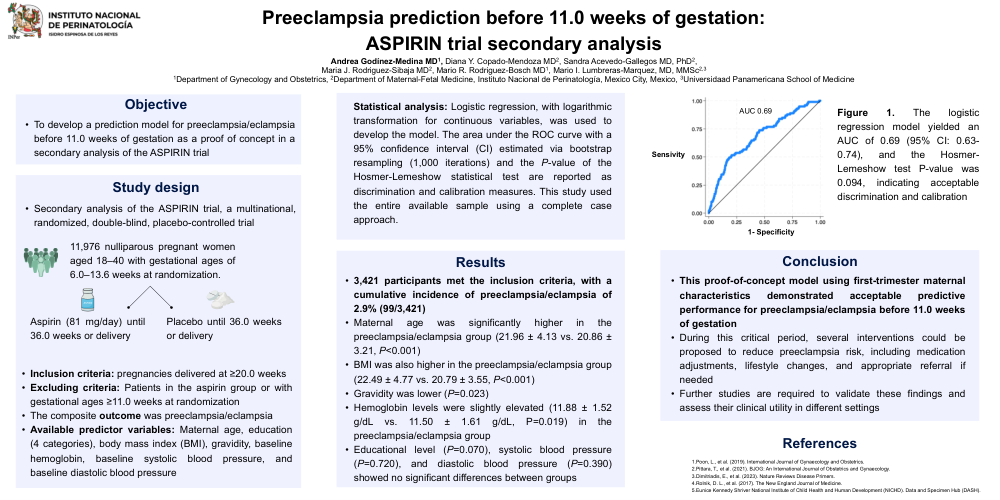
Results: 3,421 participants met the inclusion criteria, with a cumulative incidence of preeclampsia/eclampsia of 2.9% (99/3,421). Maternal age was significantly higher in the preeclampsia/eclampsia group (21.96 ± 4.13 vs. 20.86 ± 3.21, P<0.001). BMI was also higher in the preeclampsia/eclampsia group (22.49 ± 4.77 vs. 20.79 ± 3.55, P<0.001). Gravidity was lower (P=0.006), and hemoglobin levels were slightly elevated (11.88 ± 1.52 g/dL vs. 11.50 ± 1.61 g/dL, P=0.019) in the preeclampsia/eclampsia group. Educational level (P=0.070), systolic blood pressure (P=0.720), and diastolic blood pressure (P=0.390) showed no significant differences between groups. The logistic regression model yielded an AUC of 0.69 (95% CI: 0.63-0.74), and the Hosmer-Lemeshow test P-value was 0.094, indicating acceptable discrimination and calibration.
Conclusions: This proof-of-concept logistic regression model using first-trimester maternal characteristics demonstrated acceptable predictive performance for preeclampsia/eclampsia before 11.0 weeks of gestation. There are several conditions where an earlier risk assessment for preeclampsia could be helpful, for example, in patients with antiphospholipid syndrome and chronic hypertension where several interventions could be proposed since this critical period to reduce preeclampsia risk, including medication adjustments, lifestyle changes, appropriate referral if needed, and even recommend starting low-dose aspirin later in gestation. Thus, further studies are needed to validate these findings and assess their clinical utility in different settings.