2,281 posters, 63 videos, 56 audios, 43 topics, 18 sessions, 6,174 authors, 2,323 institutions
ePostersLive by SciGen Technologies S.A. All rights reserved.
RCOG World Congress 2025
June 23 - 25, 2025 | ExCeL London, UK
EP.0950
Ultrasound-guided management of gestational diabetes: Retrospective cohort study in regional Australia
Poster Presenter
Authors
Affiliations
Part of Topic
High risk pregnancy
Ultrasound Guided Management of Gestational Diabetes: A Retrospective Cohort Study of Neonatal Outcomes in Regional Australia
Background:-
Gestational Diabetes Mellitus (GDM) affects 15–18% of pregnancies in Australia, with higher prevalence in regional areas due to factors such as limited healthcare access, obesity, and increased maternal age [1], [2].
Tasmania, in particular north and northwest Tasmania, has one of the highest rates of overweight and obesity in the country [3]. Effective management strategies are essential to mitigate neonatal complications such as Special Care Nursery (SCN) admissions and neonatal hypoglycemia [4], [5]
Aim:-
To evaluate whether ultrasound guided management of GDM improves neonatal outcomes in regional areas, specifically by reducing SCN admissions and neonatal hypoglycaemia.
Previous studies have shown that ultrasound guided management has reduced these complications, though the impacts of delivering this is a regional setting has not been well documented [4]
Method:-
A retrospective cohort study at the Launceston General Hospital, analysing medical records of those women diagnosed with GDM who delivered between August 2022 and August 2024.
Inclusion criteria was all primiparous women, diagnosed with GDM at routine screening from 24-28 weeks gestation. Exclusion criteria included, type 1, type 2 diabetes, multiple pregnancy and preterm delivery.
To be classified as ultrasound guided management serial growth scans at 28, 32 and 36 weeks were completed, with management decisions ( timing of delivery, insulin therapy or monitoring adjustments) based on the results.
Neonatal outcomes ( SCN admission and neonatal hypoglycaemia were compared between ultrasound guided and conventional management
Results:-
The study found that ultrasound-guided management was associated with:
Mode of delivery did not differ significantly between groups (p=0.947).
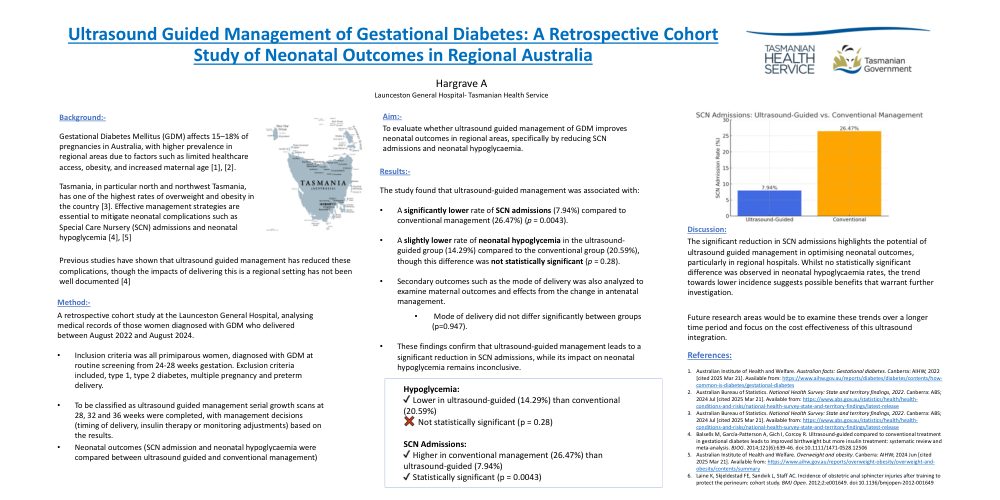
These findings confirm that ultrasound-guided management leads to a significant reduction in SCN admissions, while its impact on neonatal hypoglycemia remains inconclusive.
Discussion:
The significant reduction in SCN admissions highlights the potential of ultrasound guided management in optimising neonatal outcomes, particularly in regional hospitals. Whilst no statistically significant difference was observed in neonatal hypoglycaemia rates, the trend towards lower incidence suggests possible benefits that warrant further investigation.
Future research areas would be to examine these trends over a longer time period and focus on the cost effectiveness of this ultrasound integration.