2,281 posters, 63 videos, 56 audios, 43 topics, 18 sessions, 6,174 authors, 2,323 institutions
ePostersLive by SciGen Technologies S.A. All rights reserved.
RCOG World Congress 2025
June 23 - 25, 2025 | ExCeL London, UK
EP.0949
Second and third-trimester obstetric outcomes amongst patients with congenital uterine anomalies.
Poster Presenter
Authors
Affiliations
Part of Topic
High risk pregnancy
Second and third-trimester obstetric outcomes amongst patients with congenital uterine anomalies.
Dr Aleksandra Trojak, Miss Nirmala Vaithilingam
Department of Obstetrics and Gynaecology, Queen Alexandra Hospital, Portsmouth, United Kingdom
Objectives:
Congenital uterine anomalies (CUAs) are rare developmental malformations, which are differentiated based on aetiology, affected structures and clinical presentation. Although the exact prevalence remains undefined, the estimate for the general population varies between 3 and 7% and increases up to 24.5 % in patients affected by pregnancy loss and infertility.
CUAs have historically been associated with an increased risk of complications and adverse pregnancy outcomes, including pregnancy loss, pre-term birth, preterm pre-labour rupture of membranes, malpresentations and fetal growth restriction.
Due to scarce evidence, this study aims to evaluate the obstetric outcomes in patients with CUAs in the second and third trimesters of pregnancy.
Design:
13-month, retrospective, single-cohort study of patients with known congenital uterine anomalies.
Subsequent analysis of data obtained from local electronic health record systems (BadgerNet, Epro, Minestrone, ICE, CHIE).
Method:
Centre and data source: Pre-term birth clinic at Queen Alexandra Hospital, Portsmouth, United Kingdom
Data collection: June 2023 until July 2024
Population and clinical information:
Diagnosis, patient’s age, BMI, smoking status, gynaecological and obstetric history, surgical and medical interventions, clinical management, pregnancy and delivery outcomes
Data analysis tools: Microsoft Excel, Microsoft Word
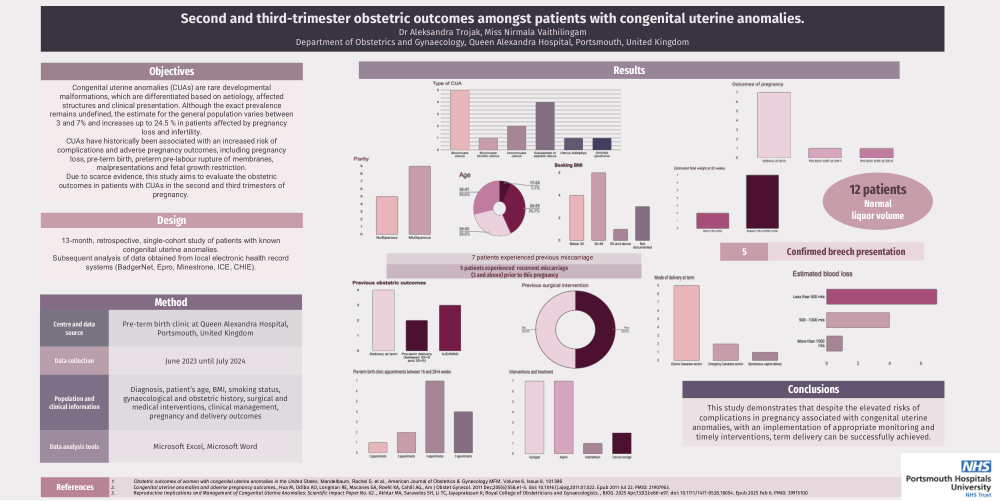
Results: as demonstrated on the graphs
Conclusions:
This study demonstrates that despite the elevated risks of complications in pregnancy associated with congenital uterine anomalies, with an implementation of appropriate monitoring and timely interventions, term delivery can be successfully achieved.
References: