2,281 posters, 63 videos, 56 audios, 43 topics, 18 sessions, 6,174 authors, 2,323 institutions
ePostersLive by SciGen Technologies S.A. All rights reserved.
RCOG World Congress 2025
June 23 - 25, 2025 | ExCeL London, UK
EP.0948
Emergency Cerclage Case Series - University Hospitals Dorset
Poster Presenter
Authors
Affiliations
Part of Topic
High risk pregnancy
EMERGENCY CERVICAL SUTURE CASE SERIES - UNIVERSITY HOSPITALS DORSET
Lynn Grant, Louise Melson, Latha Vinayakrao, Emma Andre
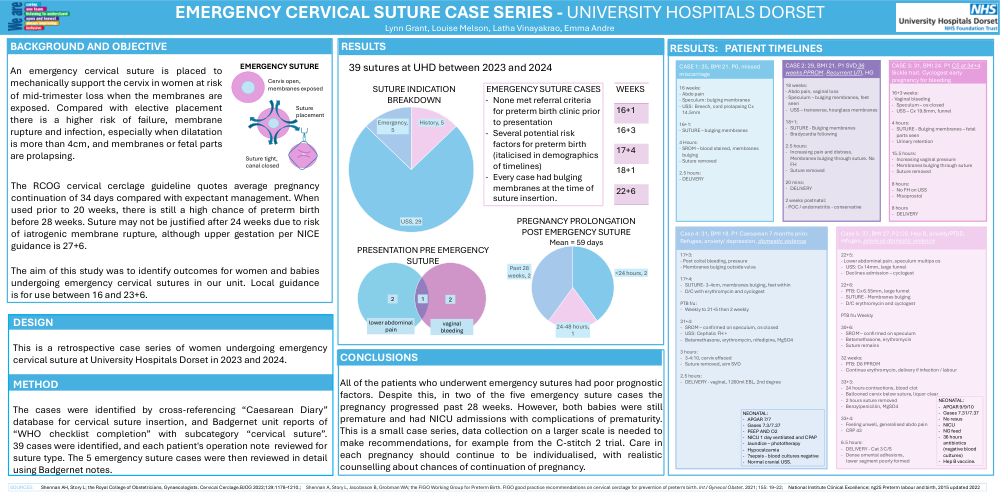
An emergency cervical suture is placed tomechanically support the cervix in women at riskof mid-trimester loss when the membranes areexposed. Compared with elective placementthere is a higher risk of failure, membranerupture and infection, especially when dilatationis more than 4cm, and membranes or fetal partsare prolapsing.
The RCOG cervical cerclage guideline quotes average pregnancycontinuation of 34 days compared with expectant management. Whenused prior to 20 weeks, there is still a high chance of preterm birthbefore 28 weeks. Suture may not be justified after 24 weeks due to riskof iatrogenic membrane rupture, although upper gestation per NICEguidance is 27+6.
The aim of this study was to identify outcomes for women and babiesundergoing emergency cervical sutures in our unit. Local guidanceis for use between 16 and 23+6.
This is a retrospective case series of women undergoing emergencycervical suture at University Hospitals Dorset in 2023 and 2024.
The cases were identified by cross-referencing “Caesarean Diary”database for cervical suture insertion, and Badgernet unit reports of“WHO checklist completion” with subcategory “cervical suture”.39 cases were identified, and each patient's operation note reviewed forsuture type. The 5 emergency suture cases were then reviewed in detailusing Badgernet notes.
All of the patients who underwent emergency sutures had poor prognosticfactors. Despite this, in two of the five emergency suture cases thepregnancy progressed past 28 weeks. However, both babies were stillpremature and had NICU admissions with complications of prematurity.This is a small case series, data collection on a larger scale is needed tomake recommendations, for example from the C-stitch 2 trial. Care ineach pregnancy should continue to be individualised, with realisticcounselling about chances of continuation of pregnancy.