2,281 posters, 63 videos, 56 audios, 43 topics, 18 sessions, 6,174 authors, 2,323 institutions
ePostersLive by SciGen Technologies S.A. All rights reserved.
RCOG World Congress 2025
June 23 - 25, 2025 | ExCeL London, UK
EP.0946
Risk of Preterm Birth in Patients with Sludge and Normal Cervical Length
Part of Topic
High risk pregnancy
Risk of Preterm Birth in Patients with Sludge and Normal Cervical Length
Design: Single-center retrospective cohort study at a tertiary academic hospital in Mexico City.
Method: Retrospective cohort study of singleton pregnancies screened for preterm birth in the second trimester (i.e., transvaginal cervical length assessment) between January 1, 2017, through April 30, 2024. Exclusion criteria included fetuses with major structural anomalies, twin pregnancies, cervical insufficiency history, cervical dilation, cerclage placement before screening, polyhydramnios, large for gestational age fetuses, and preterm births due to medical indications. The study population was stratified into three groups: (i) without sludge and normal cervical length (WSNC), (ii) sludge and normal cervical length (SNCL), and (iii) sludge with a short cervix (SSC, <25mm). Obstetric and perinatal outcomes were compared using crude and adjusted risk ratios (aRR). Confounders (maternal age, body mass index, and prior history of preterm birth) were included in the multivariable models.
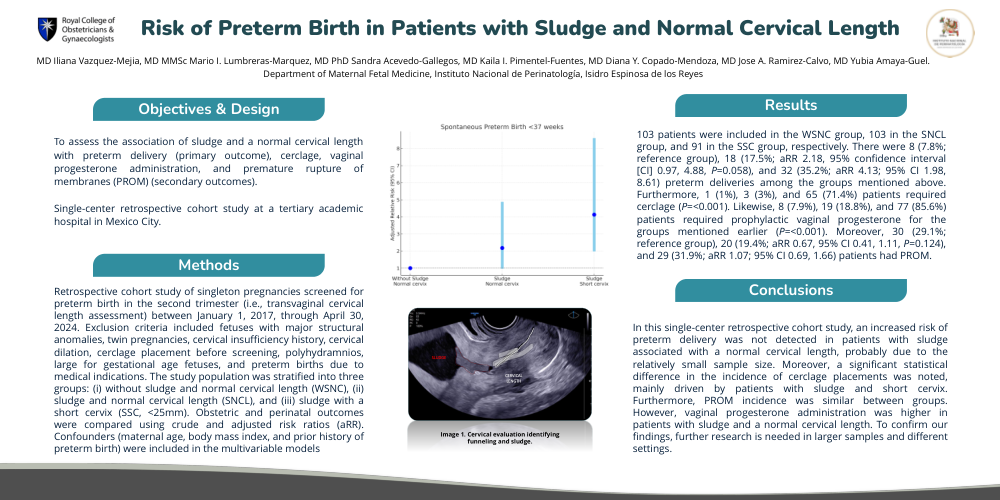
Results: 103 patients were included in the WSNC group, 103 in the SNCL group, and 91 in the SSC group, respectively. There were 8 (7.8%; reference group), 18 (17.5%; aRR 2.18, 95% confidence interval [CI] 0.97, 4.88, P=0.058), and 32 (35.2%; aRR 4.13; 95% CI 1.98, 8.61) preterm deliveries among the groups mentioned above. Furthermore, 1 (1%), 3 (3%), and 65 (71.4%) patients required cerclage (P=<0.001). Likewise, 8 (7.9%), 19 (18.8%), and 77 (85.6%) patients required prophylactic vaginal progesterone for the groups mentioned earlier (P=<0.001). Moreover, 30 (29.1%; reference group), 20 (19.4%; aRR 0.67, 95% CI 0.41, 1.11, P=0.124), and 29 (31.9%; aRR 1.07; 95% CI 0.69, 1.66) patients had PROM.
Conclusions: In this single-center retrospective cohort study, an increased risk of preterm delivery was not detected in patients with sludge associated with a normal cervical length, probably due to the relatively small sample size. Moreover, a significant statistical difference in the incidence of cerclage placements was noted, mainly driven by patients with sludge and short cervix. Furthermore, PROM incidence was similar between groups. However, vaginal progesterone administration was higher in patients with sludge and a normal cervical length. To confirm our findings, further research is needed in larger samples and different settings.